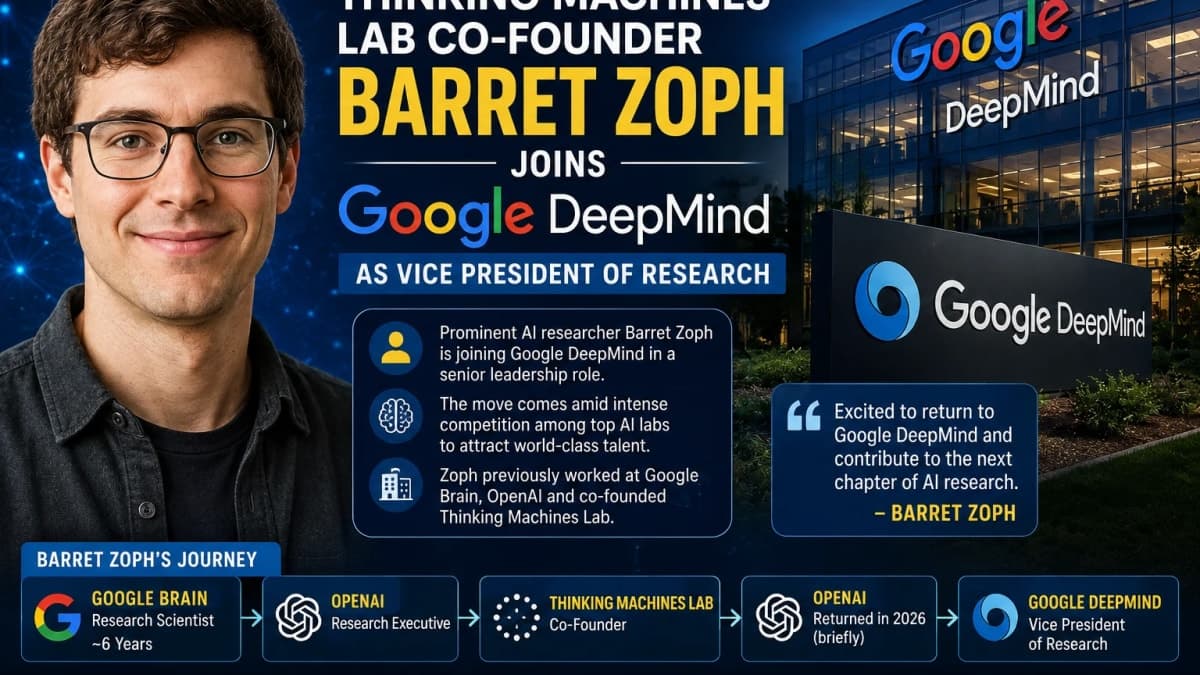
Thinking Machines Lab Co-Founder Barret Zoph Heads to Google DeepMind
August 27, 2026: Prominent artificial intelligence researcher Barret Zoph is joining Google DeepMind as Vice President of Research, marking another significant personnel move in the increasingly competitive race among leading AI laboratories.
Zoph, a co-founder of Thinking Machines Lab and a former OpenAI research executive, announced the move on Wednesday. His arrival at the Alphabet-owned AI unit represents a return to familiar territory: before his work at OpenAI and Thinking Machines Lab, Zoph spent roughly six years as a research scientist at Google.
The appointment comes at a notable moment for Google DeepMind as Alphabet reorganises parts of its artificial-intelligence operations.
Who Is Barret Zoph?
Zoph has built a career across several of the organisations at the centre of modern AI research.
He previously worked as a research scientist at Google Brain, spending six years at Google. Google Brain was later combined with DeepMind in 2023 to create the organisation now known as Google DeepMind.
After Google, Zoph joined OpenAI, where he held a senior research position. He subsequently became one of the co-founders of Thinking Machines Lab, the AI startup established by former OpenAI chief technology officer Mira Murati and other researchers.
Earlier in 2026, Zoph left Thinking Machines Lab and briefly returned to OpenAI. His latest move now takes him back to Google, this time within its consolidated DeepMind organisation.
Zoph Takes Vice President of Research Role
At Google DeepMind, Zoph is set to become Vice President of Research, putting him in a senior position inside one of the world's most influential artificial-intelligence laboratories.
His previous experience at Google Brain gives the appointment additional significance. Rather than bringing in an executive unfamiliar with Google's research culture, DeepMind is gaining someone who has already spent years working inside Google's AI ecosystem.
Zoph's more recent experience at OpenAI and Thinking Machines Lab could also give him a broad perspective on how different frontier AI organisations approach research, model development and organisational strategy.
Thinking Machines Lab's Changing Founding Team
Zoph's career move also highlights the rapid movement of researchers between competing AI companies.
Thinking Machines Lab was launched by former OpenAI CTO Mira Murati and attracted researchers from several prominent AI organisations. The startup secured substantial financial backing as investors sought exposure to new competitors in frontier AI development.
But its founding group has undergone significant changes.
Zoph and fellow co-founder Luke Metz left Thinking Machines Lab earlier in 2026 to return to OpenAI, while another co-founder, Andrew Tulloch, had previously departed for Meta. Thinking Machines named Soumith Chintala as CTO following Zoph's departure.
Zoph's subsequent move from OpenAI to Google DeepMind demonstrates just how fluid the market for experienced AI researchers has become.
Why Barret Zoph's Move Matters
The appointment matters for more than one individual's career.
Competition among major technology companies increasingly depends on access to researchers capable of developing, training and improving advanced AI systems. While computing infrastructure, proprietary data and capital remain crucial, experienced researchers have become another strategic resource.
Zoph has worked within three prominent AI environments: Google, OpenAI and Thinking Machines Lab.
That makes his return to Google particularly noteworthy as companies compete to strengthen teams responsible for frontier-model research.
Google DeepMind Is Going Through Wider Changes
Zoph's arrival also coincides with organisational changes inside Google's AI operations.
Reuters reported that Alphabet has been reshuffling parts of its AI structure. During an August 6 all-hands meeting, employees were told that some teams would move from DeepMind into the broader Google organisation, according to sources cited in the report.
The restructuring suggests Alphabet is continuing to examine how fundamental AI research should interact with Google's enormous consumer and enterprise product portfolio.
Bringing experienced researchers into senior leadership roles could become particularly important as those organisational boundaries evolve.
The AI Industry's Battle for Researchers
The biggest AI companies are no longer competing only through model releases.
They are increasingly competing for the people capable of building those models.
A relatively small group of researchers has accumulated extensive experience training large-scale AI systems, improving model performance and turning experimental techniques into deployable technologies.
As a result, moves involving senior researchers can have implications extending beyond traditional executive appointments.
Companies may gain specialised knowledge, leadership experience and an understanding of how rival AI laboratories organise their research efforts.
Zoph's movement between Google, OpenAI and Thinking Machines Lab is a striking example of this increasingly interconnected talent market.
What Google DeepMind Could Gain
Zoph's appointment could strengthen DeepMind in several ways.
His earlier Google Brain experience means he already understands parts of Google's research heritage, while his later work provides experience from organisations built around newer generations of large-scale generative AI.
As Vice President of Research, his influence could potentially extend across research priorities, technical leadership and the development of teams working on advanced AI.
However, Google has not publicly detailed which specific research programmes Zoph will oversee. It would therefore be premature to link his appointment to any particular future model or product.
Balanced Analysis: Important Hire, but Bigger Questions Remain
Zoph's appointment is clearly significant, but individual hires should not be treated as automatic indicators of future technological leadership.
AI research increasingly requires enormous computing resources, reliable infrastructure, high-quality data, strong engineering teams and effective coordination between research and product organisations.
One senior researcher can influence strategy and technical direction, but breakthroughs are generally produced by large multidisciplinary teams.
For Google, the larger question will be whether organisational changes inside DeepMind improve the company's ability to translate advanced research into products while preserving the research culture that has produced major scientific achievements.
For rivals such as OpenAI and newer laboratories including Thinking Machines, the movement of experienced researchers also illustrates the difficulty of retaining highly sought-after technical talent.
What Comes Next?
Attention will now turn to the role Zoph plays within Google DeepMind and whether his appointment signals additional changes to the organisation's research leadership.
The move also reinforces a broader trend likely to shape the next stage of the AI industry: competition for researchers is becoming nearly as important as competition between models.
Google, OpenAI, Meta, Anthropic and emerging AI laboratories are all attempting to assemble teams capable of pushing model capabilities forward.
Zoph's return to Google shows that the industry's talent map remains far from settled.
This article is based on reporting published by Reuters.