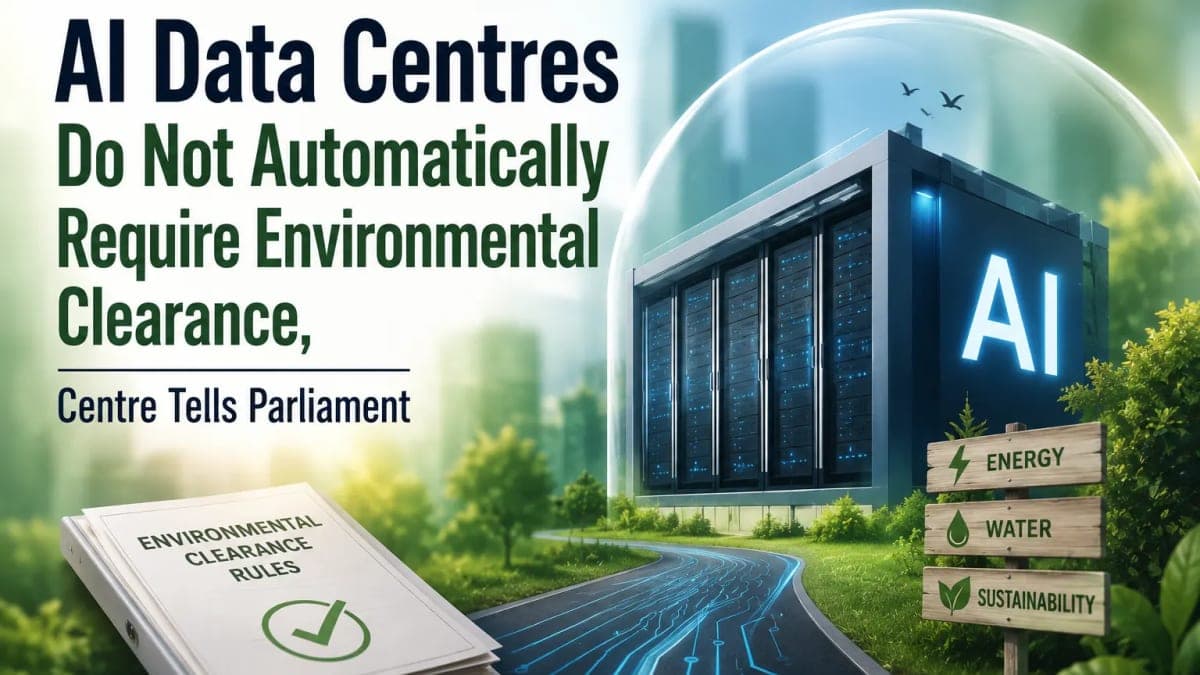
Centre Clarifies Environmental Clearance Rules for AI Data Centres
NEW DELHI: Artificial intelligence data centres do not automatically require environmental clearance simply because they operate as AI or data-processing facilities, the Centre has told Parliament, clarifying how India's existing environmental assessment rules apply to the rapidly expanding digital infrastructure sector.
In a written response in the Rajya Sabha, Minister of State for Environment, Forest and Climate Change Kirti Vardhan Singh said that data centres and AI facilities are not specifically covered as standalone project categories under the Environment Impact Assessment (EIA) Notification, 2006.
The clarification, however, does not mean that every data-centre development is exempt from environmental clearance.
According to the government, building and construction projects accommodating data centres or AI facilities with a built-up area exceeding 20,000 square metres fall under Item 8(a) of the schedule to the EIA Notification and therefore require prior environmental clearance.
The response came to Rajya Sabha Unstarred Question No. 4396, raised by MP Sangeeta Yadav and answered on April 2, 2026.
What the Centre Told Parliament
The government acknowledged that the expansion of AI infrastructure carries environmental implications, including electricity consumption, water use and electronic waste.
It said environmental assessments are undertaken for infrastructure projects that fall within the applicable clearance framework.
Where environmental clearance is required, projects are appraised before approval and can be subjected to both general and project-specific environmental conditions.
According to the Centre, these conditions can cover measures including energy efficiency, energy conservation, efficient water use and reuse of treated wastewater during construction and operation.
Electronic waste generated by such facilities is also subject to safeguards under the E-Waste (Management) Rules, 2022.
The Key Distinction: Data Centre vs Construction Project
The Centre's response draws an important regulatory distinction.
A data centre or AI facility is not currently listed as a separate category that automatically triggers prior environmental clearance under the EIA Notification solely because of its function.
Instead, the applicability of environmental clearance can depend on characteristics of the broader project, including its built-up construction area.
Under the government's parliamentary clarification, a building or construction project housing a data centre or AI facility and exceeding 20,000 square metres in built-up area comes within Item 8(a) and requires prior environmental clearance.
This distinction is particularly significant because the environmental footprint of an AI facility is not determined only by the physical size of the servers it houses. Such infrastructure can also require substantial electricity for computing and cooling, alongside water and supporting electrical systems.
The Centre itself acknowledged energy consumption, water use and electronic waste among the environmental issues associated with AI infrastructure.
How Environmental Clearance Works for Covered Projects
For projects that come within the EIA framework, environmental clearance is granted following appraisal and recommendations by the relevant expert appraisal mechanism.
The Centre said environmental safeguards are considered during this process, with clearance conditions continuing into both construction and operational stages.
This means the current framework does provide environmental scrutiny for qualifying large construction projects containing data centres, even though data centres have not been separately designated as an EIA project category.
Why the Clarification Matters
The parliamentary response comes as India seeks to expand its artificial intelligence and digital infrastructure capabilities.
AI systems depend heavily on computing infrastructure, making data centres increasingly important for cloud services, AI model development, digital platforms and other technology-intensive industries.
At the same time, the growth of these facilities has created a broader policy question: whether environmental regulation designed largely around traditional construction and industrial categories adequately captures the operational footprint of modern computing infrastructure.
The Centre's position establishes that existing rules can apply to qualifying construction projects, while confirming that there is currently no automatic EIA requirement attached specifically to the designation of a facility as an AI data centre.
Government Had Earlier Addressed Sustainability Under IndiaAI Mission
Environmental sustainability surrounding AI infrastructure has also surfaced separately in Parliament.
In February 2026, the Ministry of Electronics and Information Technology was asked about energy and environmental sustainability compliance under the IndiaAI Mission, including power and water consumption, renewable-energy procurement and coordination with other ministries.
The questions reflect growing policy attention toward the physical resources required to support India's AI ambitions alongside the country's technology and digital-economy objectives.
Balancing AI Expansion and Environmental Safeguards
The government's clarification does not amount to a blanket exemption from environmental regulation for every data centre.
Rather, it establishes that data centres and AI facilities are not independently covered merely because of their technological function, while qualifying building and construction projects remain subject to environmental clearance requirements.
Supporters of the existing approach may argue that applying established construction thresholds avoids creating an additional regulatory category while still allowing large projects to undergo environmental appraisal.
Environmental-policy advocates, however, may question whether physical construction area alone is the best way to determine when scrutiny is necessary for infrastructure whose operational impact can depend heavily on electricity demand, cooling technology and water requirements.
For policymakers, the central challenge will be maintaining conditions that support India's rapidly expanding AI ecosystem while ensuring that the resource demands accompanying large-scale computing infrastructure are adequately assessed and managed.
As investment in AI capacity grows, the question is likely to move beyond whether data centres fit within existing environmental categories to whether those categories need to evolve alongside the technology itself.
This article is based on reporting published by CNBC TV18.