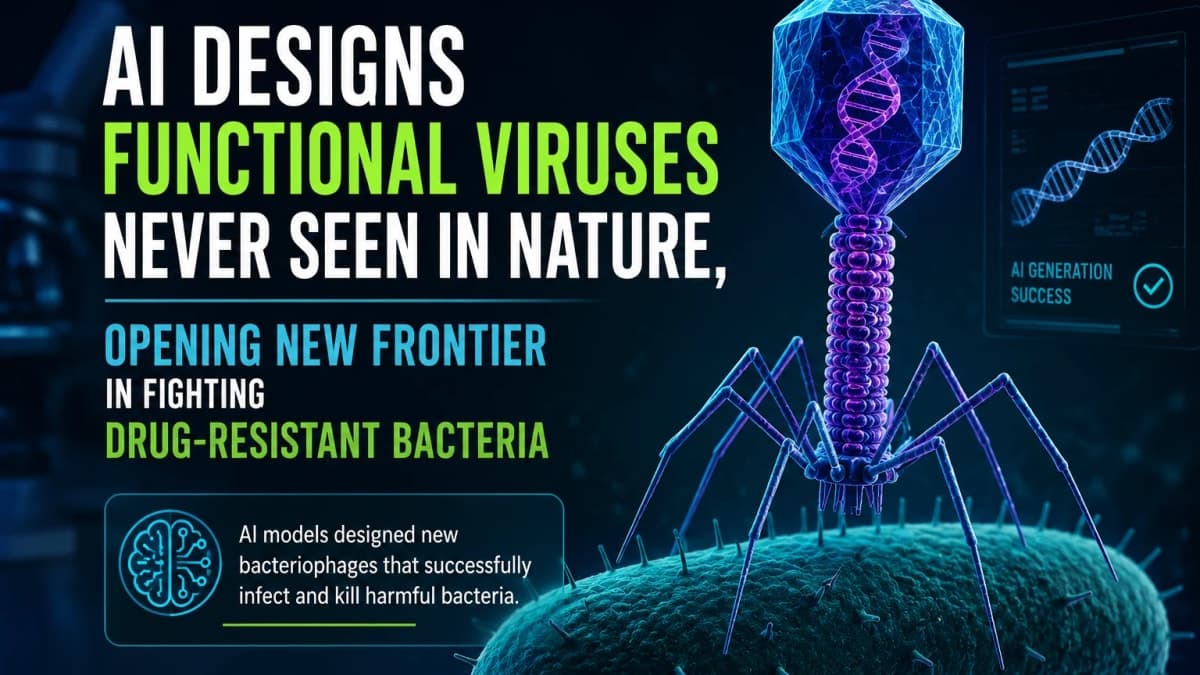
AI Moves From Designing Biological Parts to Whole Viral Genomes
Artificial intelligence has crossed a notable threshold in biological design.
Researchers from Stanford University and the Arc Institute used genome-scale AI models to generate new bacteriophage genomes. Bacteriophages, commonly shortened to phages, are viruses that infect bacteria rather than people.
The work demonstrates that generative AI can move beyond suggesting individual biological components and generate genome-scale designs capable of functioning after they are synthesized and tested experimentally.
The researchers used the well-studied lytic bacteriophage ΦX174 as a design template while working with the Evo 1 and Evo 2 genome language models.
Researchers Produced 16 Viable AI-Designed Phages
Experimental testing produced 16 viable bacteriophages from the AI-generated designs.
The successful phages were able to propagate and inhibit the growth of their intended bacterial hosts. Importantly, researchers reported that they did not affect unrelated bacterial strains, indicating that the generated phages retained useful host specificity.
That distinction matters because precision is particularly valuable when considering future phage therapies. A treatment capable of attacking a targeted pathogenic bacterium without broadly disrupting other microbes could offer advantages over less selective approaches.
Not every AI-generated design worked, however. The relatively small number of viable phages compared with the broader set of generated candidates demonstrates that computational generation is not the same thing as biological success.
Experimental validation therefore remains essential.
Some AI-Generated Phages Showed Strong Performance
The study went beyond demonstrating that synthetic phages could merely survive.
Researchers reported that multiple generated phages showed higher fitness than the natural ΦX174 reference in competitive growth experiments and measurements of bacterial destruction.
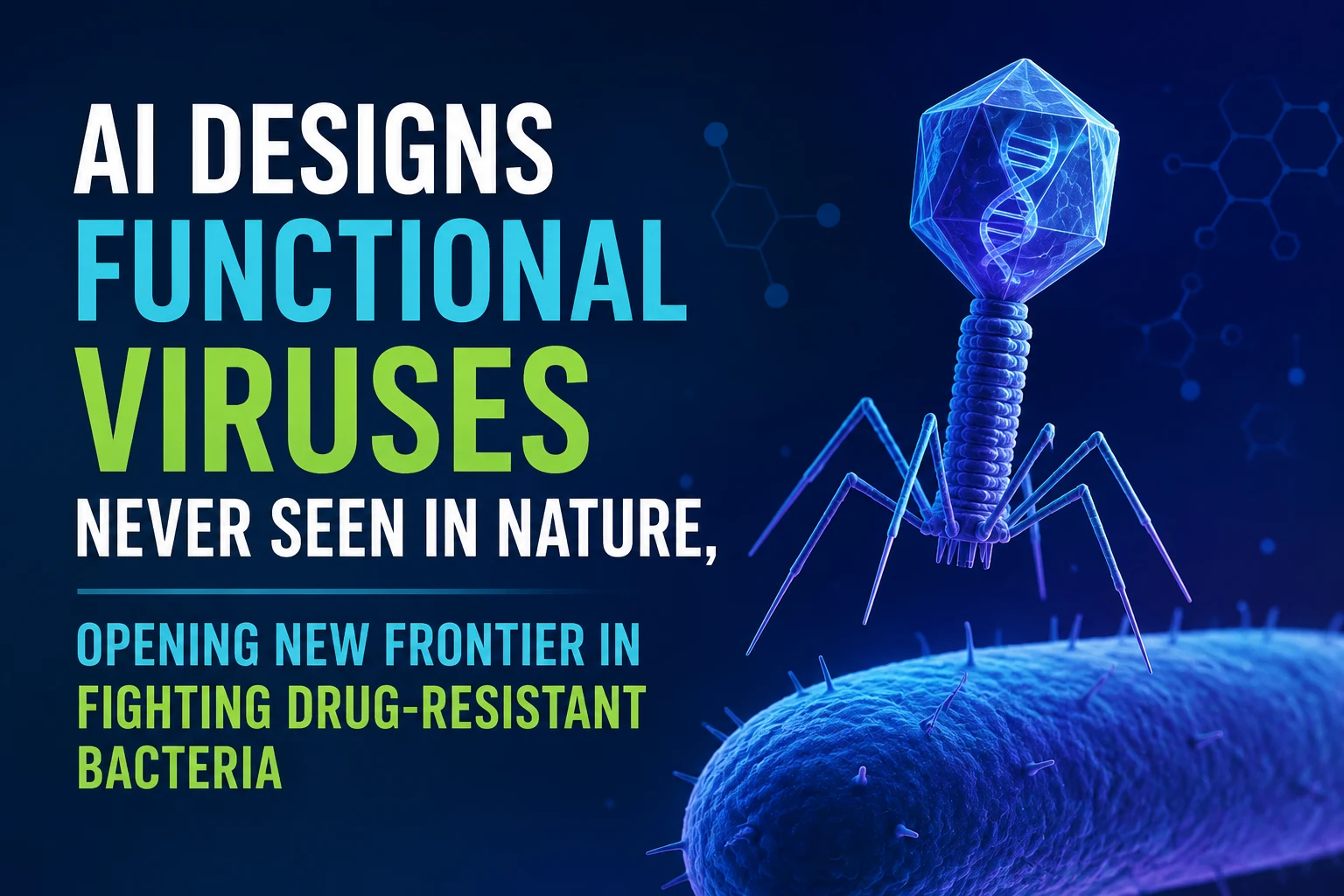
Structural analysis also revealed unusual biological features in at least one generated phage, including the use of an evolutionarily distant DNA-packaging protein within its viral structure.
These results suggest genome language models may be capable of exploring biological combinations that differ substantially from familiar natural examples while still producing functional systems.
AI-Designed Phages Overcame Resistant E. coli
One of the most medically significant findings involved bacterial resistance.
Researchers developed three E. coli strains that had become resistant to ΦX174. The natural reference phage could no longer effectively overcome them.
The scientists then tested combinations of AI-generated phages.
These phage cocktails overcame resistance across all three bacterial strains during laboratory experiments. The successful viruses incorporated genetic diversity generated through the AI-driven design process, providing different possible routes for attacking resistant bacteria.
The finding is important because resistance is not limited to antibiotics. Bacteria can also evolve defenses against bacteriophages, meaning future phage therapies may require diverse or adaptable viral combinations.
Why the Breakthrough Matters for Antibiotic Resistance
Antimicrobial resistance is one of the major challenges facing modern medicine. Bacteria can evolve mechanisms that make existing antibiotics less effective, increasing interest in alternative treatments.
Phage therapy offers one potential strategy.
Rather than using conventional drugs to kill bacteria, phage therapy employs viruses that naturally infect bacterial cells. Researchers have studied the approach for decades, but identifying and optimizing appropriate phages for particular bacterial targets can be difficult.
Generative AI could eventually change that process.
Instead of relying entirely on viruses discovered in nature, scientists could potentially use genome models to explore large numbers of possible phage designs and identify candidates suited to particular bacterial targets.
The new research is an early proof of concept rather than a ready-to-use medical treatment, but it demonstrates that AI-generated viral genomes can produce functional biological entities.
How Genome Language Models Make Biological Designs
Models such as Evo apply concepts familiar from generative AI to biological sequence information.
A conventional language model learns patterns connecting words or pieces of text. Genome models instead learn statistical and biological relationships within DNA sequences.
The goal is not simply to reproduce sequences already found in databases. Once sufficiently trained, these systems can generate new sequences while preserving patterns necessary for biological function.
Producing a viable whole genome is substantially more demanding than generating an isolated protein or short DNA sequence because many genes and regulatory elements must operate together correctly.
That is one reason the successful creation of functional phages represents an important technical milestone.
Breakthrough Also Raises Biosafety Questions
The scientific promise comes with an unavoidable dual-use issue.
The experiment involved bacteriophages targeting bacteria, and the researchers deliberately took precautions around the biological material used in developing the system. The study should therefore not be interpreted as evidence that AI has created a new human-infecting virus.
Nevertheless, the broader capability demonstrated by the research raises questions about how genome-generating AI should be governed as models become more powerful.
If future systems become capable of reliably designing increasingly complex biological organisms, scientists and regulators will need safeguards covering model access, DNA synthesis, laboratory practices and experimental testing.
Experts have consequently argued that progress in generative biology should be accompanied by stronger biosecurity systems rather than treating computational models as isolated research tools.
Breakthrough or Biosafety Risk?
The most accurate answer may be that the technology represents both an important scientific advance and a reason for greater attention to biosafety.
From a medical perspective, AI-designed bacteriophages could eventually help researchers develop new ways to attack bacterial infections, particularly as antibiotic resistance becomes harder to manage.
From a safety perspective, demonstrating that an AI system can contribute to designing viable genomes shows why biological AI requires careful oversight.
The immediate experiment involved bacterial viruses under controlled research conditions—not a newly engineered human pathogen. That distinction is crucial when assessing the actual findings.
At the same time, the technological direction is significant.
AI is increasingly moving from analyzing biology toward actively designing it. The successful generation of functional bacteriophages suggests genome-scale generative biology is becoming experimentally viable.
For medicine, that could open an entirely new design space for therapeutics. For regulators and scientists, it creates an equally important challenge: ensuring that biological design capabilities develop alongside effective safeguards.