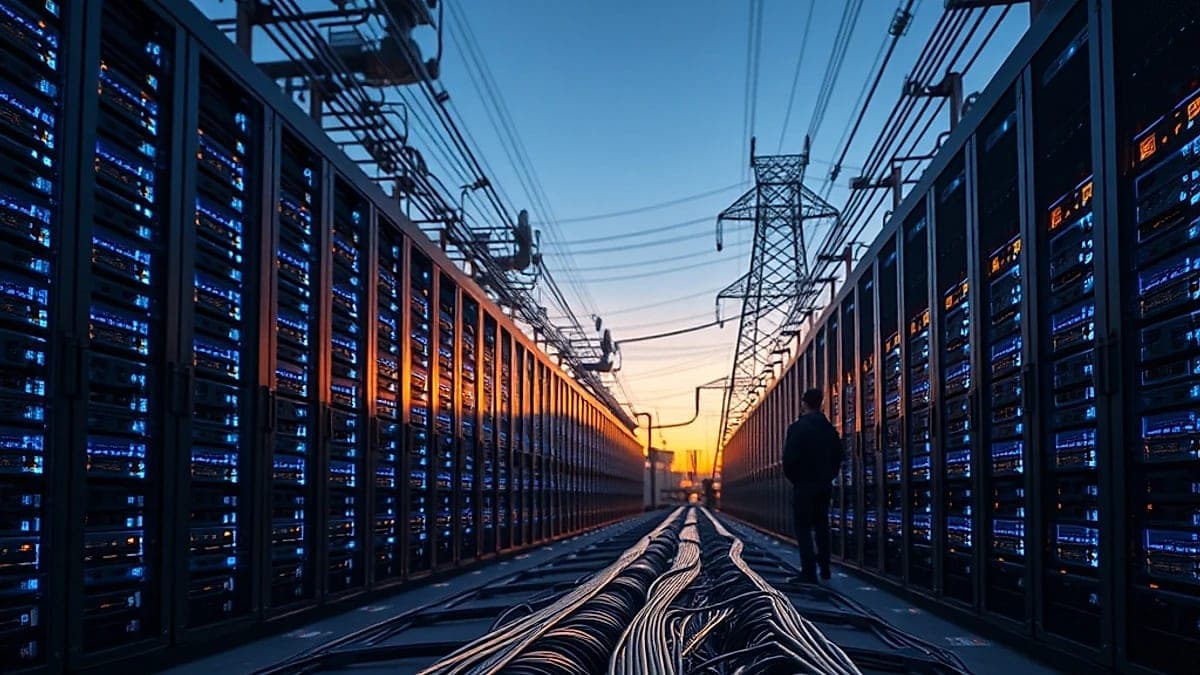
India’s data‑centre footprint is expanding faster than ever, with the country’s power draw expected to jump from about 1,500 MW at the start of 2025 to more than 2,000 MW by the end of 2026. The expansion is driven by a surge in artificial‑intelligence workloads that require massive compute, storage and connectivity. In response, five publicly listed companies are stepping in to supply the missing layers of the AI stack, from server assembly to cloud rental, fibre cabling, power delivery and building infrastructure.
The government has added a fiscal boost, offering a tax holiday for foreign cloud operators until 2047 and forecasting that the cloud sector alone could grow four‑to‑five‑fold by 2030. This policy environment has turned the AI infrastructure market into a high‑growth, capital‑intensive arena that rewards firms that can scale quickly while managing debt.
What Has Changed
Until recently, most Indian data‑centres relied on imported servers and outsourced power, leaving domestic firms with limited roles. The current wave has shifted the focus to a complete domestic supply chain. The five companies highlighted here each occupy a distinct niche: Netweb builds high‑performance AI servers; E2E Networks offers GPU‑as‑a‑service; Anant Raj Group constructs data‑centre campuses; Sterlite Technologies supplies the optical fibre backbone; and Hitachi Energy delivers the high‑voltage power infrastructure.
Financially, the sector has moved from modest margins to multi‑billion‑rupee revenues. Netweb’s revenue rose 172 % to ₹8.2 bn in the June 2026 quarter, while E2E’s profit flipped from a loss to ₹439 m thanks to a new 1,024‑chip GPU cluster. Sterlite’s profit hit a record ₹1.97 bn as its fibre order book doubled to ₹186 bn. Hitachi Energy’s backlog reached ₹322 bn, underscoring the growing appetite for power solutions.
Who Is Affected
Netweb – Server Assembly
Netweb, an official partner of Nvidia and AMD, assembles the AI servers that host the chips. The company’s sales from AI hardware now account for almost two‑thirds of its total revenue, up from a modest share a year earlier. With a ₹25 bn order book and contracts under the IndiaAI Mission, Netweb is positioned to capture the growing domestic demand for locally built AI clusters.
E2E Networks – Cloud Rental
E2E Networks is India's first listed pure‑play GPU‑as‑a‑service provider. Its revenue quadrupled to ₹1.57 bn in the latest quarter, and it now manages over 5,100 GPUs. The company’s recent 5‑for‑1 stock split aims to broaden ownership, but the high cost and rapid obsolescence of GPUs mean continued capital expenditure is unavoidable.
Anant Raj Group – Data‑Centre Construction
Former property developer Anant Raj has pivoted to building data‑centre campuses. The group currently operates 28 MW of capacity in Manesar and Panchkula, with plans to scale to 63 MW by December 2026 and 117 MW by 2028. A ₹250 bn investment pact with Haryana and a Singapore arm signal a long‑term expansion strategy, though the venture’s heavy cash burn remains a concern.
Sterlite Technologies – Fibre Connectivity
Sterlite supplies the optical fibre that interconnects AI racks. The company’s revenue jumped 87 % to ₹19.1 bn, and its ₹186 bn order book is dominated by a ₹100 bn contract to supply connectivity for next‑generation AI centres until 2029. While fibre pricing is cyclical, Sterlite’s strong balance sheet and cash reserves give it a competitive edge.
Hitachi Energy – Power Delivery
Hitachi Energy provides the high‑voltage transformers and switchgear that feed data‑centres. Its order backlog of ₹322 bn includes a large‑scale power project for a Hyderabad data‑centre. The firm is building a twentieth factory in India to meet the surge in demand, but its valuation remains steep at nearly 150 × earnings.
What It Costs, What It Saves
High valuations are a hallmark of the sector. Netweb trades above 100 × earnings, E2E at similar multiples, and Hitachi Energy near 150 ×. These price tags reflect the need for constant reinvestment in cutting‑edge GPUs, fibre, and power equipment.
Capital intensity: Building data‑centres, installing fibre, and deploying transformers can cost hundreds of millions of rupees per megawatt.
Debt risk: Rapid expansion often relies on borrowing; a slowdown could erode margins.
Operational costs: AI workloads consume enormous electricity, driving long‑term power contracts and cooling expenses.
Technology churn: GPUs and fibre modules have short lifecycles, necessitating continual upgrades.
The Bigger Context
India’s AI infrastructure boom mirrors global trends, as U.S. cloud giants invest billions in new data‑centres worldwide. The domestic market offers a lower cost of capital and a growing talent pool, making it an attractive destination for foreign investment. The government’s 2047 tax holiday is designed to keep the sector competitive against overseas rivals.
However, the sector faces headwinds. The cyclical nature of fibre and power markets can squeeze margins, and the high upfront costs of building data‑centres mean that many firms operate at negative cash flow for years. Moreover, the rapid pace of AI innovation could render existing infrastructure obsolete if upgrades are not timely.
In this environment, the “shovel sellers” – Nvidia and AMD – continue to dominate the supply chain, while the five listed companies provide the essential services that allow those chips to be deployed at scale.
What To Do About It
Investors should focus on companies with strong order books and healthy balance sheets. Monitoring debt levels and the ability to fund ongoing upgrades is critical, as is tracking the pace of new contracts. Diversifying across the supply chain – from server builders to power providers – can reduce concentration risk.
For policymakers, maintaining incentives such as tax holidays and facilitating cross‑sector collaboration can help keep India competitive. Continued investment in fibre and power infrastructure will be essential to support the projected growth in data‑centre capacity.
This article is based on reporting published by livemint.