AI Is Rewiring India’s E-Commerce Market as Shopping Becomes More Conversational
Artificial intelligence is rapidly changing India's e-commerce market, moving beyond the algorithms that quietly recommend products to become a more visible part of how consumers search, compare and decide what to buy.
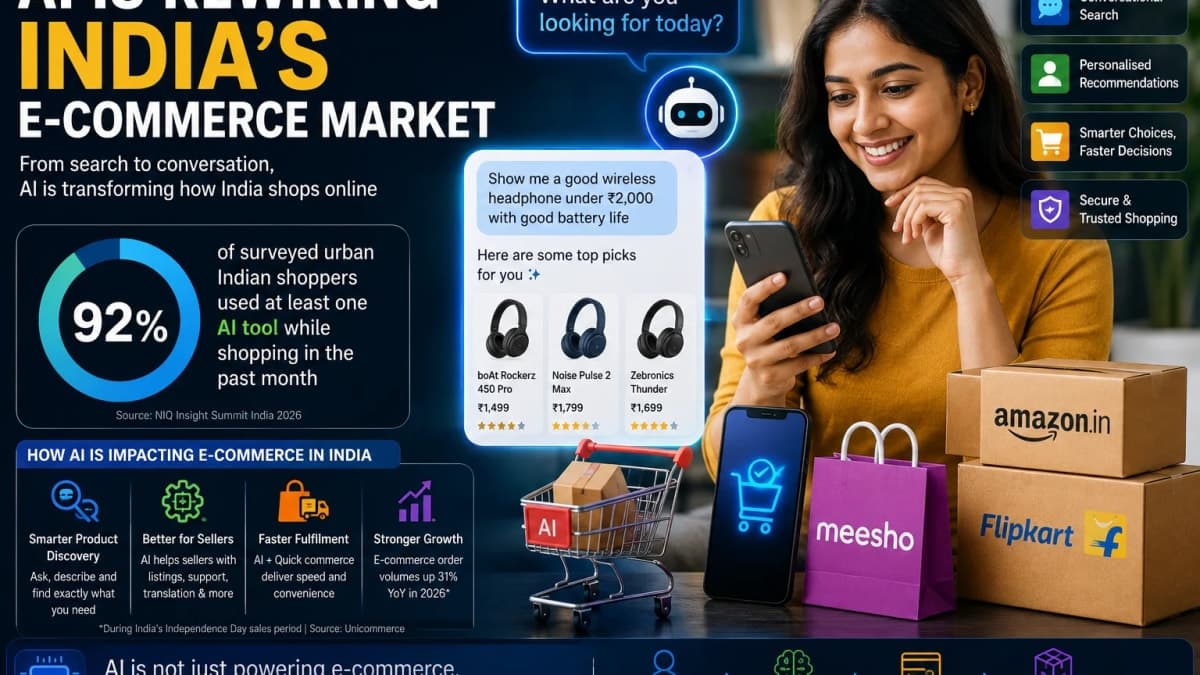
New findings presented at the NIQ Insight Summit India 2026 show just how quickly this transition is occurring. According to the findings, 92% of surveyed urban Indian shoppers used at least one AI tool during their shopping activities in the previous month.
The number indicates that AI-assisted shopping is no longer limited to a small group of technology enthusiasts. For many digitally connected Indian consumers, artificial intelligence is becoming another tool in the purchasing process.
Instead of simply typing a product name into a search box and scrolling through hundreds of listings, shoppers can increasingly describe what they want in ordinary language and receive recommendations tailored to their requirements.
That seemingly simple change could eventually reshape one of the world's most competitive digital-commerce markets.
AI Is Moving From Recommendations to Conversations
Artificial intelligence has been operating behind e-commerce platforms for years.
Machine-learning systems already help determine search rankings, recommendations, advertising, fraud detection, logistics and demand forecasting.
Generative AI is introducing something different: a conversational layer between the shopper and the marketplace.
A consumer might ask for a laptop suitable for college under a specific budget, clothes for a particular occasion, or a kitchen appliance that fits a small apartment.
AI systems can interpret those requirements and narrow down available choices.
This approach potentially changes product discovery from “search and filter” to “ask and discover.”
That distinction matters in India, where enormous product catalogues, multiple languages, different levels of digital literacy and wide variations in household budgets can make conventional online shopping complicated.
Amazon, Flipkart and Meesho Are Bringing AI Deeper Into Commerce
The shift is already visible across major Indian e-commerce platforms.
Amazon India has been promoting AI-powered shopping tools including Rufus, Lens AI, Review Highlights and Price History. Rufus allows customers to use conversational prompts to find suitable products, while visual-search technology can help shoppers locate products using images.
AI is also being deployed beyond the consumer-facing interface.
Indian e-commerce companies are applying machine learning and generative AI to areas including seller operations, customer support, product listings, fraud prevention, logistics and recommendations.
At Meesho, for example, generative AI is being integrated across product discovery, seller operations, engineering, customer support and trust systems.
The broader trend suggests that AI is becoming infrastructure rather than simply another feature added to an e-commerce application.
India's Unique Shopping Market Makes AI Particularly Important
India presents an unusually complex environment for digital commerce.
Consumers shop across multiple languages, income groups, regions and product categories. Many shoppers are highly experienced with digital services, while others continue to find conventional online interfaces difficult to navigate.
Conversational AI could potentially reduce some of that friction.
Instead of understanding categories, filters and complicated navigation menus, a shopper could simply describe a requirement:
“Show me a comfortable office chair under ₹5,000 with good reviews.”
The AI system could interpret the price limit, product category, intended use and quality preference simultaneously.
Voice-based AI could make this transition even more significant.
If conversational shopping systems become reliable across Indian languages, consumers who are less comfortable typing complex searches may find online shopping considerably easier.
AI Could Change the E-Commerce Conversion Funnel
For online retailers, better product discovery is not simply about convenience.
It can directly affect sales.
Traditional e-commerce involves several points where customers abandon purchases. A shopper may fail to find the right product, become overwhelmed by choices, struggle to compare specifications or leave before checkout.
AI systems can potentially intervene throughout that journey.
They can interpret customer intent, compare products, summarise reviews, answer questions and recommend alternatives.
As these systems improve, e-commerce companies could move closer to a digital equivalent of an experienced salesperson who understands what a customer wants before suggesting a product.
That could improve conversion rates while reducing the amount of time consumers spend searching.
Sellers Could Become Major Beneficiaries
The AI transformation is not limited to shoppers.
Small sellers and brands could also benefit significantly.
Generative AI can help merchants create product descriptions, translate listings, generate marketing material, analyse customer feedback and automate routine support requests.
This could be particularly valuable in India's fragmented seller ecosystem, where smaller businesses often lack the technology and marketing resources available to large brands.
AI tools could reduce some of those barriers.
A small merchant could theoretically use AI to create professional listings, translate them into several languages and respond to customer questions without maintaining a large digital-commerce team.
However, easier content creation could also produce an explosion of similar or low-quality listings, making marketplace quality controls increasingly important.
The Next Stage: AI Agents That Can Shop for Consumers
The biggest transformation may still be ahead.
The global technology industry is increasingly discussing agentic commerce — AI systems capable of completing multiple stages of a shopping task on behalf of a consumer.
Today's AI might recommend running shoes.
A future shopping agent could potentially understand a person's requirements, compare products across merchants, evaluate reviews, monitor prices and eventually complete the transaction after receiving appropriate permission.
In that environment, consumers may spend less time browsing individual product pages.
Instead, AI agents could become intermediaries between customers and retailers.
For e-commerce businesses, that would fundamentally change competition.
Companies would need to optimise product information not only for human shoppers and traditional search engines but also for AI systems deciding which products deserve to be recommended.
India's E-Commerce Growth Provides a Powerful Testing Ground
The transformation is occurring while India's online retail market continues expanding.
During the country's 2026 Independence Day sales period, e-commerce order volumes increased 31% year over year, while gross merchandise value rose about 30%, according to data from e-commerce enablement platform Unicommerce.
That growth gives platforms a massive volume of interactions through which AI-powered discovery and personalisation can be tested and improved.
At the same time, quick commerce is changing consumer expectations around delivery speed.
The combination of AI-powered discovery and increasingly rapid fulfilment could make shopping significantly more immediate: consumers describe what they need, software identifies the product and logistics networks deliver it shortly afterwards.
The Risk: Recommendations Can Become Too Powerful
The advantages of AI-driven commerce come with significant concerns.
Personalisation requires data.
The more an AI system understands about a consumer's purchases, browsing behaviour, preferences and budget, the better its recommendations can potentially become.
But that also creates questions around privacy and data governance.
There is another challenge: who controls the recommendation?
When an AI assistant recommends three products out of thousands, consumers need confidence that those suggestions genuinely match their requirements rather than simply reflecting advertising payments or commercial relationships.
Transparency will therefore become increasingly important.
Consumers may eventually need clearer distinctions between organic AI recommendations, personalised advertisements and sponsored products.
AI Can Also Make Mistakes
Generative AI systems can produce incorrect information.
In e-commerce, inaccurate information about a product's dimensions, compatibility, ingredients, warranty or price could directly affect purchasing decisions.
The consequences become more serious as AI systems move from recommending products toward acting on behalf of shoppers.
Retailers will therefore need accurate and frequently updated product data.
Human oversight, clear return policies and mechanisms for correcting AI-generated mistakes will remain important even as shopping becomes increasingly automated.
Balanced Analysis: AI Could Democratise Shopping — or Concentrate Influence
AI has the potential to make Indian e-commerce considerably easier to navigate.
Conversational interfaces could help people who struggle with conventional search systems, while translation and voice technologies could expand digital commerce beyond English-speaking consumers.
Smaller sellers could gain sophisticated tools that were previously available mainly to large companies.
However, the same technology could concentrate enormous influence in the AI systems controlling product discovery.
If shoppers increasingly ask an assistant what to buy instead of manually comparing dozens of products, being recommended by that assistant could become extremely valuable.
The competitive battle may therefore shift.
Today's sellers compete for the top position in search results.
Tomorrow's sellers may compete to become the product that an AI assistant recommends first.
That could create an entirely new digital marketplace — and new questions about fairness, transparency and competition.
What Comes Next for India's AI Shopping Revolution?
India appears well positioned to become an important testing ground for AI-driven commerce because of its enormous consumer base, rapidly evolving digital payments infrastructure, strong e-commerce platforms and widespread smartphone adoption.
The next stage will likely involve deeper conversational shopping, better visual search, regional-language AI, automated customer support and increasingly capable shopping agents.
But adoption alone will not determine the winners.
Trust will.
Consumers will need confidence that AI recommendations are accurate, transparent and genuinely useful.
Retailers will need to prove that automation improves shopping rather than simply creating another mechanism for selling more products.
If those challenges are addressed successfully, artificial intelligence may do more than improve India's existing e-commerce market.
It could fundamentally change how Indians discover what to buy in the first place.
This article is based on reporting published by The Captable.