AI That Keeps Learning Without Erasing the Past
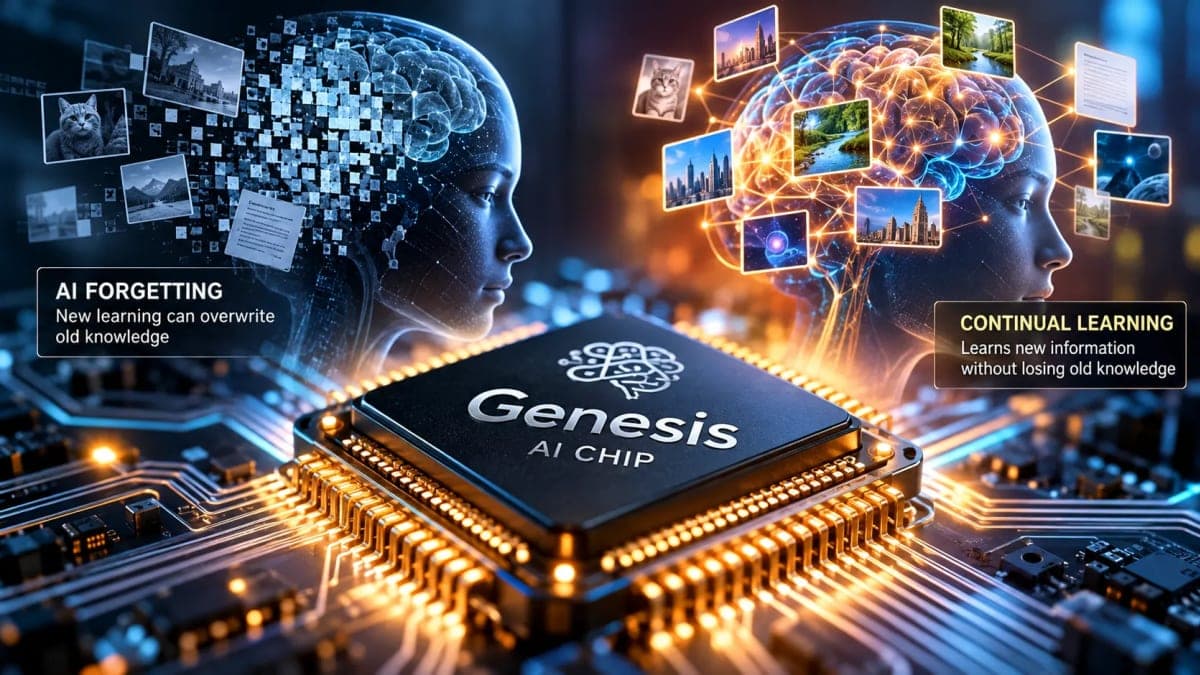
Artificial intelligence systems can perform increasingly sophisticated tasks, but continuously teaching them new skills creates a difficult technical problem: learning something new can interfere with information learned before.
Researchers at the MATRIX AI Consortium at the University of Texas at San Antonio (UT San Antonio) are attempting to tackle that challenge with Genesis, a neuromorphic accelerator designed specifically for continual learning.
The project takes inspiration from how biological brains manage changing information while preserving important existing knowledge.
What Is Catastrophic Forgetting?
Catastrophic forgetting occurs when a neural network trained sequentially on new tasks loses some of its ability to perform tasks it learned earlier.
This is different from a chatbot simply failing to remember an earlier conversation. It is a problem involving how a machine-learning model updates its learned parameters as it encounters new information.
Solving it could become increasingly important for AI systems operating for long periods in changing environments, where repeatedly retraining a model from scratch may be impractical.
How Genesis Works
Genesis combines spiking neural networks with a brain-inspired concept called metaplasticity.
Rather than treating every artificial neural connection as equally easy to modify, the architecture keeps track of information related to the importance and history of connections. Connections considered important can become more resistant to change, while other parts of the network remain available for new learning.
The approach is intended to reduce the risk that new training will overwrite previously acquired knowledge.
Genesis also incorporates hardware and memory-management techniques intended to make continual learning practical on devices with limited computing resources.
Research results reported for the architecture showed 74.6% mean classification accuracy on a task-agnostic split-MNIST benchmark, with estimated power consumption of 17.08 milliwatts using a 65-nanometre technology node.
Why Energy Efficiency Matters
Continual learning is especially challenging outside large data centres because updating an AI system can require significant computation and memory.
The Genesis architecture uses spiking activity, where computation occurs through neuron-like pulses, alongside specialized data movement and memory techniques.
The researchers say this approach could eventually make continually learning AI more practical for applications such as sensors, drones, wearable technology and other edge devices where cloud connectivity or abundant power cannot always be assumed.
Balanced Analysis: Promising, but Not a Universal AI Memory Fix
Genesis represents an interesting direction because it attempts to address continual learning at the hardware level rather than relying entirely on larger models or additional cloud computing.
However, the results should not be interpreted as proof that AI's broader memory problem has been solved.
The reported performance comes from controlled continual-learning benchmarks, and the technology remains in the research and testing stage. Real-world AI systems face substantially more complex information and changing environments.
Genesis therefore provides evidence that brain-inspired hardware can reduce catastrophic forgetting under specific experimental conditions, but broader testing will be necessary to determine how effectively the approach scales to more demanding AI applications.
Why Genesis Could Matter
If continual-learning hardware matures, AI devices could become less dependent on the traditional pattern of training a model, deploying it and periodically retraining or replacing it.
Instead, some systems could adapt locally as conditions change while attempting to preserve useful knowledge accumulated earlier.
That could be particularly valuable for autonomous and edge AI systems expected to operate for long periods without constant access to powerful cloud infrastructure.