Amit Shah, Eknath Shinde Hold 30-Minute Meeting in Mumbai as Political Speculation Grows
A private conversation between Amit Shah and Eknath Shinde has attracted attention in Maharashtra, not because either leader announced a major decision afterwards, but because of the political circumstances surrounding their meeting.
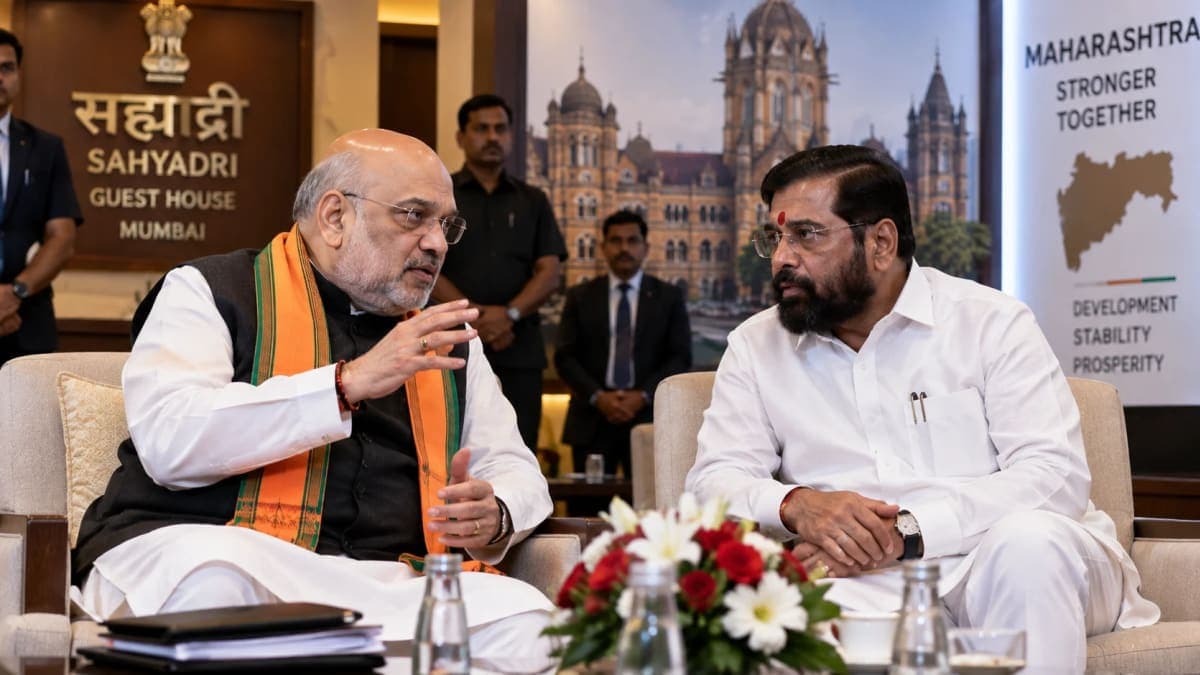
The Union Home Minister met Shinde, Maharashtra’s Deputy Chief Minister and leader of the Shiv Sena, at Mumbai’s Sahyadri Guest House during his visit to the city. According to media reports, the discussion lasted about 30 minutes.
Shah and Shinde then left together for the Asiatic Society, travelling in the same vehicle.
Neither side has publicly provided a detailed account of what was discussed behind closed doors. That leaves a relatively narrow set of confirmed facts around the meeting, alongside considerably broader political speculation.
Why the meeting is being closely watched
A meeting between Shah and Shinde would attract attention in Maharashtra under almost any circumstances.
Shah remains one of the BJP’s most influential national leaders, while Shinde heads a crucial constituent of the state’s ruling Mahayuti coalition. The alliance brings together the BJP, Shinde-led Shiv Sena and Ajit Pawar-led NCP under Chief Minister Devendra Fadnavis.
The BJP occupies the strongest position within that arrangement. It won 132 seats in the 2024 Maharashtra Assembly election, compared with 57 for Shinde’s Shiv Sena.
Those numbers established the BJP as the dominant partner, but they did not make Shinde politically peripheral. His party remains important to the coalition’s legislative strength, organisation and electoral calculations.
That balance gives meetings between Shinde and the BJP’s senior leadership significance even when they produce no immediate public announcement.
No official account of the conversation
Several possible subjects have been attached to the Mumbai meeting in political and media discussion, including coalition coordination and the politically sensitive Maratha reservation issue.
There is not enough verified information, however, to state that either was the principal subject of the conversation.
No detailed agenda has been released and neither Shah nor Shinde has publicly confirmed that the meeting produced a decision on reservation policy, government positions or a new political arrangement.
That distinction matters. The timing of a political meeting can provide context, but it does not establish what was said inside the room.
Maratha reservation remains an important backdrop
The speculation around reservation did not emerge in isolation.
Maratha reservation remains a major political and social issue in Maharashtra, requiring the state government to balance competing demands while navigating the legal and administrative questions surrounding quota policy.
That makes the issue relevant to the wider political environment in which Shah and Shinde met.
It does not, by itself, establish that reservation was on their agenda.
Unless one of the leaders or their parties provides further details, reports linking the private discussion directly to a specific decision should therefore be treated cautiously.
Mahayuti requires constant political management
There is another reason the meeting has attracted interest: coalition politics in Maharashtra involves more than keeping enough MLAs together to run the government.
The BJP, Shiv Sena and NCP have their own leadership structures, electoral bases and organisational priorities. Questions over representation, election strategy and the distribution of political positions inevitably require negotiation among the partners.
Shinde has previously taken such issues directly to Shah.
In June 2026, the two met against the backdrop of negotiations over Maharashtra Legislative Council seats. Shinde’s Sena was seeking a larger allocation, while the BJP’s position was that the distribution should reflect the relative strength of the alliance partners.
That earlier episode provides useful context for the relationship between the two leaders. It does not prove that their latest conversation covered the same ground.
Shah’s visit carried a wider political message
The Shinde meeting was only one part of Shah’s Maharashtra visit.
The Union Home Minister also attended political and public programmes in Mumbai and made a significant statement on the Uniform Civil Code.
Shah said BJP-led NDA governments across 21 states would implement the UCC before 2029, placing the issue firmly on the party’s longer-term political agenda.
His Maharashtra visit therefore had a national political dimension as well as the state-level attention generated by his conversation with Shinde.
What the same-car departure does — and doesn’t — tell us
The sight of Shah and Shinde leaving together after their meeting inevitably added to the interest.
Politically, such images can carry symbolic value. They can convey access, communication and coordination between allies.
But they are poor evidence for more elaborate conclusions.
Travelling together does not establish that the leaders resolved an internal dispute, agreed on an electoral formula or settled a contentious policy question. In a coalition government, direct communication between senior leaders can just as easily be routine political management.
For that reason, claims of a “secret deal” or an imminent Mahayuti shake-up would run ahead of the available evidence.
Shinde remains central to the coalition equation
The political transition after the 2024 Assembly election changed Shinde’s formal position but did not remove his importance within the ruling alliance.
He had served as chief minister after the 2022 split in the Shiv Sena. Following Mahayuti’s 2024 victory, Devendra Fadnavis returned as chief minister and Shinde became deputy chief minister.
The arrangement placed the BJP firmly at the centre of the government while preserving Shinde’s role as a major coalition leader.
That history explains why his relationship with the BJP leadership is closely scrutinised. A routine coordination meeting can generate speculation because any meaningful change in that relationship would have consequences for the wider coalition.
The significance may lie in what follows
For now, the meeting offers fewer conclusions than the political conversation around it might suggest.
The confirmed picture is straightforward: Shah and Shinde met privately at Sahyadri Guest House for roughly half an hour and later travelled together to another engagement.
The substance of their conversation has not been disclosed.
If the Maharashtra government or Mahayuti subsequently announces a decision involving coalition arrangements, reservation policy or another major state issue, the meeting may acquire clearer significance in retrospect.
Until then, its importance lies mainly in the fact that two senior figures in Maharashtra’s governing alliance chose to hold a private discussion at a politically busy moment — not in any agreement that has yet been demonstrated.