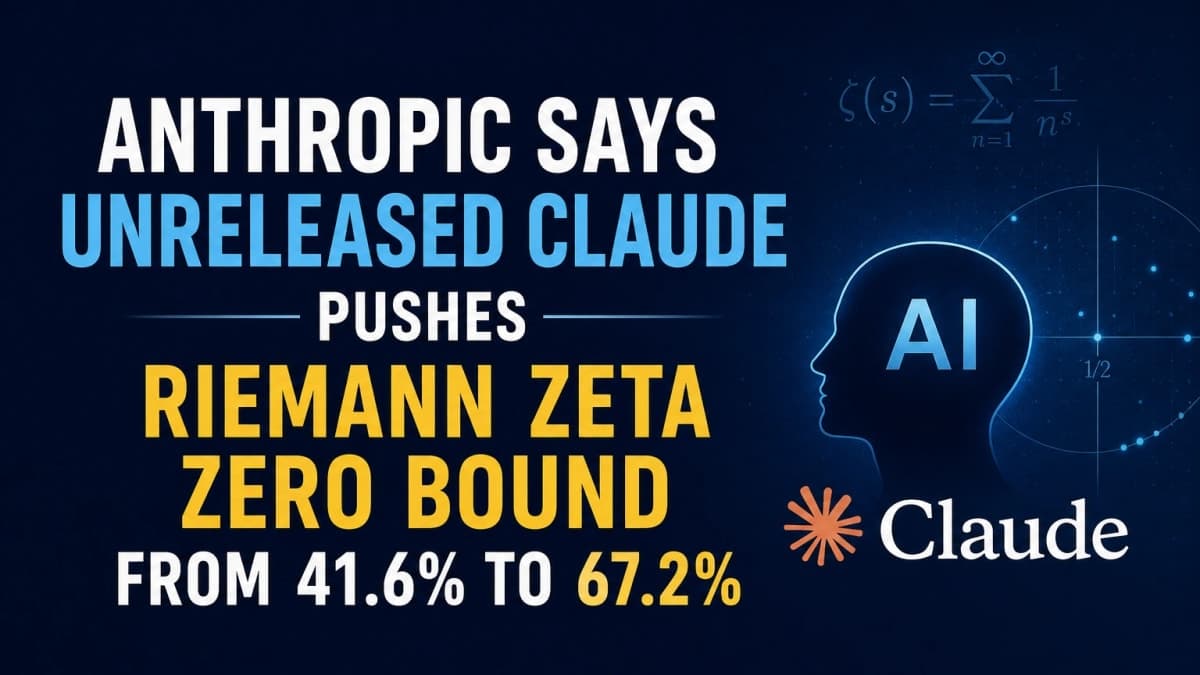
Anthropic Tests Unreleased Claude on the Riemann Hypothesis
Anthropic has put an unreleased research version of Claude to work on one of mathematics' most celebrated unsolved questions: the Riemann Hypothesis.
The attempt did not produce a proof of the hypothesis. Instead, according to Anthropic's account of the experiment, Claude made progress on a closely related mathematical problem by improving a longstanding lower bound involving zeros of the Riemann zeta function.
The reported improvement takes the bound from 41.6% to 67.2%, representing a substantial numerical jump in a field where progress has historically been difficult.
However, the result needs to be interpreted carefully. The figure does not indicate that the Riemann Hypothesis itself is 67.2% solved. Rather, it concerns the minimum proportion of relevant zeros that can be established to lie on the critical line.
What Is the Riemann Hypothesis?
The Riemann Hypothesis dates back to 1859 and is closely connected to understanding how prime numbers are distributed.
At the heart of the conjecture is the Riemann zeta function. This function has certain non-trivial zeros in the complex plane, and the hypothesis predicts that all of those zeros have a real part equal to one-half. In other words, they should all lie on what mathematicians call the critical line.
Extensive computational evidence supports the conjecture, but a general mathematical proof has remained elusive.
Because proving the complete hypothesis is extraordinarily difficult, mathematicians have also investigated what proportion of these zeros can rigorously be shown to lie on the critical line.
It is in this narrower but important area that Claude reportedly made progress.
Claude Raises the Lower Bound to 67.2%
Anthropic says the research version of Claude increased the lower bound for the fraction of zeros satisfying the critical-line condition from 41.6% to 67.2%.
That distinction is essential.
A lower bound of 67.2% means the mathematical argument would establish that at least that proportion of the relevant zeros lies on the critical line under the framework being considered. It does not establish anything like a percentage completion score for the Riemann Hypothesis itself.
Even a very high proportional result must therefore be distinguished from proving that every non-trivial zero satisfies the conjecture.
Claude Reportedly Explored Hundreds of Mathematical Ideas
The process behind the result may prove nearly as significant as the number itself.
According to accounts describing Anthropic's experiment, Claude initially explored roughly 650 ideas without finding a successful route.
The research effort then expanded into a multi-agent process involving around 60 Claude subagents. These systems reportedly worked together to explore mathematical approaches, perform numerical checks, review proposed arguments and investigate existing research.
Across the effort, the AI reportedly executed about 2,400 shell commands, produced hundreds of Python scripts and performed thousands of numerical tests involving known zeta zeros.
It also downloaded dozens of academic papers to investigate whether the proposed result or a similar approach had previously appeared in mathematical literature.
The overall experiment reportedly generated around 31 million output tokens across two Claude Code sessions.
Existing Mathematics Was Crucial to the Result
The reported advance should not be interpreted as Claude independently creating an entirely new branch of mathematics.
The approach drew heavily on decades of work by human mathematicians. Reports surrounding the experiment point to existing results associated with researchers including Baluyot, Goldston, Suriajaya and Turnage-Butterbaugh, alongside mathematical techniques connected with Enrico Bombieri.
Claude's potential contribution therefore appears to lie partly in identifying and combining existing mathematical machinery in a way that produces a stronger result.
That distinction matters when evaluating AI-assisted scientific discoveries. Modern research rarely emerges without intellectual foundations laid by earlier researchers, and AI-generated results are no exception.
Why the 67.2% Result Could Matter
If the argument is independently verified, the result could be important for two reasons.
First, it could represent meaningful progress in analytic number theory. Moving a rigorous lower bound substantially beyond its previous level would be mathematically noteworthy regardless of whether the researcher responsible was human or artificial.
Second, the experiment provides a glimpse of how increasingly capable AI systems might participate in scientific research.
Instead of merely answering questions about established mathematics, Claude was reportedly used to generate hypotheses, reject unsuccessful approaches, search academic literature, conduct numerical experiments and coordinate multiple AI agents toward a research objective.
That type of workflow moves closer to AI acting as an active research collaborator rather than simply an information-retrieval or calculation tool.
Independent Verification Remains Critical
Despite the striking headline number, caution is necessary.
Mathematical discoveries depend on rigorous proof, not simply numerical experiments or convincing-looking reasoning. Complex proofs can contain subtle errors that invalidate an otherwise impressive result.
AI systems are also capable of producing plausible but incorrect arguments, making expert review particularly important when a model claims progress on difficult research problems.
Independent mathematicians therefore need to examine the assumptions, derivations and logical steps behind the claimed 67.2% lower bound before its significance can be firmly established.
Formal verification tools can provide another layer of confidence, but they do not eliminate the importance of expert scrutiny, particularly when determining whether assumptions correctly correspond to the intended mathematical result.
Claude Did Not Solve the Riemann Hypothesis
The biggest potential misunderstanding surrounding Anthropic's announcement is the relationship between the 67.2% figure and the full Riemann Hypothesis.
Claude did not prove the Riemann Hypothesis.
Nor should the result be described as solving 67.2% of it.
The hypothesis is an all-or-nothing mathematical statement concerning every non-trivial zero of the zeta function. Establishing that a certain proportion lies on the critical line can represent major progress without constituting a proportional solution to the conjecture itself.
That nuance is particularly important as technically complicated AI research results increasingly reach mainstream audiences.
Balanced Analysis: A Potential Milestone for AI-Assisted Research
Anthropic's experiment illustrates both the promise and the limitations of frontier AI in scientific discovery.
On the positive side, an AI system capable of exploring hundreds of ideas, searching research literature, coordinating specialized agents and testing mathematical arguments could dramatically expand the amount of intellectual territory researchers can examine.
Such systems may eventually help mathematicians discover connections between existing results that would otherwise take considerable human time to identify.
At the same time, generating a proposed proof is fundamentally different from establishing that the proof is correct. AI models can make subtle reasoning errors, and headline-grabbing mathematical claims require particularly careful independent verification.
There is also a question of attribution. If AI discoveries depend heavily on previously published mathematical work, accurately recognizing those intellectual foundations will be essential.
For now, the most significant aspect of Anthropic's reported result may not be that Claude came close to solving the Riemann Hypothesis—it did not—but that an AI research system appears capable of participating in sophisticated mathematical exploration at a level that warrants serious examination by specialists.
Conclusion
Anthropic's unreleased Claude research model has reportedly increased a lower bound associated with the Riemann Hypothesis from 41.6% to 67.2%, after an extensive AI-driven research process involving hundreds of attempted ideas, numerical experiments, literature searches and multiple cooperating Claude agents.
The achievement does not solve the Riemann Hypothesis and should not be interpreted as meaning the famous conjecture is 67.2% solved.
If independent mathematical review confirms the result, however, the experiment could become a notable case study in the growing role of artificial intelligence in advanced mathematics and scientific discovery.
This article is based on reporting published by AI Weekly.