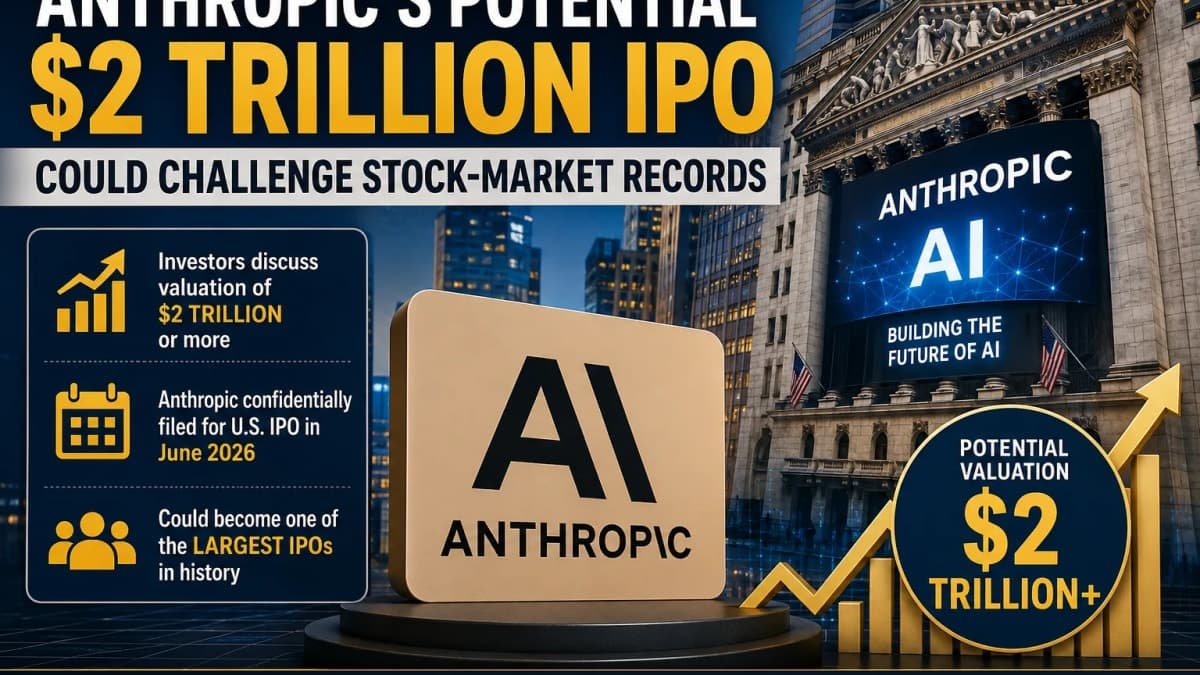
Anthropic’s Potential Stock-Market Debut Could Challenge IPO Records
The artificial intelligence investment boom could soon face one of its biggest tests yet.
Anthropic, the AI company best known for developing the Claude family of models, is preparing for a potential public listing that could challenge records on Wall Street. The company confidentially filed for a U.S. initial public offering in June 2026, putting it on a path toward becoming one of the first major frontier-AI laboratories to face the daily scrutiny of public markets.
Recent reports suggest some Anthropic investors believe the company could command a valuation of $2 trillion or more in a possible listing. The Financial Times has reported expectations among investors for an October float, although the final valuation and timing have not been formally fixed.
If those expectations become reality, Anthropic's arrival on the stock market would represent far more than another major technology IPO. It could become a defining moment for the current AI investment cycle.
Why Anthropic’s IPO Could Make History
The scale being discussed is remarkable even by the standards of today's technology sector.
SpaceX set a historic benchmark when its June 2026 stock-market debut valued the company at roughly $1.77 trillion and raised about $85.7 billion, according to reports. Anthropic's bankers have reportedly discussed the possibility of raising more than $100 billion, potentially giving the AI company a valuation around $2 trillion.
Such an outcome would put a five-year-old AI company into a valuation category historically occupied by a small group of the world's biggest technology corporations.
It would also demonstrate just how dramatically investor expectations around artificial intelligence have changed.
Anthropic’s Valuation Has Risen at Extraordinary Speed
Anthropic's potential IPO becomes even more striking when viewed against its recent fundraising history.
In February 2026, the company announced a $30 billion Series G funding round at a $380 billion post-money valuation. The financing was led by GIC and Coatue and included several major institutional investors.
Only months later, reports surrounding another funding round placed Anthropic's valuation at approximately $965 billion.
Now, investors are discussing the possibility of a public-market valuation around $2 trillion.
That rapid progression illustrates how aggressively investors are pricing future growth in generative AI rather than simply valuing these companies on their current financial performance.
Claude and Enterprise AI Are Central to the Story
Anthropic has positioned itself as one of the leading competitors in the global generative-AI market.
Its Claude models compete across areas including coding, research, business automation and enterprise applications. The company's growing presence among corporate customers has become particularly important because enterprise AI spending could provide more predictable revenue than consumer experimentation alone.
Investor expectations are therefore closely tied to whether Anthropic can turn demand for increasingly capable AI systems into a durable, profitable business.
Reports suggest investors are modeling significant future revenue growth as part of the case for a possible $2 trillion valuation.
Why the IPO Matters Beyond Anthropic
An Anthropic listing could effectively give public investors a new benchmark for valuing frontier artificial intelligence companies.
For several years, many of the industry's most influential AI developers have remained privately held. Their valuations have largely been determined through private funding rounds involving relatively small groups of sophisticated investors.
A major public listing changes that equation.
Once shares begin trading, thousands of institutional and retail investors can continuously reassess the company's value based on revenue growth, profitability, competition, AI infrastructure costs and expectations about the future.
That means Anthropic's IPO performance could influence how investors value the broader AI industry.
A successful debut could encourage other AI companies to accelerate their own public-market plans. A disappointing performance could have the opposite effect, forcing investors to reconsider some of the aggressive valuations created during the AI investment boom.
The $2 Trillion Question
The biggest debate surrounding a potential Anthropic IPO is likely to be whether its growth prospects justify such an enormous valuation.
Supporters can point to rapid adoption of generative AI, increasing corporate spending and the possibility that AI assistants will become fundamental infrastructure across software development and knowledge work.
But investors would also have reasons for caution.
Training and operating frontier AI models requires enormous amounts of computing infrastructure and capital. Competition is intense, technological leadership can shift quickly, and governments around the world continue to debate how powerful AI systems should be regulated.
Anthropic would therefore need to demonstrate not only rapid growth but also that it can maintain competitive advantages while controlling costs and eventually producing sustainable profits.
Public Markets Will Bring a Different Kind of Pressure
Becoming a public company would also change Anthropic itself.
Private companies can often prioritize long-term research while absorbing significant spending without facing constant market reaction. Public companies must report financial results regularly and explain their performance to a much broader shareholder base.
That could create tension between Anthropic's long-term AI development goals and investors seeking predictable financial returns.
At the same time, access to enormous amounts of public capital could help finance the computing infrastructure, research teams and data-center capacity required to develop future generations of AI systems.
A Major Test for the AI Boom
Anthropic's potential listing may ultimately become a referendum on how much investors are willing to pay for the future of artificial intelligence.
The enthusiasm surrounding AI has already transformed technology investment, semiconductor demand and data-center spending. But much of the value attached to leading AI laboratories has so far been established in private markets.
An Anthropic IPO would bring that optimism directly onto Wall Street.
If investors support a valuation approaching or exceeding $2 trillion, it would signal extraordinary confidence that generative AI can create businesses comparable in scale to today's largest technology companies.
If public investors prove more cautious, the listing could instead expose a gap between private-market expectations and what the broader market is prepared to pay.
Either way, Anthropic's potential stock-market debut is shaping up as much more than a conventional IPO. It could become one of the clearest tests yet of whether the enormous expectations surrounding artificial intelligence can survive the discipline of public markets.
This article is based on reporting published by The Economic Times.