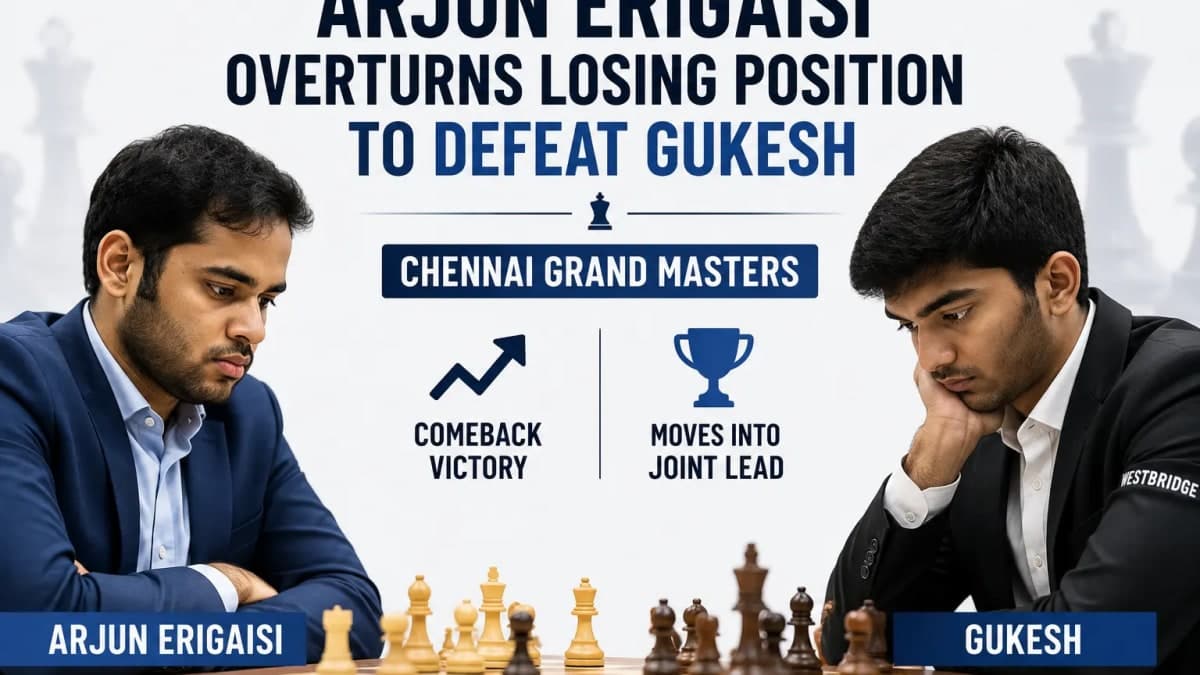
Gukesh Lets Winning Advantage Slip
D Gukesh appeared well placed to secure his first victory of the tournament after building a powerful attack against Arjun Erigaisi’s exposed king.
Playing with the white pieces, Gukesh created dangerous attacking chances in a complex middlegame. Erigaisi had won an extra pawn, but his king remained vulnerable, allowing Gukesh to generate significant pressure with his rook and bishops. Analysis indicated that Gukesh held a winning advantage around the 23rd move.
The position began to change after Gukesh failed to find the most accurate continuation. His advantage disappeared, and the game returned to roughly equal terms as Erigaisi defended carefully.
Time Pressure Changes the Direction of the Game
Gukesh used a considerable amount of time while calculating his attack, leaving him with very little time for the later stages of the game.
As the position became increasingly complicated, Erigaisi maintained a sizeable advantage on the clock. That difference became crucial when Gukesh played 54.Rf5+, a move assessed as a serious error that allowed Erigaisi’s king to become active and support a dangerous passed pawn.
Although Gukesh still had material resources, he could not organise an effective defence. Erigaisi coordinated his pieces and advanced pawn before Gukesh resigned on the 63rd move.
Erigaisi Moves Into Joint Lead
The victory was Erigaisi’s second win of the tournament and lifted him to 3.5 points, level with Alireza Firouzja after five rounds.
Firouzja drew his game against Dmitry Andreikin, while Nodirbek Abdusattorov defeated Nihal Sarin to move within half a point of the leaders. Gukesh remained on 1.5 points, having recorded two defeats and three draws in his opening five games.
The result leaves Erigaisi firmly involved in the title race, with matches against Nihal Sarin and Firouzja still to come.
A Difficult Tournament for the World Champion
The defeat continued a challenging run for Gukesh at his home tournament.
He had earlier lost to Firouzja in the second round and drawn his other three matches. With only two rounds remaining, the world champion faced a difficult task to recover his position in the standings.
Gukesh was scheduled to face M Pranesh in the sixth round before completing the tournament against American grandmaster Hans Niemann.
Background
The Chennai Grand Masters is a high-level classical chess competition featuring leading Indian and international grandmasters.
The tournament holds particular significance for Gukesh because he won its inaugural edition in 2023. That result helped him strengthen his position in the FIDE Circuit and contributed to his qualification for the Candidates Tournament, which he later won before becoming world champion.
Erigaisi has also established himself among India’s strongest players and entered the Chennai event as the country’s highest-ranked competitor. His victory over Gukesh reinforced his reputation as one of the most dangerous attacking and tactical players in elite chess.
Why the Result Matters
The game demonstrates how quickly an advantage can disappear in top-level chess.
Gukesh’s early success showed that his preparation and attacking instincts remain strong. However, his inability to convert the position under time pressure raised questions about decision-making and clock management during a difficult run of form.
For Erigaisi, the victory was important both competitively and psychologically. Winning with the black pieces against the reigning world champion moved him into title contention and provided further evidence of the depth within Indian chess.
The match also highlights the growing rivalry among India’s leading young grandmasters, who are increasingly competing against one another for tournament titles, rating positions and international recognition.
Balanced Analysis
Gukesh’s defeat should not be interpreted as evidence that his overall chess strength has significantly declined. Even the best players experience periods in which strong positions are not converted, particularly in demanding tournaments featuring several elite opponents.
His ability to obtain a winning position against Erigaisi remains a positive sign. The larger concern is that this was another game in which time pressure and an inaccurate decision prevented him from turning good play into a result.
Erigaisi deserves substantial credit for remaining composed while under attack. His defence forced Gukesh to continue finding difficult moves, and once the opportunity appeared, he converted the resulting advantage efficiently.
From a tournament perspective, the result strengthened Erigaisi’s title prospects and increased the pressure on Gukesh. From a broader perspective, it offered another example of the narrow margins separating the world’s strongest chess players.


