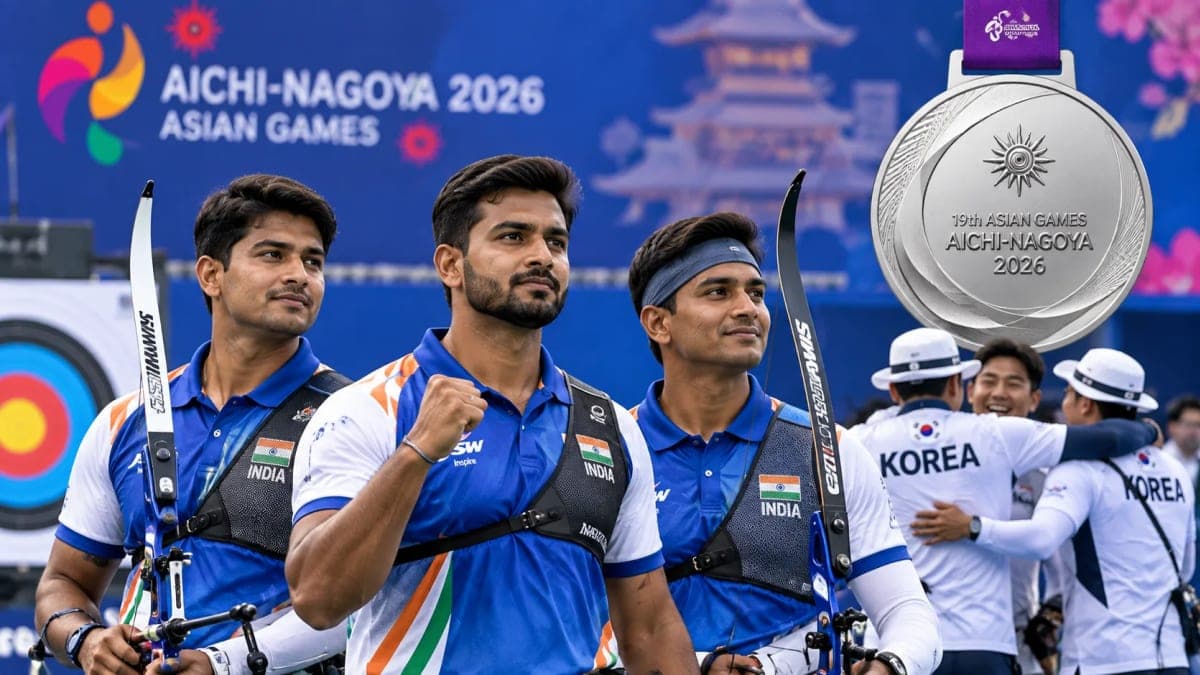
India Take Silver in Men’s Recurve Team Event
India added another medal to its strong archery campaign at the Aichi-Nagoya 2026 Asian Games, with the men’s recurve team finishing second after facing South Korea in Friday’s final.
The Indian trio of Dhiraj Bommadevara, Yashdeep Sanjay Bhoge and Neeraj Chauhan lost the gold-medal contest 5-1 on set points at Okazaki Chuo Sogo Park Multipurpose Square in Okazaki, Japan, on October 2.
South Korea were represented by Kim Woo-jin, Kim Je-deok and Lee Woo-seok, who successfully defended the country’s men’s recurve team title.
India and South Korea Share Opening Set
India remained level with the defending champions through the opening set.
Both teams shot 56, meaning the two sides received one set point each and entered the second set tied at 1-1.
South Korea then raised the level significantly. Lee, Kim Je-deok and Kim Woo-jin opened the second set with three consecutive 10s.
India responded with 9, 8 and 8 from its opening three arrows and eventually finished the set on 50. South Korea accumulated 57, winning the set and moving into a 3-1 lead.
South Korea Clinch Gold in Third Set
India needed to win the third set to extend the final.
Both teams began with 28 from their opening three arrows, leaving the contest finely balanced. India then recorded 7, 9 and 10 with its remaining shots to finish on 54.
South Korea remained consistent and scored 56, taking the set and completing a 5-1 victory.
The result gave South Korea a second consecutive Asian Games gold medal in the men’s recurve team competition.
Dominant Semi-Final Sends India Into Gold-Medal Match
India reached the final after an emphatic performance against Iran.
Bommadevara, Bhoge and Chauhan defeated the Iranian team of Mohammadhossein Golshani, Sadegh Ashrafi and Reza Shabani 6-0 in the semi-final.
India won the three sets 58-53, 56-53 and 56-55, completing a straight-sets victory and securing at least a silver medal before meeting South Korea.
South Korea also reached the final without conceding a set point in their semi-final, defeating Chinese Taipei 6-0.
How Recurve Team Scoring Works
Unlike events decided simply by adding every arrow to a cumulative total, recurve team matches use a set-point system.
Each team consists of three archers, with every archer shooting two arrows in each set. The six arrows therefore produce a maximum possible score of 60.
Winning a set earns two points, while a tied set gives each team one point. The first team to reach five set points wins the match.
That explains why the final officially finished 5-1 even though the teams also recorded individual arrow scores within each set.
Silver Matches India’s Hangzhou Result
The medal maintains India’s recent progress in the men’s recurve team event.
India also won silver at the Hangzhou Asian Games, meaning the country has now reached the podium in the event at consecutive editions.
While the team was unable to convert its latest final appearance into gold, reaching another Asian Games final provides evidence of sustained competitiveness at the continental level.
South Korea, however, remains a major benchmark in international recurve archery, and its experienced trio proved more consistent after the opening set in Friday’s final.
A Major Day for Indian Recurve Archery
The men’s silver formed part of an unusually successful day for India's recurve programme.
Earlier, Ankita Bhakat, Kirti Sharma and Kumkum Mohod defeated South Korea to give India its first Asian Games gold medal in the women’s recurve team event.
Bommadevara was also involved in another medal performance, partnering Kumkum Mohod to take silver in the mixed recurve team competition after losing the final to China.
Combined with India's compound successes, the men's silver took the country's archery haul at these Games to seven medals — four gold, two silver and one bronze at that point in the competition.
Why the Silver Medal Matters
The result carries significance beyond adding another medal to India's Asian Games tally.
Recurve is the traditional Olympic archery discipline, and sustained success against Asia’s strongest teams provides an important measure of India's international competitiveness.
South Korea has historically been one of the dominant forces in global recurve archery, making matches against its leading archers an important test for India.
Friday’s final also exposed the narrow margins at the highest level. India matched Korea in the opening set but fell behind once the defending champions produced greater consistency in the following two sets.
Balanced Analysis: Strong Campaign, but Korea Remains the Benchmark
India's silver represents a successful team campaign rather than a failed gold-medal bid.
Bommadevara, Bhoge and Chauhan reached the final convincingly and matched South Korea through the first set. Their 6-0 semi-final victory over Iran also demonstrated the quality of India's route to the medal match.
The final nevertheless highlighted the area separating the two teams on the day.
South Korea responded to the tied opening set with a 57 and 56 in the next two sets, while India posted 50 and 54. At that level, a handful of lower-scoring arrows can rapidly change a match because of the set-point format.
India therefore leaves the competition with another major recurve medal and consecutive Asian Games men's team silvers, while South Korea retains the title.
For Indian archery, the wider significance lies in the combined performance across men's, women's and mixed events—a campaign that demonstrated greater depth across the recurve programme.


