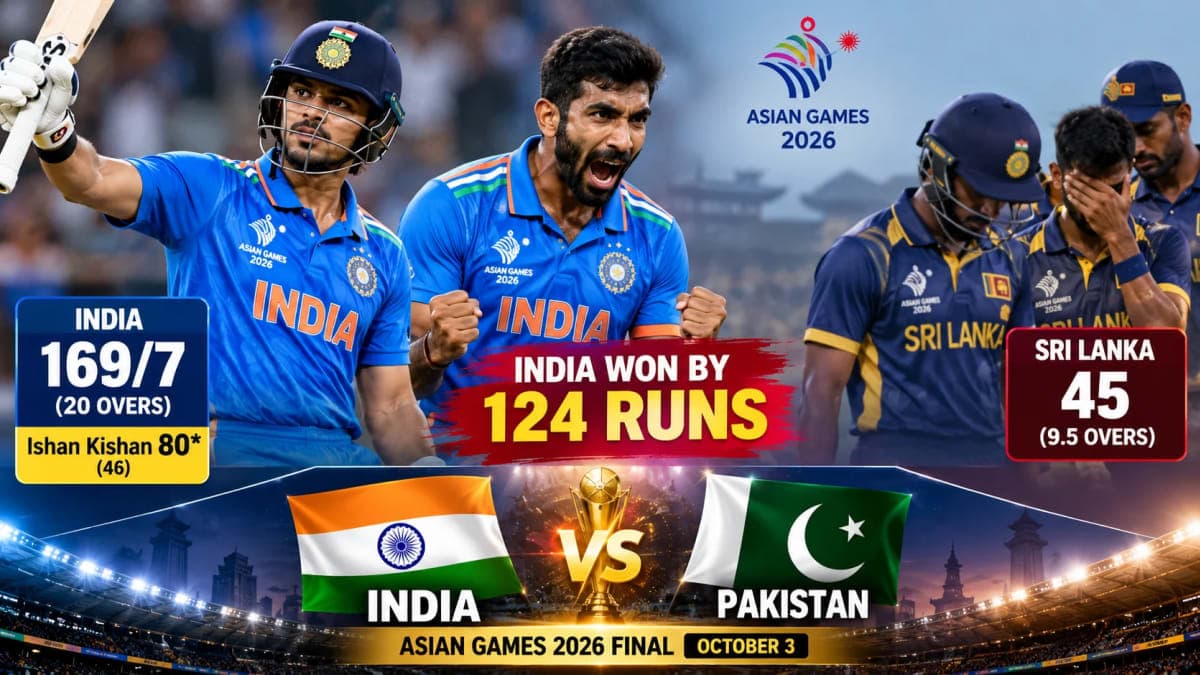
India produced a dominant all-round performance against Sri Lanka on Thursday to reach the Asian Games 2026 men's cricket final, setting up a high-profile gold-medal encounter with Pakistan.
Batting first at Korogi Sports Park in Nisshin, India posted 169/7 from 20 overs. Ishan Kishan provided the backbone of the innings with an unbeaten 80 from 46 deliveries.
India's bowlers then transformed a competitive total into a one-sided semi-final. Sri Lanka collapsed to 45 all out in just 9.5 overs, handing India a commanding 124-run victory.
The result means India will meet Pakistan for the Asian Games men's cricket gold medal on October 3.
Early Wickets Put India's Batting Under Pressure
Sri Lanka won the toss and chose to bowl, and their decision initially appeared effective.
India lost Abhishek Sharma and Sanju Samson for seven runs each, preventing the batting order from settling immediately.
Young opener Vaibhav Sooryavanshi, however, responded aggressively. His 38 helped India maintain momentum during the early overs and ensured that the loss of wickets did not completely stall the scoring rate.
Sooryavanshi eventually departed, while further wickets left India needing someone to construct a substantial innings on a surface where batting was not straightforward.
That responsibility fell to Ishan Kishan.
Ishan Kishan's Unbeaten 80 Changes the Game
Kishan produced the defining batting performance of the semi-final.
While several teammates struggled to convert their starts, the left-hander adjusted to the conditions and remained unbeaten on 80 from 46 balls.
His innings enabled India to reach 169/7 despite losing wickets at regular intervals.
The knock was particularly valuable because the subsequent Sri Lankan collapse demonstrated how difficult scoring could become once the bowlers found the right areas.
Kishan's contribution therefore went beyond its numerical value. He gave India's bowlers a substantial target to defend on a pitch that offered them enough assistance to attack from the beginning.
Jasprit Bumrah Strikes Immediately
If Kishan established India's advantage, Jasprit Bumrah ensured Sri Lanka had almost no opportunity to recover.
The fast bowler struck twice in his opening over, immediately destabilising Sri Lanka's chase.
From that point, wickets continued to fall rapidly.
Bumrah, Axar Patel and Abhishek Sharma finished with two wickets each, while India's fielding added further pressure through three run-outs.
Sri Lanka never developed a meaningful partnership and were eventually dismissed for 45 before completing 10 overs.
The collapse turned what might have been a competitive chase into one of the most emphatic victories of the tournament.
Sri Lanka's 45 Highlights India's Bowling Control
Sri Lanka's total of 45 was not merely a poor chase; it also demonstrated how effectively India exploited the conditions.
India attacked early rather than allowing Sri Lanka's top order time to settle. Bumrah supplied the initial breakthrough, while the other bowlers maintained the pressure.
Sri Lanka also contributed to their difficulties through run-outs, making a recovery increasingly unlikely as the innings progressed.
The result underlined the depth of India's attack: the decisive wickets were not dependent on one bowler alone.
Pakistan Beat Bangladesh to Reach Final
Pakistan secured their place in the gold-medal match earlier by defeating Bangladesh by six wickets in a rain-affected semi-final.
That match was reduced to 13 overs per side. Pakistan successfully chased a target of 112, completing the pursuit with nine balls remaining.
The two semi-finals therefore produced an India-Pakistan final, adding another major chapter to one of international cricket's most closely followed rivalries.
India Still Have Batting Questions Before the Final
The scale of India's victory should not completely obscure some issues visible during the first innings.
Kishan's unbeaten 80 and Sooryavanshi's 38 accounted for a large share of India's total, while several other batters struggled to make substantial contributions.
Against Pakistan, India may need greater stability across the batting order, particularly if conditions again favour spin or make stroke-making difficult.
The semi-final nevertheless demonstrated an important strength: India were able to recover from batting setbacks and then defend their total with overwhelming effectiveness.
Why the India-Pakistan Final Matters
The final carries significance beyond the usual attention surrounding an India-Pakistan cricket match.
A continental gold medal will be at stake, meaning the rivalry will unfold within a multi-sport event rather than a conventional bilateral series or ICC tournament.
India enter the contest after a 124-run semi-final victory, while Pakistan arrive after successfully navigating a shortened chase against Bangladesh.
Those contrasting semi-final routes provide useful context, but they do not determine how the final will unfold. Conditions, execution under pressure and adaptation on the day will remain decisive.
A Statement Performance Before the Gold-Medal Match
India's victory over Sri Lanka combined two very different forms of control.
Kishan first provided the composure required to construct a competitive innings after early wickets. Bumrah and the rest of the bowling attack then converted that platform into a crushing victory.
At the same time, India's middle-order difficulties provide an area to examine before the final.
The semi-final therefore delivered both a powerful statement and a reminder: India's bowling attack appears capable of deciding matches quickly, but a more complete batting performance could become important when Pakistan stand between them and the Asian Games gold medal.


