India’s World Cup Pace Planning Remains Unsettled
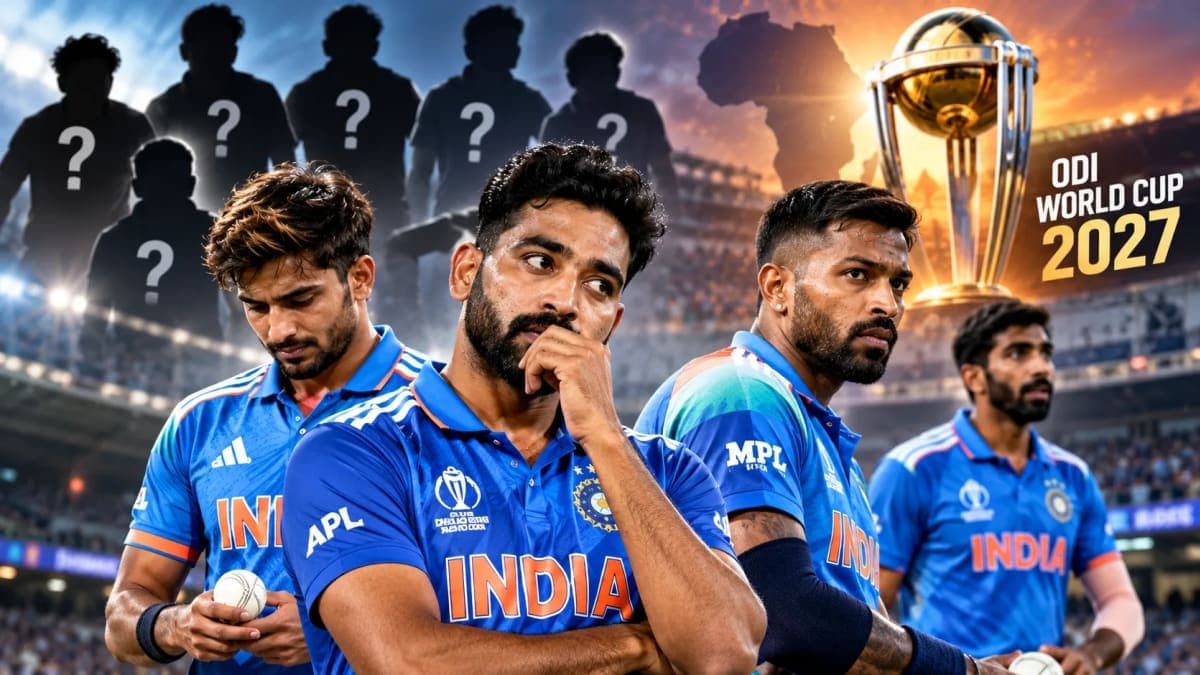
India may have several fast-bowling options available, but with the 2027 ODI World Cup approaching, identifying exactly who performs which role remains an unfinished task.
The scale of the experimentation illustrates the issue. India have already used 10 pace-bowling options in 11 ODIs during 2026, as the team management tests combinations and deals with injuries and workload considerations.
Jasprit Bumrah remains central to India's plans when available, but the structure around him is far less settled. Mohammed Siraj, Prasidh Krishna, Arshdeep Singh, Harshit Rana and other seamers have all featured in the broader conversation, while India are simultaneously searching for sufficient pace-bowling depth from their all-rounders.
The ongoing series against West Indies has brought that uncertainty into sharper focus.
Where Does Mohammed Siraj Fit?
One of India's biggest decisions concerns Mohammed Siraj.
Siraj has considerable international experience and was an important member of India's pace attack during the 2023 ODI World Cup. But India's recent experiments indicate that the management is still evaluating alternatives and combinations for 2027.
Siraj was left out of the first ODI against West Indies as India experimented with Nitish Kumar Reddy taking the new ball.
That decision raised a broader question: if Bumrah is available and India continue developing other specialist quicks, what precise role will Siraj occupy in the final World Cup attack?
The issue is less about whether Siraj has international pedigree and more about how India distribute new-ball, middle-over and death-bowling responsibilities across a limited World Cup squad.
With the tournament scheduled to be played in South Africa, Zimbabwe and Namibia, the eventual pace combination could be particularly significant.
Nitish Kumar Reddy Gets a New-Ball Test
India's attempt to develop Nitish Kumar Reddy into a more substantial bowling option is another important part of the equation.
Against West Indies in Thiruvananthapuram, India handed Reddy the new ball in Siraj's absence.
The experiment produced a difficult start.
Returning from a quadriceps injury, Reddy struggled with his control, including an expensive over in which he conceded 18 runs, and captain Shubman Gill subsequently removed him from the opening spell.
The performance does not settle the question of Reddy's long-term value, but it demonstrates the challenge India face when searching for an alternative to Hardik Pandya.
Bowling coach Morne Morkel has spoken positively about Reddy's development, saying the youngster has made progress with his bowling and can compete for an all-rounder's position. Reddy, however, remains relatively inexperienced in ODI cricket.
Why Replacing Hardik Pandya Is So Difficult
Hardik Pandya provides something that is difficult to reproduce with a single replacement: a genuine top-seven batting option who can also deliver meaningful overs of pace bowling.
That combination affects the construction of the entire XI.
With Hardik available, India can potentially field specialist bowlers without sacrificing as much batting depth. His seam bowling can also provide another tactical option when conditions favour pace.
When he is unavailable, India face a more complicated calculation.
Selecting another specialist batter strengthens the batting but reduces bowling flexibility. Picking an additional specialist bowler can lengthen the tail. Using a developing seam-bowling all-rounder such as Reddy attempts to preserve the balance, but requires that player to contribute reliably in both disciplines.
India have tried multiple players in the pace-bowling all-rounder role during Hardik's absences, illustrating how difficult it has been to find a direct substitute.
Prasidh Krishna and Other Pacers Keep Competition Open
India's experimentation is not restricted to Siraj and Reddy.
Prasidh Krishna has become an increasingly significant part of the ODI pace group, while other fast bowlers are also being assessed before the World Cup squad takes shape.
The selectors therefore face two interconnected decisions: identifying India's strongest specialist pace combination and determining how many overs can reliably come from the all-rounders.
That distinction matters because the World Cup squad cannot accommodate every promising fast bowler.
Different bowlers also offer different attributes—new-ball movement, extra bounce, left-arm variation, middle-over wicket-taking or death-over execution.
India's challenge is ultimately to turn those individual options into a coherent attack.
New ODI Conditions Add Another Complication
India's pace concerns are also unfolding against changes in the ODI game's bowling environment.
Recent analysis of India's fast bowlers has highlighted difficulties when operating with an older ball following changes to ODI playing conditions. Indian Express reported a notable deterioration in the statistical returns of India's pacers following the relevant rule change, although performances across different periods and opposition must be interpreted within their respective contexts.
This increases the importance of finding bowlers capable of contributing across multiple phases rather than simply exploiting the new ball.
The World Cup venues could create different demands from match to match, making adaptability another important selection consideration.
Gambhir Says India's Experiments Will Continue
India head coach Gautam Gambhir has indicated that the team has not finished experimenting.
After India's record chase against West Indies in Guwahati, Gambhir pointed to the limited preparation window before the 2027 World Cup and confirmed that India would continue trying players as they work toward the final combination.
That approach explains some of India's recent selection changes.
Experimentation itself is not necessarily evidence of a crisis. The purpose of bilateral cricket before a major tournament is partly to establish depth and test contingency plans.
The concern is timing.
Eventually, experimentation must produce clarity about roles.
Why the Pace Question Matters for the 2027 World Cup
The next ODI World Cup will be staged across southern Africa, where pace, bounce and seam movement can become important depending on the venue and conditions.
India therefore need more than a collection of talented fast bowlers.
They need clarity over who takes the new ball, who attacks during the middle overs, who handles the closing stages and who provides the additional seam option without compromising the batting order.
Bumrah's availability would solve a major part of that equation, but building an entire pace strategy around one bowler would leave India vulnerable to fitness or workload disruptions.
Siraj's experience, Krishna's progress and the development of younger alternatives therefore remain important.
The same applies to Hardik. His ability to balance the XI makes him exceptionally valuable, but India's experiments with Reddy demonstrate why preparing another seam-bowling all-rounder remains strategically important.
Balanced Analysis: A Problem of Roles Rather Than Options
India's situation can be viewed in two ways.
On one hand, repeatedly changing fast bowlers can prevent players from settling into clearly defined ODI roles. Ten pace options across 11 matches demonstrates how wide India's search has become.
On the other hand, testing players now could leave India better prepared for injuries during a long World Cup campaign.
Reddy's difficult new-ball outing should therefore be viewed as one data point rather than a final verdict on his future. Morkel's comments suggest the coaching staff sees developmental potential in his bowling.
Similarly, Siraj's omission from an experimental combination does not by itself establish his eventual World Cup status.
The more significant issue is whether India can identify clearly differentiated roles among their fast bowlers while developing a credible contingency for Hardik.
With roughly a year remaining before the tournament, India still have time to answer those questions—but every ODI from here becomes increasingly valuable evidence.


