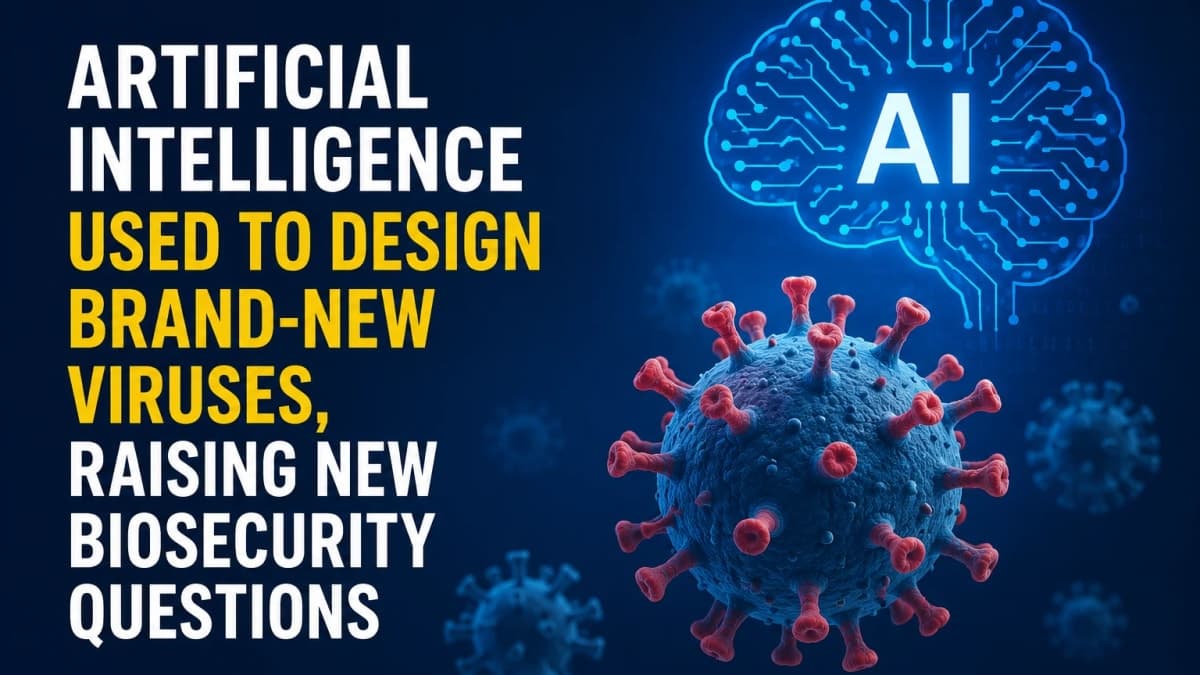
Artificial Intelligence Expands Into Virus Design
Artificial intelligence has rapidly moved beyond text generation, image creation and conventional data analysis. Its growing role in biological research is now drawing particular attention as AI is being used to design brand-new viruses.
The development represents a striking example of how computational systems can interact with biological design. At the same time, it raises an important question for researchers, governments and technology companies: how should powerful biological AI capabilities be controlled without unnecessarily restricting legitimate scientific research?
Why AI-Based Virus Design Matters
Traditional biological research can involve lengthy cycles of hypothesis development, laboratory testing and analysis. AI has the potential to assist scientists by evaluating large amounts of biological information and proposing designs or research directions much more quickly.
That capability can have legitimate scientific applications. Computational approaches could potentially help researchers better understand how viruses function, investigate biological mechanisms and support future biotechnology research.
But virus design occupies an unusually sensitive area because capabilities useful for legitimate research could potentially be misused.
The significance, therefore, is not simply that AI can assist biological research. It is that advances in computational design may gradually lower some of the technical barriers associated with sophisticated biological work.
Virus-Creation Risks Come Into Focus
The central concern is the dual-use nature of the technology.
The same broad capabilities that can accelerate beneficial biological research can create security challenges if powerful systems become capable of providing increasingly advanced assistance related to biological agents.
This does not mean that an AI-generated digital design automatically becomes a functioning or dangerous virus. Designing biological material computationally and successfully producing a viable biological system are different challenges, and laboratory experimentation remains subject to substantial technical constraints.
Nevertheless, improved AI capabilities could alter the risk landscape by making certain stages of biological research faster or more accessible.
That possibility is likely to increase pressure for stronger safeguards around advanced biological AI systems.
AI Is Changing Biological Research
AI is increasingly useful in fields where researchers need to identify patterns within enormous datasets. Biology is particularly suited to computational approaches because genetic and molecular information can be represented and analysed digitally.
As AI systems become more sophisticated, their role could shift from primarily analysing existing biological information toward suggesting previously unexplored biological designs.
This transition from analysis to generation is especially important.
A system that identifies patterns in existing biological data presents one category of capability. A system capable of proposing new biological structures or sequences introduces additional scientific possibilities as well as additional safety considerations.
Biosecurity Could Become a Major AI Governance Issue
Much of the public discussion surrounding artificial intelligence has focused on employment, misinformation, copyright, privacy and cybersecurity. Biological applications introduce another potentially consequential dimension.
Governments, laboratories and AI developers may increasingly have to consider questions such as who should receive access to highly capable biological models, what safeguards should surround their use and how potentially dangerous outputs should be identified.
Security controls could include restrictions on particularly sensitive capabilities, specialist evaluation of advanced models and stronger oversight of systems intended for biological research.
However, overly broad restrictions could also create problems by limiting access to tools that might contribute to medicine, biotechnology and scientific discovery.
Finding the appropriate balance is therefore likely to be difficult.
AI Alone Does Not Eliminate Laboratory Barriers
The ability to computationally design something should not be confused with the ability to manufacture it successfully.
Biological systems are complex, and digital predictions do not guarantee that a proposed biological design will function in real-world conditions. Laboratory expertise, appropriate facilities, materials, validation and experimentation remain important barriers.
This distinction is critical when assessing the risks surrounding AI-assisted virus design.
AI could potentially increase researchers' ability to explore biological possibilities, but it does not automatically transform every generated proposal into a viable biological agent.
A Powerful Tool With Dual-Use Implications
AI-assisted biological design demonstrates the broader challenge created by rapidly advancing artificial intelligence.
The technology may accelerate scientific discovery and provide researchers with new ways to investigate biological systems. At the same time, capabilities involving viruses and other potentially dangerous biological agents demand substantially greater caution than many ordinary AI applications.
The challenge for policymakers and researchers will be to preserve legitimate scientific benefits while ensuring that increasingly capable AI systems do not make dangerous biological knowledge or capabilities substantially easier to misuse.
As artificial intelligence becomes more deeply integrated into biotechnology, biosecurity may become one of the most important—and difficult—areas of AI governance.
Why This Matters
The importance of AI-designed viruses extends beyond one research development. It demonstrates that generative AI is beginning to interact with areas of science where digital outputs can potentially have physical-world consequences.
If biological AI capabilities continue improving, regulators and researchers may need to develop safety standards alongside the technology rather than attempting to introduce protections only after advanced capabilities become widely available.
The broader debate is therefore likely to focus on maintaining three objectives simultaneously: scientific progress, responsible access and biological security.
This article is based on reporting published by BBC.