A Child’s Simple Message Captures India’s Attention
A few sincere words from a young girl in Arunachal Pradesh have turned into a powerful social-media conversation about what it means to look Indian.
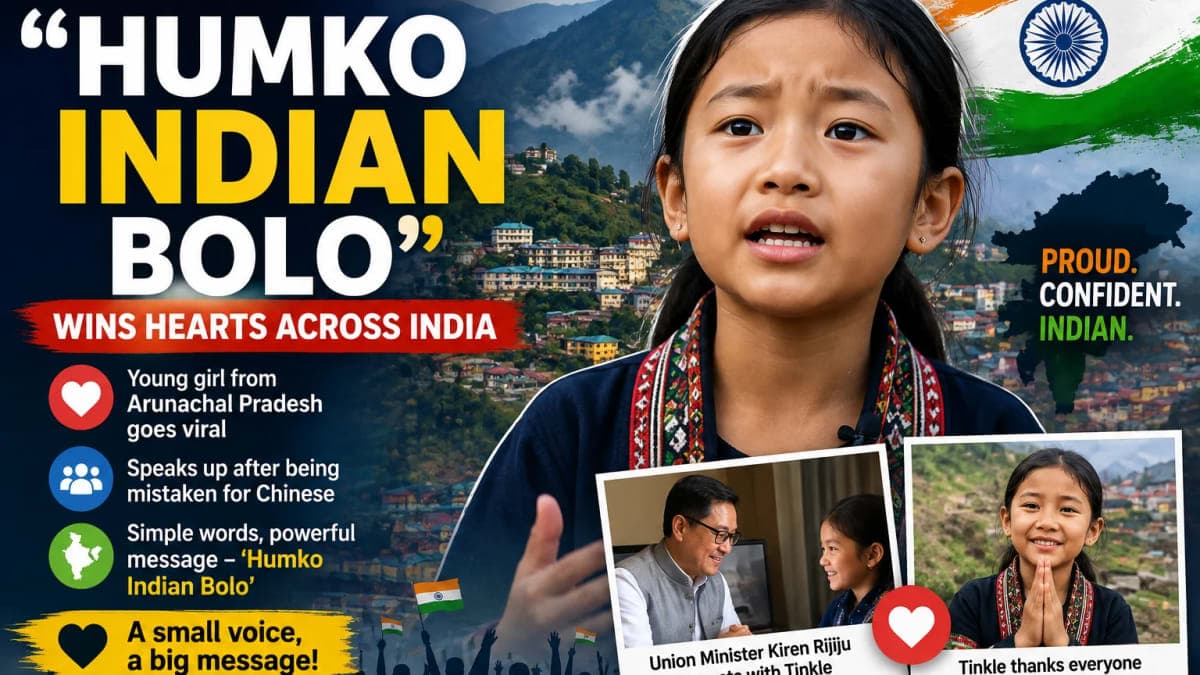
Karga Tinkle Gongo, a young girl from Itanagar, became the centre of widespread online attention after a video showed her responding to being identified as Chinese.
Instead of ignoring the remark, the girl made her feelings clear. She explained that such comments made her feel angry and sad and asked people to recognise her for what she is — Indian.
Her appeal could be summed up in three words that quickly became associated with the viral moment:
“Humko Indian bolo.”
The simplicity of the statement struck a chord with viewers across the country.
Why the ‘Humko Indian Bolo’ Video Went Viral
The clip stands out because the girl addresses a complicated social issue without complicated language.
There is no political speech or carefully prepared argument. Her message comes from a child's understanding of belonging: she lives in India, comes from Arunachal Pradesh and considers herself Indian, so she wants others to recognise that identity.
That straightforward reasoning helped the video travel rapidly across social-media platforms.
People responding to the clip praised her confidence and innocence, while many also pointed out that no Indian should have to repeatedly prove their nationality because of their facial features or regional background.
The Bigger Issue Behind a Heartwarming Viral Moment
While the video has generated affectionate reactions, the subject behind it is more serious.
People from India's Northeastern states have long spoken about encountering assumptions concerning their nationality based on appearance. Being incorrectly labelled Chinese or treated as foreign can turn what might appear to some as a casual comment into an experience of exclusion for the person receiving it.
The viral video therefore became more than an entertaining social-media moment.
It highlighted how narrow ideas about what an Indian is “supposed” to look like can overlook the country's enormous ethnic and cultural diversity.
India's national identity has never been represented by one facial appearance, language, cuisine, dress or cultural tradition.
The Northeast is an essential part of that diversity.
Arunachal Pradesh and India’s Northeastern Identity
Arunachal Pradesh lies in India's Northeast and is home to numerous communities, languages and cultural traditions.
Like the wider Northeast, the state adds a distinct dimension to India's national character.
Yet geographic distance from many of India's largest population centres and limited understanding of Northeastern cultures can sometimes contribute to misconceptions.
The response to Tinkle's video demonstrates why greater cultural awareness matters.
Recognising the Northeast as an integral part of India's identity should not require viral moments. Greater representation in education, entertainment, media, tourism and everyday conversations can help reduce stereotypes before they emerge.
Social Media Turns Her Message Into a National Conversation
As the video circulated online, messages of affection and encouragement poured in.
The reaction was not limited to ordinary social-media users. Public figures also amplified the girl's message, bringing further attention to the conversation surrounding Northeastern identity and stereotyping.
The attention eventually reached Union Minister Kiren Rijiju, who is himself from Arunachal Pradesh. He later interacted with Tinkle through a video call and reassured her that people across India were supporting her.
That interaction further expanded the reach of a video that had begun with one child's response to an uncomfortable remark.
From Hurt to an Outpouring of Support
There was also a happier development after the original clip.
Following the enormous response, Tinkle appeared in another video thanking people for their affection and support.
The shift in tone was significant.
A moment that began with a child explaining why a stereotype hurt her evolved into thousands of people publicly affirming her Indian identity.
That does not erase the larger problem highlighted by the original incident, but it shows how social media can occasionally transform an unpleasant personal experience into an opportunity for awareness.
Why the Video Matters Beyond Social Media
Viral videos appear and disappear every day. This one carries a message capable of surviving beyond its moment of online popularity.
India's diversity is frequently celebrated through slogans, festivals and cultural events. But genuine inclusion is also reflected in everyday behaviour — including how people speak to someone whose appearance, language or traditions differ from their own.
Tinkle's reaction exposes a simple contradiction.
If India celebrates itself as a diverse nation, being Indian cannot be associated with a single physical appearance.
Someone from Itanagar is no less Indian because they look different from someone in Mumbai, Delhi, Jaipur, Chennai or Lucknow.
That may appear obvious, yet the response to the video suggests it remains an important point to reinforce.
A Lesson About Curiosity Over Assumptions
There is another useful takeaway from the episode: curiosity and stereotyping are not the same thing.
India contains hundreds of communities and an enormous variety of cultures. It is natural for people to be interested in backgrounds different from their own.
The problem begins when curiosity becomes an assumption about someone's nationality or belonging based solely on appearance.
A more respectful approach is simple: ask about someone's background without deciding it for them.
That small difference can make everyday interactions considerably more inclusive.
Balanced Analysis: Viral Support Is Welcome, but Awareness Matters More
The overwhelming support for the Arunachal girl is encouraging.
It demonstrates that many Indians immediately understood why her message mattered and wanted to reassure her that she belongs.
At the same time, the incident should not be reduced entirely to a heartwarming viral story.
The fact that a young child felt compelled to explain that she is Indian raises uncomfortable questions about stereotypes faced by some people from the Northeast.
Online affection can generate awareness, but lasting progress depends on what happens after the viral attention disappears.
Education about India's regions, greater Northeastern representation in mainstream culture and more thoughtful everyday interactions could have a deeper impact than social-media support alone.
A Small Voice Carrying a Big Message
Perhaps the reason “Humko Indian bolo” resonated so strongly is precisely because it was so simple.
The girl was not asking for special recognition.
She was asking to be recognised as belonging to the country she already calls home.
In doing so, Tinkle unintentionally delivered a larger reminder about India's identity: the country's diversity is not something found only in textbooks or national celebrations. It is visible in the different faces, languages, communities and cultures of its people.
Her viral moment may eventually disappear from social-media feeds.
But the idea behind those three words deserves to remain:
India does not have one face.
This article is based on reporting published by TOI.