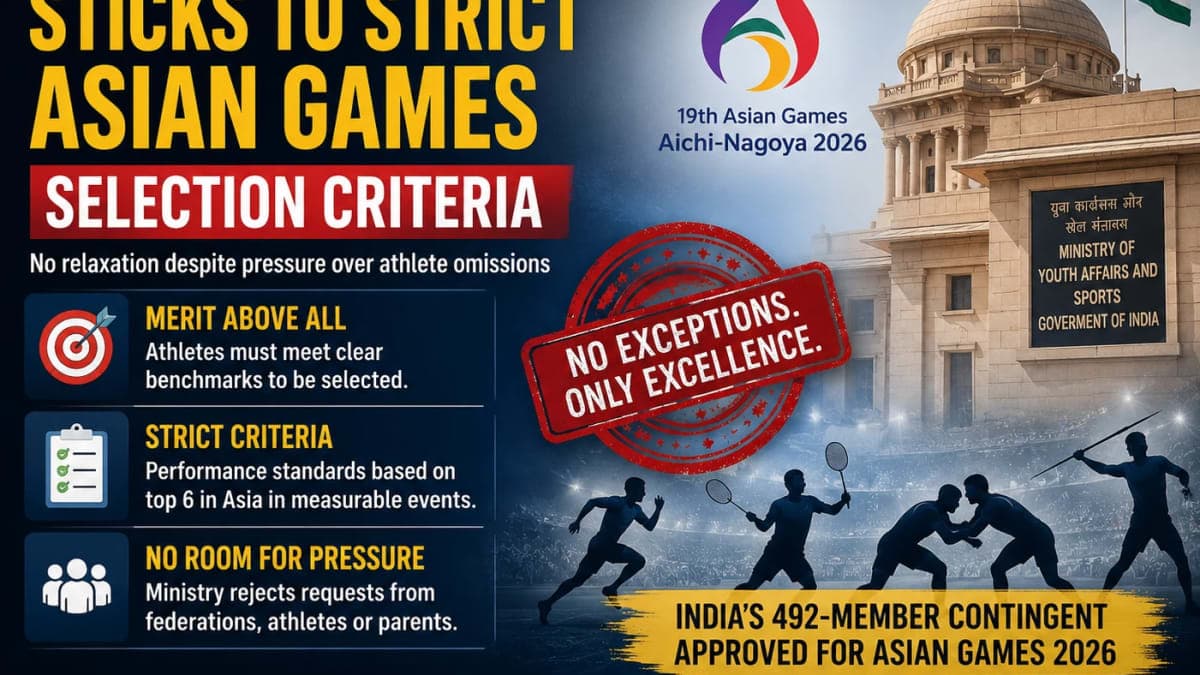
Sports Ministry Sticks to Strict Asian Games Selection Criteria
India’s Sports Ministry has made it clear that it does not intend to dilute its selection standards for the 2026 Asian Games, despite mounting criticism and requests to reconsider athletes who have been left out of the national contingent.
The government has already approved a 492-athlete Indian squad for the Asian Games in Aichi-Nagoya, Japan, scheduled from September 19 to October 4, 2026. Athletics accounts for the largest group in the contingent, with 73 competitors.
Some additions remain possible, subject to approval from the Olympic Council of Asia, but the ministry has indicated that athletes who do not satisfy the established standards should not expect exemptions simply because of outside pressure.
Why Is the Sports Ministry Taking Such a Strict Position?
The central argument behind the government's policy is straightforward: India should send athletes to major multi-sport competitions when their performances suggest they have a credible chance of competing successfully at the continental level.
The Ministry of Youth Affairs and Sports formally published its criteria for the 2026 Asian Games in September 2025, describing the framework as an attempt to create a transparent and equitable system that prioritises athletes with genuine medal potential.
For measurable individual disciplines, the benchmark broadly focuses on performances comparable with the top six in Asia. The ministry has now reiterated that it intends to apply those standards rather than expand the contingent primarily to provide international exposure.
Ministry Rejects Pressure to Expand the Team
The firmness of the government's position follows appeals surrounding athletes who missed selection.
A ministry source acknowledged that officials had faced considerable pressure, including representations from parents seeking places for athletes who had been excluded. The government's response has been that competitors who satisfy the announced criteria will be selected, while those falling short will not be included simply because of appeals.
The ministry's position effectively treats the Asian Games as a performance-focused competition rather than a development event.
That distinction sits at the heart of the current controversy.
Tennis Omissions Trigger Major Debate
Tennis has emerged as one of the most visible examples of disagreement over the policy.
The Sports Ministry excluded Manas Dhamne, Vaishnavi Adkar, Sahaja Yamalapalli, Vaidehee Chaudhari and Prarthana Thombare from the list submitted by the All India Tennis Association after they did not satisfy the applicable criteria.
Former doubles star and two-time Asian Games gold medallist Rohan Bopanna publicly criticised the decision, questioning an approach that he believes can determine an athlete's prospects before competition actually begins.
The controversy is particularly notable because some of the excluded players are young athletes for whom participation in a continental multi-sport event could have provided significant competitive exposure.
India's No. 1 Women's Singles Player Also Misses Out
The exclusions have attracted additional attention because Sahaja Yamalapalli, India's highest-ranked women's singles player at the time, was among those left out.
Yamalapalli expressed disappointment and argued that major competitions can produce unexpected results, with lower-ranked athletes sometimes defeating stronger opponents.
Her case illustrates one of the fundamental questions surrounding performance benchmarks.
Rankings and previous results can help predict medal prospects, but sport is inherently unpredictable. Athletes can improve rapidly, favourable draws can emerge and breakthrough performances can happen during the competition itself.
Government Says Rules Must Be Applied Consistently
From the ministry's perspective, making exceptions creates a different problem.
If clearly announced standards are relaxed after lobbying from individual federations, athletes or families, the selection system risks becoming inconsistent.
The criteria were announced nearly a year before the Games rather than being introduced immediately before the final squad was chosen. The government therefore argues that athletes and federations had advance knowledge of the benchmarks.
That strengthens the ministry's argument that applying the rules consistently is preferable to deciding individual cases after the selection deadline.
492 Athletes Cleared to Represent India
India's approved contingent currently contains 492 athletes, with several prominent competitors expected to represent the country across multiple disciplines.
The final number represents a selective approach compared with simply approving every athlete nominated by national federations.
Both India's men's and women's cricket teams have been cleared, while athletics contributes the largest number of competitors with 73 athletes.
The composition indicates that the government is attempting to concentrate participation around athletes and teams that satisfy its competitive benchmarks.
The Larger Question: Medals or Development?
The controversy raises a broader question about the purpose of sending athletes to events such as the Asian Games.
The government's approach treats the competition primarily as an elite performance platform.
Under that philosophy, public funding and national resources should be concentrated on athletes with demonstrated potential to finish near the top of their disciplines.
Supporters of a broader selection policy see another benefit.
Competing at the Asian Games can expose emerging athletes to elite opponents, high-pressure environments and major-event conditions that are difficult to replicate at smaller competitions.
A young athlete who is not a medal contender in 2026 could potentially use that experience while preparing for future Asian Games, world championships or Olympic campaigns.
Why the Selection Policy Matters Beyond Asian Games 2026
The implications extend beyond the upcoming competition in Japan.
India is simultaneously attempting to develop a more systematic high-performance sports structure ahead of future global competitions, particularly the Los Angeles 2028 Olympics.
In July 2026, the Sports Ministry instructed recognised national federations in Olympic disciplines to publicly disclose their qualification pathways and athlete-selection processes for LA 2028. The government also reiterated that selection policies for major competitions should generally be published well in advance.
That suggests the Asian Games controversy forms part of a larger shift toward formalised, data-driven selection systems.
Balanced Analysis: Consistency Versus Opportunity
There is a credible argument behind the ministry's insistence on maintaining published standards.
Clear benchmarks can reduce arbitrary selections, discourage lobbying and give athletes objective performance targets. Applying the same rules after announcing them well in advance can also improve accountability.
A medal-focused policy may additionally help India concentrate resources on athletes most capable of delivering podium finishes.
But objective benchmarks have limitations.
Different sports cannot always be evaluated equally through rankings or historical performances. Injuries, rapidly improving athletes, strength of competition and tournament formats can all affect whether a numerical benchmark accurately predicts medal potential.
There is also a legitimate developmental argument for exposing promising younger competitors to major international events.
The challenge, therefore, is not simply choosing between strict and relaxed selection. It is creating criteria sophisticated enough to reward proven performance while leaving carefully defined pathways for exceptional cases.
What Happens Next?
With the Aichi-Nagoya Asian Games beginning September 19, attention will increasingly shift from selection disputes to India's medal prospects.
A limited number of additions could still be made if the necessary approvals are received from the Olympic Council of Asia.
For now, however, the Sports Ministry's message is clear: pressure alone will not be sufficient to secure an Asian Games place.
The ultimate test of that policy will arrive in Japan. If India's streamlined contingent produces strong results, the ministry's medal-first approach could gain greater support. If excluded athletes subsequently demonstrate performances suggesting they could have competed successfully, the debate over selection criteria is likely to continue well beyond the 2026 Games.
This article is based on reporting published by The Economic Times.


