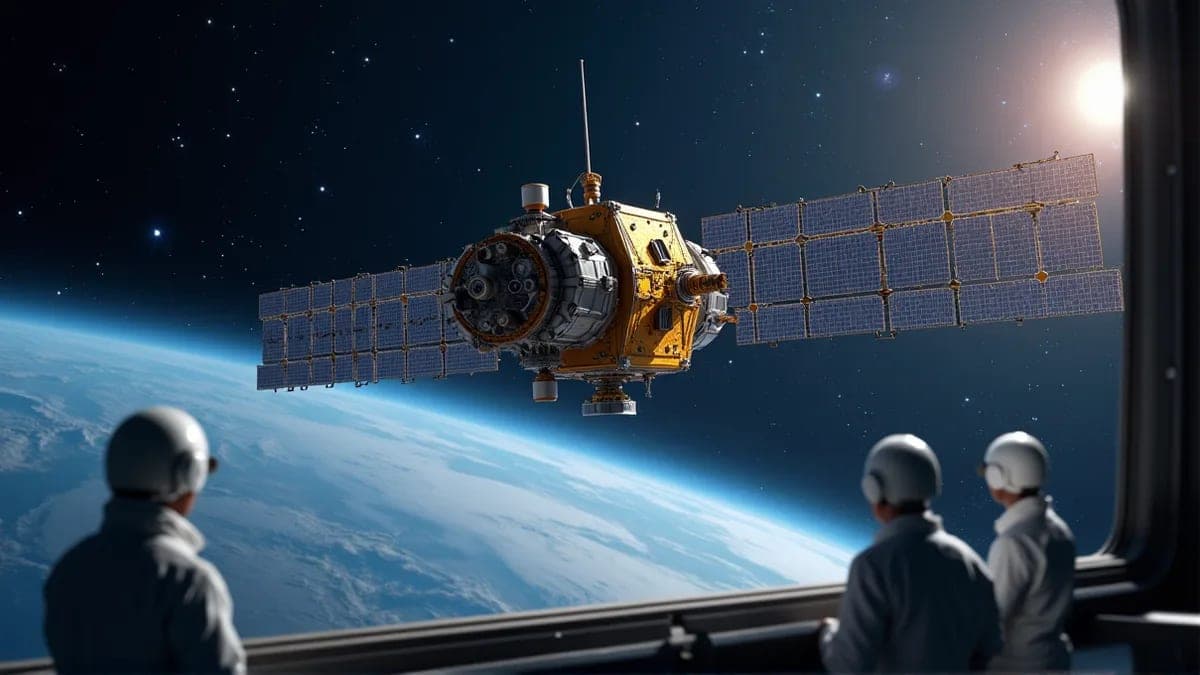
Jay Panchal, a 25‑year‑old entrepreneur, believes that abandoning a satellite because it has exhausted its propellant is as wasteful as leaving a car stranded on a highway. He argues that the $100 billion worth of privately owned geostationary satellites in orbit could keep generating revenue if a low‑cost propulsion add‑on could give them a new lease on life.
That conviction has driven Aule Space, a Bengaluru‑based deep‑tech venture, to develop a small spacecraft it calls a “jetpack satellite.” The vehicle is designed to approach a dead satellite, attach itself and provide thrust, effectively turning a retired asset into a functional one again.
The Development
Aule Space was founded less than a year ago and quickly secured $2 million in pre‑seed capital led by pi Ventures. The firm also participates in the Entrepreneurs First accelerator and receives backing from the Transpose Platform. Within eighteen months, the team has moved its concept from laboratory benches to India’s space agency facilities, where it demonstrated key subsystems and achieved Technology Readiness Level 6.
Technology Readiness Level, or TRL, is a nine‑step scale originally created by NASA to gauge how close a technology is to commercial use. Reaching TRL 6 means that a prototype has been validated in a relevant environment. Panchan says that a successful on‑orbit docking demonstration planned for next year would push the system to TRL 9, the stage at which a product is ready for market deployment.
The company’s approach differs from earlier docking missions. Northrop Grumman’s 2020 demonstration and NASA’s robotic servicing projects relied on expensive lidar or radar sensors and were built around satellites that already featured docking ports. Aule’s design, by contrast, uses a vision‑based navigation suite that relies on cameras and computer‑vision algorithms to locate and align with satellites that have no dedicated docking hardware.
To train those algorithms, Aule has constructed a dark‑room test chamber equipped with a sun simulator that recreates the harsh lighting conditions of space. An air‑bearing platform provides a near‑frictionless environment for testing the docking mechanics, allowing engineers to fine‑tune control loops before the first flight.
The Numbers
Financial and market metrics illustrate why investors are watching the venture closely.
Pre‑seed funding: $2 million, led by pi Ventures.
Projected mission cost: $20 million–$30 million per satellite‑service flight.
Targeted life extension: up to five years per serviced satellite.
Geostationary communications fleet: roughly 320 satellites, with 20–25 losing fuel annually.
On‑orbit servicing market forecast: $5.5 billion by 2030, growing at 10–11 % CAGR.
Team size: about 23 engineers and managers, many drawn from ISRO, Pixxel, Skyroot and other Indian space firms.
Reading Between The Lines
The price point that Aule proposes – roughly a tenth of the cost of historic satellite‑refurbishment missions – suggests a disruptive business model. If a single servicing spacecraft can attend to multiple customers over its operational life, the economics of extending satellite revenue streams become compelling for operators facing multi‑hundred‑million‑dollar replacement costs.
By focusing on high‑value communication satellites, the startup is targeting a segment where even a modest extension of service life translates into significant cash flow. A five‑year extension on a satellite that generates, for example, $50 million per year could deliver $250 million of additional revenue, dwarfing the $20‑30 million service fee.
The reliance on vision‑based navigation also signals a broader trend of AI‑driven autonomy in space. Training computer‑vision models on simulated imagery reduces the need for heavy, power‑hungry sensors, potentially lowering mass and launch costs. This aligns with the company’s claim of building “the world’s lightest and most efficient” servicing platform.
Moreover, the fact that Aule has already achieved TRL 6 within a year indicates rapid prototyping capabilities. The involvement of former ISRO engineers and advisors who participated in the SpaDex docking mission adds credibility, suggesting that the team can navigate the regulatory and technical hurdles that often stall Indian space startups.
The Risks
Despite the promise, several uncertainties remain. Docking with a satellite that was never designed for such interaction poses significant technical challenges. The lack of a standardized interface means that each target may require bespoke adjustments, potentially inflating mission complexity and cost.
Regulatory approval for on‑orbit servicing is still evolving worldwide. While India’s space agency has cleared experimental docking, commercial operations will need clear liability frameworks, especially in the congested geostationary belt where debris mitigation is a priority.
Market adoption also hinges on operator confidence. Satellite owners may be reluctant to entrust a third‑party vehicle with a critical asset, especially given the limited heritage of autonomous docking in the commercial sector. Demonstrating a flawless first mission will be essential to overcome that hesitation.
What To Watch
The upcoming in‑orbit docking test, slated for early next year, will be the first public benchmark of Aule’s technology. Successful attachment and thrust delivery will likely trigger a wave of commercial interest and could accelerate the company’s path to TRL 9.
Investors and industry watchers should also monitor the company’s ability to secure follow‑on funding. Scaling from a single prototype to a fleet capable of serving multiple customers will require substantial capital, and the next financing round could set the tone for the startup’s growth trajectory.
This article is based on reporting published by Yourstory.