BJP Turns to Booth-Level Planning Ahead of 2027 UP Election
The Bharatiya Janata Party has begun a more detailed phase of its preparations for the 2027 Uttar Pradesh Assembly election, with senior leaders reviewing the organisation from the state leadership down to individual polling booths.
BJP national general secretary (organisation) B.L. Santhosh has been involved in the latest round of discussions, including consultations with former Uttar Pradesh BJP presidents. The exercise is aimed at gathering assessments from leaders who have previously managed the party organisation in a state that remains central to the BJP's national political strength.
The work is starting well before the formal election campaign. That timing gives the party room to address weaknesses exposed during the 2024 Lok Sabha election while building an organisation capable of defending its state government for a third consecutive term.
The 18,900 Booths BJP Wants to Win Back
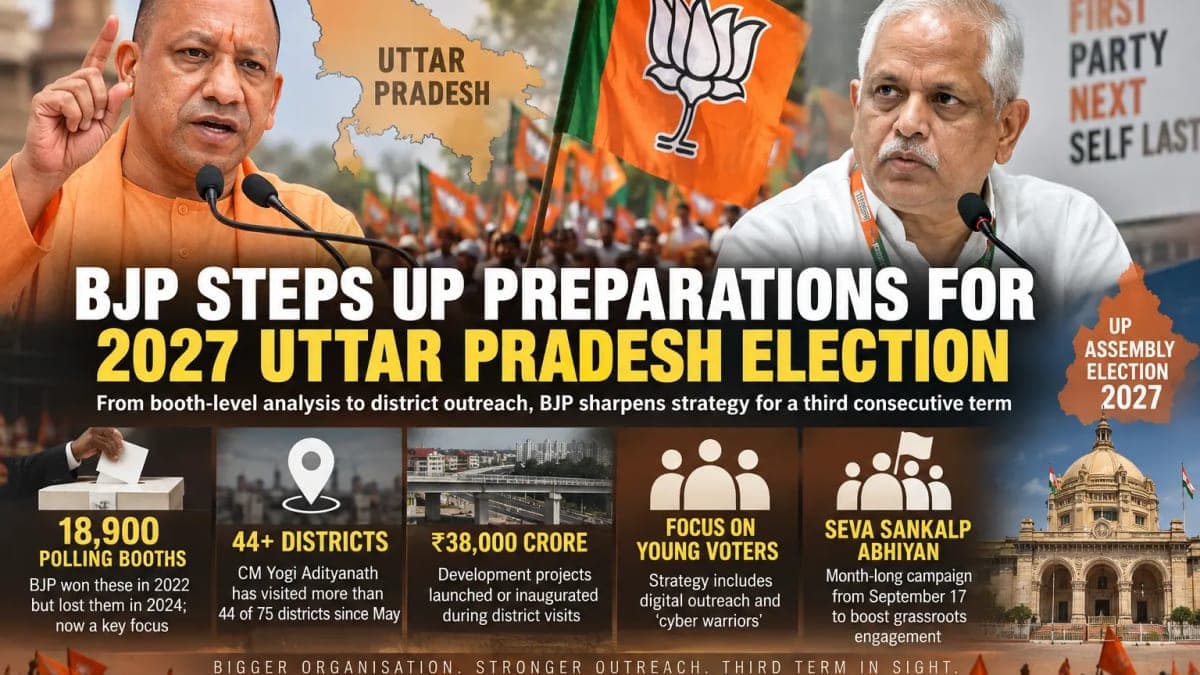
One figure offers a particularly useful window into the party's thinking: roughly 18,900 polling booths.
The BJP won those booths during the 2022 Uttar Pradesh Assembly election but lost them in the 2024 Lok Sabha contest. They have now become an important part of the party's electoral review.
The significance is less about the statewide total than what the data can reveal locally. A booth-by-booth examination can help identify whether support shifted because of candidate selection, local dissatisfaction, changes in caste or community voting patterns, organisational weakness or other constituency-specific factors.
Not every Lok Sabha voting pattern will carry into an Assembly election. State elections place greater weight on local candidates, constituency issues and the record of the state government. But the 2024 results provide the BJP with a recent map of where its support declined.
Lessons From the 2024 Lok Sabha Election
That review matters because Uttar Pradesh produced one of the BJP's most significant setbacks in the 2024 general election.
The party's Lok Sabha tally in the state fell from 62 seats to 33. The result strengthened the position of the opposition and forced the BJP to reassess areas where it had previously enjoyed a stronger electoral advantage.
The party is now approaching 2027 with that experience in mind rather than treating the Assembly election simply as a continuation of its previous state campaigns.
Its preparations combine several tracks: strengthening booth organisations, reviewing political feedback, expanding government-linked outreach and bringing national leaders into the process well before candidate selection and full-scale campaigning dominate the election calendar.
Yogi Adityanath Expands Ground-Level Outreach
Chief Minister Yogi Adityanath's schedule has added another dimension to the preparations.
Since May, Adityanath has visited more than 44 of Uttar Pradesh's 75 districts and launched or laid the foundation for development projects valued at more than ₹38,000 crore, according to reports on the BJP's election preparations.
His outreach has covered 115 Assembly constituencies, many of them politically important because of the voting patterns recorded in the 2024 Lok Sabha election.
Of those Assembly segments, the Samajwadi Party-Congress alliance led in 67 during the parliamentary election. The BJP led in 47, while its ally Rashtriya Lok Dal led in one.
The projects associated with these visits cover areas including roads, hospitals, schools, electricity and water infrastructure, tourism, panchayat facilities and skill development. Welfare benefits have also been distributed during the outreach programme.
For the BJP, this allows the state government to put its development record at the centre of its political engagement while concentrating attention on constituencies where the electoral contest is likely to be demanding.
Senior BJP Leaders Join the Preparations
The campaign structure is also drawing greater involvement from the BJP's national organisation.
Santhosh's consultations with former state presidents form part of that process. Instead of relying only on the current leadership, the party is seeking assessments from figures with experience managing previous electoral cycles in Uttar Pradesh.
A meeting of the BJP's Uttar Pradesh core group in Lucknow also examined the emerging strategy for 2027. The discussions included welfare programmes and ways to engage younger voters, particularly Gen Z.
BJP president Nitin Nabin has meanwhile begun election-related outreach from western Uttar Pradesh, with visits planned across the party's six organisational regions.
State in-charge Vinod Tawde is scheduled to visit around 15 districts between September 16 and 22, widening the organisational review across different parts of the state.
Taken together, the visits suggest that the BJP is trying to establish a common assessment of its electoral position before the campaign moves into a more public and candidate-driven phase.
Young Voters Become a Separate Campaign Priority
The BJP's interest in younger voters is not limited to conventional political meetings.
The party is also preparing a stronger digital operation, including trained online workers described in reports as "cyber warriors." A quick-response system is expected to help party teams react to opposition messaging and political narratives circulating on social-media platforms.
The emphasis on Gen Z is notable because younger voters consume political information differently from many older groups. Digital platforms can shape the speed at which campaign messages, criticism and counterclaims spread, making online organisation increasingly important alongside traditional booth networks.
For the BJP, the challenge will be to connect that digital activity with its wider campaign rather than treating social media as a separate operation.
Seva Sankalp Abhiyan Adds a Grassroots Layer
The party is also preparing a month-long "Seva Sankalp Abhiyan", beginning on September 17, Prime Minister Narendra Modi's birthday.
The programme is expected to include yatras, cleanliness drives and enrolment camps linked to government welfare schemes.
Such an exercise serves more than one organisational purpose. It gives local workers a reason to engage directly with residents, provides a platform for promoting welfare programmes and helps activate the party machinery months before the intensity of the election campaign peaks.
For a party preparing to defend power after two consecutive Assembly victories, keeping that local network active will be as important as high-profile rallies later in the campaign.
A Third Consecutive Term Is the Goal
Uttar Pradesh's 403-member Assembly makes the coming election one of the largest and most consequential state contests in the country.
The BJP won 255 seats in the 2022 Assembly election, compared with 111 for the Samajwadi Party, allowing Yogi Adityanath to return for a second consecutive term as chief minister.
The political environment for 2027, however, will not be identical to 2022. The 2024 Lok Sabha election demonstrated that the BJP's dominance in Uttar Pradesh could be challenged, while the next Assembly contest will bring its own combination of state-level issues, alliances, candidates and local calculations.
That helps explain why the party is starting with granular electoral work rather than waiting for the campaign season.
The approximately 18,900 booths that changed hands between the 2022 Assembly and 2024 Lok Sabha elections provide the BJP with a concrete starting point. At the same time, Adityanath's district visits, national-level organisational reviews, youth outreach and welfare campaigns indicate that the strategy extends beyond recovering individual polling stations.
The BJP is effectively using the period before the formal campaign to determine where its organisation needs reinforcement and where its political message needs adjustment.
Whether those preparations translate into votes will ultimately depend on the campaign itself, the candidates chosen and the strength and strategy of the opposition. For now, the BJP's approach shows that the contest for Uttar Pradesh has already entered its organisational phase.