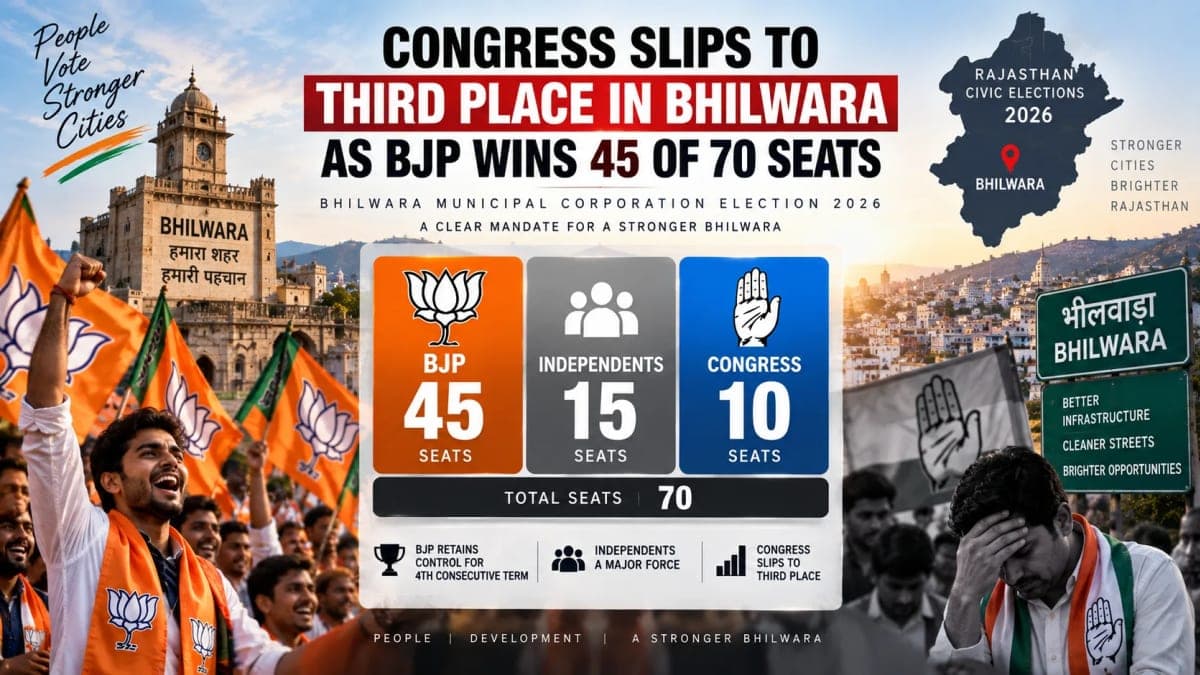
BJP Wins Clear Majority in Bhilwara; Congress Slips to Third Place With Just 10 Seats
Introduction
The Bharatiya Janata Party (BJP) has secured a decisive victory in the Bhilwara Municipal Corporation election, winning 45 of the 70 wards and comfortably crossing the majority mark required to control the civic body.
The result delivered a particularly sharp setback to the Congress, which won only 10 wards.
More strikingly, Congress did not even finish second. Independent candidates won 15 wards, placing them five seats ahead of the opposition party.
The verdict allows the BJP to retain control of the Bhilwara civic body for a fourth consecutive term, strengthening the party's position in a city that was historically regarded as a Congress stronghold.
Bhilwara Election Result 2026: Final Seat Tally
The final results from all 70 wards produced a clear BJP majority.
BJP — 45 seats
Independents — 15 seats
Congress — 10 seats
Total — 70 seats
With 36 seats required for a simple majority, the BJP finished nine seats above the threshold.
That means the party does not need support from Independents to command a majority in the corporation.
For Congress, however, the result carries a different political message: Independents collectively won 50% more seats than Congress, taking 15 compared with the party's 10.
Congress Falls Behind Independents
Congress's third-place finish is one of the most notable aspects of the Bhilwara verdict.
The party was already dealing with organisational difficulties before polling.
According to reporting from Bhilwara, Congress did not allot official election symbols in 17 wards. As a result, the party contested only 53 of the corporation's 70 wards.
The impact was visible in the final result.
While Congress managed 10 victories, Independents collectively secured 15 wards.
The outcome does not establish that the symbol dispute alone caused Congress's defeat; voter preferences can be influenced by numerous local and political factors. But the organisational issue is an important part of the context surrounding the party's performance.
Several Congress Figures Suffer Setbacks
The defeat was not limited to the overall seat count.
Several people associated with prominent Congress leaders also suffered losses.
According to local reporting, former municipal council head and Congress Assembly candidate Om Narayaniwal saw his wife and brother defeated. The wife of the Bhilwara Congress city president also lost her contest.
Veteran Congress leader Manju Pokharna, a six-time councillor, was also defeated.
These individual results add another dimension to the broader setback for the party's local organisation.
BJP Retains Bhilwara for Fourth Consecutive Term
The result means the BJP has retained control of the Bhilwara civic body for a fourth straight term.
That is politically significant because Bhilwara has historically been viewed as a city where Congress had considerable influence.
Municipal elections are heavily shaped by local issues, candidates and ward-level political networks, so they should not automatically be treated as a direct forecast of future Assembly or Lok Sabha elections.
Nevertheless, maintaining control across four consecutive terms points to the BJP's sustained organisational strength in Bhilwara's urban politics.
Independents Emerge as a Major Force
The BJP's victory is the headline, but the performance of Independent candidates deserves equal attention when examining the result.
Winning 15 of 70 wards means Independents secured more than one-fifth of all seats in the corporation.
Their success was enough to push Congress into third place.
In Bhilwara itself, the BJP's clear majority means Independents will not determine who controls the corporation.
Elsewhere in the district, however, Independents could play a much more important role.
Mixed Results Across Bhilwara District
The broader district-level results were more varied than the corporation result alone suggests.
The BJP secured clear majorities in the Mandalgarh and Jahazpur municipalities, while Congress obtained clear majorities in Shahpura and Gangapur.
No party secured a majority in six other municipalities:
Banera, Bigod, Bijolia, Gulabpura, Hamirgarh and Asind.
In those municipalities, Independents are expected to play an important role in board formation and the selection of municipal leadership.
This makes the wider Bhilwara district verdict more complex than a simple BJP-versus-Congress result.
The BJP dominated the main municipal corporation, but several smaller civic bodies produced fragmented mandates.
Bhilwara Part of a Much Larger Rajasthan Civic Verdict
The Bhilwara election was part of Rajasthan's large-scale urban local body elections covering 309 urban local bodies.
Polling took place in two phases on September 9 and September 11, 2026.
Across the state, the BJP emerged ahead of Congress in the ward tally. As results for more than 10,200 wards were declared, the BJP had won more than 4,171 wards, compared with more than 3,597 for Congress.
However, the results across major municipal corporations produced a mixed political picture rather than a uniform statewide sweep.
The BJP secured majorities in important corporations including Bhilwara, Udaipur and Kota, while Congress performed strongly elsewhere.
Congress Finds Success Elsewhere Despite Bhilwara Loss
Bhilwara's result should therefore be viewed within the broader Rajasthan picture.
Congress won 42 of 80 wards in Bikaner Municipal Corporation, securing control there.
In Ajmer, Congress emerged as the largest party with 37 of 80 wards, compared with the BJP's 32 and Independents' 11.
Congress also emerged as the largest party in Pali, winning 29 of 65 wards, while the BJP secured 21 and Independents 15.
Jodhpur produced an exceptionally close contest, with the BJP and Congress winning 44 wards each in the 100-member corporation, while Independents took 10.
The statewide results therefore contain victories and setbacks for both major parties.
Bhilwara, however, stands out as one of the BJP's clearest municipal victories.
Why Bhilwara's Result Matters Politically
Three numbers capture the significance of the verdict:
45 for BJP.
15 for Independents.
10 for Congress.
For the BJP, 45 seats provide not merely the position of largest party but a comfortable governing majority.
For Independents, 15 victories demonstrate considerable support for candidates outside the two major parties.
For Congress, finishing behind Independents makes the result more damaging than an ordinary second-place defeat.
The party now faces questions over its organisation in the city, particularly after the controversy surrounding the failure to issue party symbols in 17 wards.
At the same time, municipal elections are shaped strongly by local candidate selection, civic issues and ward-level equations. It would therefore be premature to automatically extrapolate Bhilwara's result to future statewide elections.
Mayor Election Is the Next Major Step
With the councillor results decided, attention will now turn toward the leadership of the new municipal corporation.
The Bhilwara mayor's post is reserved for a woman from the general category in this election cycle.
Mayors and municipal chairpersons across Rajasthan are scheduled to be elected on September 21.
Because the BJP already holds 45 of Bhilwara's 70 seats, it enters that process from a position of clear numerical strength.
What the Result Ultimately Shows
Bhilwara has produced one of the most decisive outcomes among Rajasthan's major municipal contests.
The BJP crossed the 36-seat majority requirement comfortably and retained the civic body for a fourth consecutive term.
But perhaps the most politically striking result belongs to Congress.
With Independents winning 15 seats against Congress's 10, the opposition party has been pushed into third place in a city where it once held substantial political influence.
For the BJP, the challenge now shifts from winning the election to governing the corporation.
For Congress, the questions are more immediate: how did its organisation weaken to the point where it contested only 53 wards, and what will it need to change before the next major electoral contest?
Those questions give the Bhilwara result significance beyond the simple 45-15-10 seat tally.


