The Bharatiya Janata Party emerged as the leading party in Rajasthan's 2026 urban local body elections, winning more wards than any other party and securing clear majorities in several important municipal corporations.
That is the clearest headline from the results.
But it is not the whole story.
The BJP won 4,179 wards, compared with 3,613 for Congress, giving the ruling party a 566-seat advantage in the declared results. Independents, however, won an extraordinary 2,273 wards, while smaller parties captured hundreds more.
More importantly, reported statewide vote-share figures put the BJP at 35.18% and Congress at 34.24%—a difference of just 0.94 percentage point.
That creates two simultaneously valid readings of the election.
The BJP clearly won more wards.
But the underlying statewide BJP-Congress vote was much closer than the ward tally alone might suggest.
And once Rajasthan's individual cities are examined, the result becomes even less uniform.
The Statewide Score: BJP First, Congress Second, Independents a Major Force
Results based on State Election Commission data show the BJP winning 4,179 of 10,244 wards across Rajasthan's 309 urban local bodies.
Congress won 3,613.
Independents secured 2,273.
Among smaller parties, the Rashtriya Loktantrik Party won 63 wards, AAP 42, CPI(M) 38, BSP 19 and Bharat Adivasi Party eight. Repolling was required in nine wards when this statewide count was reported.
Put another way, BJP won about 40.8% of all wards, while Congress won roughly 35.3%.
Independents alone accounted for about 22.2% of the 10,244 wards.
These are shares of wards won, not vote shares.
That distinction is essential.
BJP's Ward Advantage Was Much Larger Than Its Reported Vote-Share Advantage
This may be the single most useful number for understanding the election.
The reported statewide vote shares were:
BJP: 35.18%
Congress: 34.24%
That produces a BJP advantage of only 0.94 percentage point.
Yet BJP finished 566 wards ahead of Congress.
There is nothing inherently contradictory about those numbers.
Municipal elections are decided ward by ward. A party can narrowly win many individual wards while its opponent accumulates larger winning margins elsewhere.
Independent and smaller-party candidates can further reshape the relationship between statewide votes and ward victories.
The result therefore illustrates why seat or ward share and vote share answer different questions.
Ward totals tell us who won more representation.
Vote share tells us how votes were distributed across the electorate.
For readers trying to understand Rajasthan's political balance, both numbers matter.
Independents Won More Than One in Five Wards
The other major story is the scale of the Independent vote.
Independent candidates won 2,273 wards, equivalent to roughly 22% of the statewide total.
That is not merely a footnote to a BJP-Congress contest.
In many local bodies, neither major party secured an outright majority, meaning Independent councillors can directly influence who controls municipal administrations.
The State Election Commission subsequently issued notices for elections of mayors and chairpersons in 305 urban local bodies.
The political contest therefore did not end with councillor counting.
In hung bodies, the next question is whether Independents support BJP, Congress, another party or remain outside those blocs.
Rajasthan's 10 Municipal Corporations Show How Uneven the Verdict Was
Looking only at statewide ward totals conceals dramatic differences between Rajasthan's largest urban centres.
The BJP secured clear majorities in Jaipur, Udaipur, Kota and Bhilwara, while Congress secured an outright majority in Bikaner.
Neither BJP nor Congress won a majority in Ajmer, Alwar, Jodhpur or Pali.
And Bharatpur produced an Independent-dominated verdict.
That means only half of Rajasthan's 10 municipal corporations produced an outright BJP or Congress majority: four for BJP and one for Congress.
The remaining five required a more complicated reading of the numbers.
Jaipur Shows BJP's Strength in the State Capital
Jaipur was an important BJP result.
The party crossed the majority threshold in the 150-member Jaipur Municipal Corporation as later counting progressed, reaching 78 wards, while Congress had 53 and Independents 15, with four wards awaiting repolling in the reported tally.
Securing control of the state capital gives BJP one of its most visible victories from the election.
But Jaipur should not automatically be treated as representative of every large Rajasthan city.
Other corporations moved very differently.
Udaipur and Bhilwara Produced Decisive BJP Majorities
In Udaipur, BJP won 53 of 80 wards.
Congress won 23, Independents three and CPI(M) one.
The result gave BJP a comfortable standalone majority.
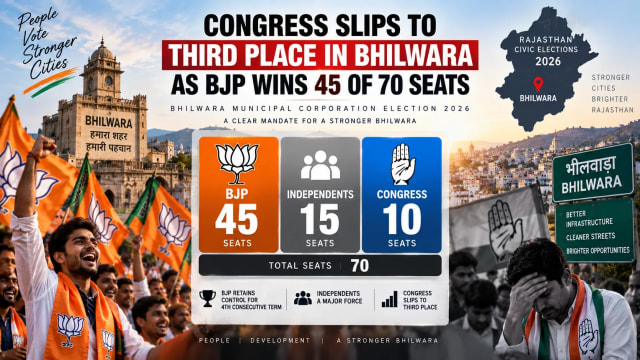
Bhilwara was similarly decisive.
BJP won 45 of 70 wards, compared with just 10 for Congress.
Perhaps more strikingly, Independents won 15 seats—five more than Congress.
That left Congress in third place in the corporation.
These are examples where the description of a clear BJP victory is supported directly by the council arithmetic.
Bikaner Went the Other Way
Bikaner demonstrates why the statewide result should not be converted into a claim of uniform BJP dominance.
Congress won 42 of the corporation's 80 wards, enough for an outright majority.
BJP finished with 27, Independents won 10 and RLP took one.
Bikaner therefore produced almost the reverse political outcome from Udaipur or Bhilwara.
For Congress, it was one of the party's clearest victories among Rajasthan's major cities.
Ajmer Produced Another Important Congress Gain
Congress also emerged as the largest party in Ajmer, winning 37 of 80 wards.
BJP won 32 and Independents 11.
Congress did not reach the 41 seats needed for an outright majority, meaning post-election support becomes important.
But the result represented a substantial shift from the previous election, when BJP had won 48 seats and Congress 18, according to SEC-based reporting.
This is an important distinction:
Congress did not win an outright Ajmer majority, but it did finish ahead of BJP.
Calling Ajmer simply a BJP statewide “win” would therefore conceal a significant local reversal.
Pali Is Especially Interesting Because of Who Calls It Home
In Pali, Congress won 29 of 65 wards, becoming the largest party.
BJP won 21 and Independents 15.
Neither party reached the 33 seats needed for a majority.
Pali is also the hometown of Rajasthan BJP president Madan Rathore, adding political attention to the result.
Still, the safest conclusion is numerical: Congress finished first but needs additional support to control the corporation.
The result itself does not establish why voters chose as they did.
Jodhpur Was Almost Perfectly Split
Few results demonstrate Rajasthan's competitiveness better than Jodhpur.
BJP and Congress each won 44 seats in the 100-member corporation.
Independents won 10 and RLP one, while one ward remained undecided in the tally reported after counting.
Neither BJP nor Congress could reach the 51-seat majority mark on its own.
In a corporation divided almost exactly between the two major parties, Independent councillors consequently become central to the formation of the municipal administration.
That is very different from the straightforward majority BJP achieved in Bhilwara or Congress achieved in Bikaner.
Bharatpur May Be the Election's Most Unusual Big-City Result
The most striking rejection of the BJP-Congress binary came in Bharatpur Municipal Corporation.
Independent candidates dominated the 65-member corporation.
Current reporting based on the results puts Independents and other non-major-party candidates far ahead of both BJP and Congress, with BJP winning 20 wards and Congress only seven.
The result attracted additional attention because Bharatpur lies within the broader political territory associated with Chief Minister Bhajan Lal Sharma.
But it would be inappropriate to treat the corporation result as a direct personal referendum on the Chief Minister without voter-level evidence demonstrating that motivation.
What the numbers establish is simpler: neither BJP nor Congress came close to dominating Bharatpur's corporation; Independents did.
AAP's Baran Result Shows Smaller Parties Also Found Openings
The election produced another result that deserves more attention.
The Aam Aadmi Party won 31 of the 60 seats in Baran Municipal Council, giving it a majority.
Congress won 18 seats, BJP nine and Independents two.
Across Rajasthan as a whole, AAP won only 42 wards.
That means the overwhelming majority of its statewide victories were concentrated in Baran.
This is a useful reminder that statewide totals can hide highly concentrated local strength.
A party can remain small statewide while becoming dominant in a particular municipal body.
BJP's Victory Was Broad, but Control of Local Bodies Is More Fragmented
Another way to examine the verdict is not simply to count wards but to ask how many local bodies gave a party an outright majority.
SEC-based reporting found BJP with a clear majority in 86 of Rajasthan's 309 urban local bodies, while Congress had outright majorities in 46.
Neither party had crossed the majority mark in 177 local bodies at that stage.
Among those bodies, BJP was ahead in 96, Congress in 69, and the two parties were tied in 12.
That produces a much more nuanced picture than the statewide ward total.
BJP was clearly ahead.
But more than half of the state's urban local bodies did not give either BJP or Congress an outright majority.
That makes coalition-building and Independent councillors unusually important in the next phase.
BJP and Congress Offered Different Interpretations
Chief Minister Bhajan Lal Sharma presented the result as an endorsement of the BJP government's performance.
He said voters had accepted the BJP's development agenda and expressed confidence in the party's governance.
Rajasthan Congress president Govind Singh Dotasra offered a different interpretation, pointing to the narrow statewide vote-share gap and arguing that BJP had not secured the scale of mandate it expected.
Those are political interpretations from the two parties.
Neither should be presented as an independently established explanation of voter behaviour.
The election results establish how people voted. They do not, by themselves, establish why millions of individual voters made those choices.
Congress Has Also Raised Allegations About Delimitation
Congress has alleged that ward delimitation disadvantaged the party and has challenged aspects of the electoral process.
Dotasra has argued that large variations in voter numbers between wards affected fairness, while Congress has sought recounting in a substantial number of wards. These remain Congress allegations and demands, not established findings that delimitation altered the statewide result.
Similarly, BSP chief Mayawati has alleged irregularities affecting some BSP candidates during recounts.
Those allegations have not been independently established by the election results themselves and should remain clearly attributed to the party making them.
What Can — and Cannot — Be Inferred About 2028
These elections inevitably attract attention because Rajasthan's next Assembly election is due in 2028.
But municipal elections and Assembly elections are different contests.
Urban local body elections are fought ward by ward and can be heavily influenced by candidate selection, local civic issues, neighbourhood networks and Independent candidates.
Assembly elections aggregate voters into much larger constituencies and are more directly shaped by state-level leadership, government performance and broader political issues.
The 2026 civic result therefore provides evidence about the parties' current urban organisational strength and voter support.
It does not establish how Rajasthan will vote in 2028.
Nor does the 0.94-point reported vote-share difference justify declaring either party the likely winner of a future Assembly contest.
The Most Useful Way to Read the Rajasthan Verdict
Rather than forcing the results into a single political narrative, the numbers support several factual conclusions at once.
BJP won the statewide contest. It secured the most wards—4,179—and finished 566 seats ahead of Congress.
The BJP-Congress popular-vote contest was much closer. Reported statewide figures put them at 35.18% and 34.24%, respectively, a gap of only 0.94 percentage point.
Independents were a major electoral force. Their 2,273 victories represent more than one-fifth of all wards.
The big cities did not move uniformly. BJP won clear majorities in Jaipur, Udaipur, Kota and Bhilwara; Congress controlled Bikaner and finished first without a majority in Ajmer and Pali; Jodhpur was effectively tied; and Bharatpur was dominated by Independents.
Smaller parties demonstrated pockets of concentrated strength. AAP's 31-seat majority in Baran is the clearest example.
Taken together, those numbers describe a BJP victory—but one occurring within a competitive and highly fragmented urban political landscape.
That distinction is more useful than either calling the result an across-the-board BJP sweep or attempting to reinterpret a clear BJP statewide lead as a Congress victory.
The numbers support neither description.
They show BJP first, Congress competitive, and Independents unusually consequential.