BRICS Opposes Unilateral Trade Measures as EU Carbon Border Tax Draws Scrutiny
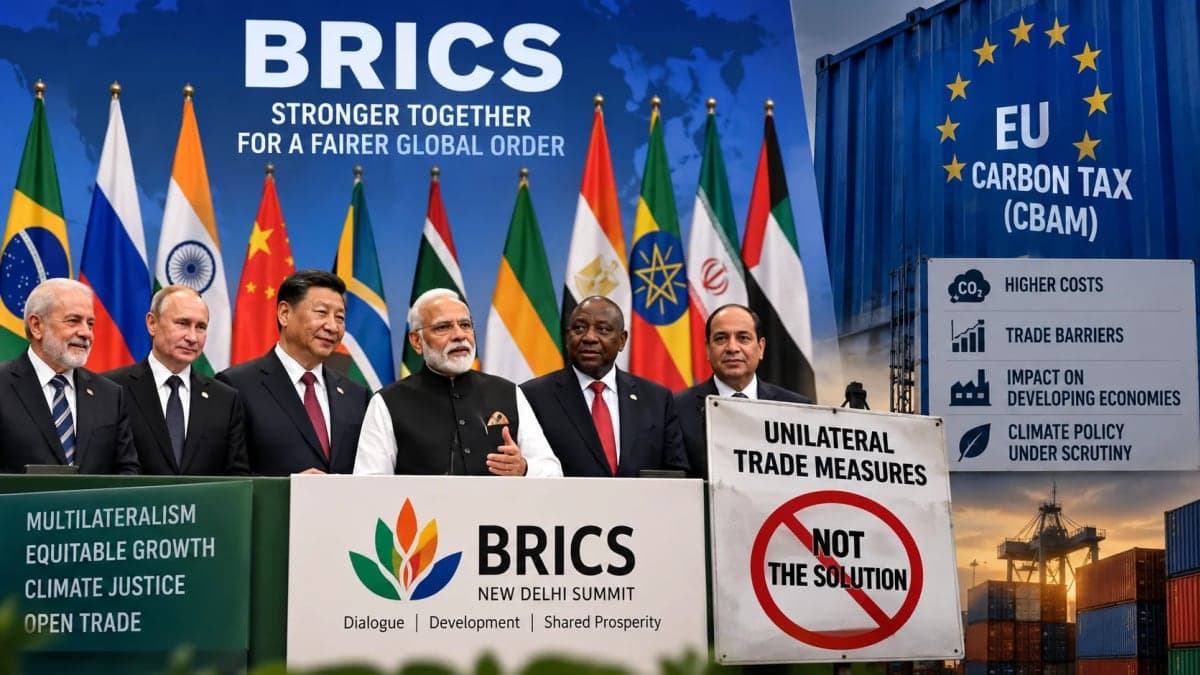
BRICS countries have sharpened their criticism of trade restrictions imposed outside multilateral frameworks, placing carbon-related border measures among the policies they say could disadvantage developing economies.
In the New Delhi Declaration adopted at the 18th BRICS Summit, members expressed concern over unilateral tariff and non-tariff measures and reiterated their support for a more open, predictable and rules-based international trading system.
The language brings the European Union's Carbon Border Adjustment Mechanism, or CBAM, into a broader argument over how climate policy should interact with global trade. For BRICS economies, the question is not simply how quickly emissions can be reduced, but whether the cost of that transition is being distributed fairly.
Carbon Policy Meets Trade Policy
The EU introduced CBAM as part of its climate strategy. The mechanism applies a carbon-related cost to imports of certain emissions-intensive products, with the aim of preventing European companies subject to domestic carbon pricing from being undercut by producers operating under less stringent carbon rules.
The system covers sectors including steel, aluminium and cement.
From Brussels' perspective, the measure is intended to prevent "carbon leakage", where production or investment moves to countries with weaker emissions constraints rather than producing a genuine reduction in global carbon output.
BRICS countries approach the issue differently. They have repeatedly argued that unilateral environmental measures should not become disguised restrictions on international trade, particularly when developing economies face higher financing costs and need substantial investment to modernise carbon-intensive industries.
That disagreement has made CBAM more than a technical climate instrument. It is now part of a larger dispute about competitiveness, development and who pays for the transition to lower-carbon production.
BRICS Backs Climate Action but Questions the Method
The declaration does not amount to a rejection of international climate commitments.
BRICS members reaffirmed their support for the Paris Agreement and stressed the importance of mitigation and adaptation. They also continued to press developed economies for finance and technology that could help poorer countries meet climate goals without compromising development priorities.
That distinction is central to the group's position.
BRICS is arguing that governments should pursue emissions reductions without using environmental policy as an unjustified trade barrier. Developing countries, in its view, should also have sufficient policy space to manage the transition according to their economic circumstances.
The debate therefore involves two objectives that do not necessarily conflict: cutting emissions and maintaining fair access to international markets. The disagreement lies in how those goals should be reconciled.
Developing Economies Face a Different Transition
For emerging economies, carbon-intensive industries remain closely tied to infrastructure, employment, manufacturing and exports.
Reducing their emissions can require expensive changes in energy supply, industrial processes and technology. Exporters may also have to build more sophisticated systems to calculate, document and verify the carbon footprint of products sold overseas.
Those costs matter for countries trying to expand manufacturing while simultaneously meeting climate commitments.
European policymakers argue that imported goods should face a carbon cost comparable with that imposed on domestic producers. Without such a mechanism, companies could shift production outside Europe while continuing to sell carbon-intensive products into the European market.
BRICS members have focused instead on the risk that unilateral measures could transfer part of the financial burden of developed-country climate policies to exporters in emerging markets.
The competing positions illustrate why carbon border measures have become one of the most difficult issues linking climate diplomacy and international commerce.
Fossil Fuels Remain Part of the Equation
Energy security adds another layer to the debate.
The BRICS declaration recognised that fossil fuels are likely to remain part of the global energy mix, particularly in developing economies where governments must balance decarbonisation with affordability, industrial growth and reliable access to energy.
That does not remove renewable energy from the group's agenda. Instead, BRICS has framed the transition as one that will proceed at different speeds and through different energy mixes depending on national circumstances.
Critical minerals are increasingly important to that calculation. Expanding renewable power, battery storage, electric vehicles and other clean technologies requires large quantities of minerals and significant investment in supply chains.
For resource-rich BRICS members, the clean-energy transition is therefore also an industrial and economic opportunity.
The Dispute Predates the New Delhi Summit
BRICS criticism of climate-linked trade restrictions did not begin in New Delhi.
At the 2025 summit in Rio de Janeiro, the grouping raised objections to unilateral trade measures introduced under environmental justifications. The issue subsequently remained part of discussions among BRICS governments and ministers.
Its appearance in the New Delhi Declaration gives the subject greater political weight at a time when climate regulations are increasingly influencing international trade.
The broader concern among BRICS governments is that rules created by individual economies or regional blocs can have substantial effects well beyond their borders.
That argument extends beyond CBAM. BRICS has also criticised unilateral economic restrictions and secondary sanctions while calling for greater reliance on multilateral institutions.
A Larger Debate Over Global Economic Rules
The disagreement with the EU fits into a much wider BRICS agenda.
The grouping has sought greater influence for emerging economies in institutions that shape global finance, development and trade. Calls for reform of the International Monetary Fund and World Bank form part of that effort, as does BRICS' support for stronger representation of developing countries in international decision-making.
Its expansion has increased the weight behind those demands.
BRICS began with Brazil, Russia, India, China and South Africa. Its membership has since expanded to include Egypt, Ethiopia, Indonesia, Iran and the United Arab Emirates, bringing together major commodity producers, manufacturing economies and rapidly growing consumer markets.
Their interests are not identical, and BRICS does not operate as a conventional political or economic bloc with a single policy on every issue. Trade restrictions, development finance and the distribution of climate costs, however, provide areas where members have found substantial common ground.
Why the Carbon Border Debate Matters
CBAM exposes a problem that governments are likely to encounter more often as climate policy becomes embedded in trade rules.
Countries with aggressive carbon-pricing systems want to prevent domestic industries from losing competitiveness to producers facing lower environmental costs. Developing economies want to retain access to major export markets without being required to absorb costs created by policies they had little role in designing.
Both pressures are likely to intensify as governments pursue deeper emissions reductions.
For exporters, the practical consequences could include investment in cleaner manufacturing, more detailed emissions accounting and changes to supply chains. Governments may also have to decide whether domestic carbon policies need to evolve as major markets impose stricter environmental conditions on imports.
The New Delhi Declaration places BRICS firmly in that discussion. Its message is that climate action should continue, but the transition should not give individual economies a free hand to reshape international trade in ways that developing countries consider discriminatory or protectionist.
The argument over Europe's carbon border mechanism is therefore about more than a tax on selected imports. It has become part of a broader contest over who writes the economic rules of the global energy transition, and how those rules account for countries starting from very different levels of development.