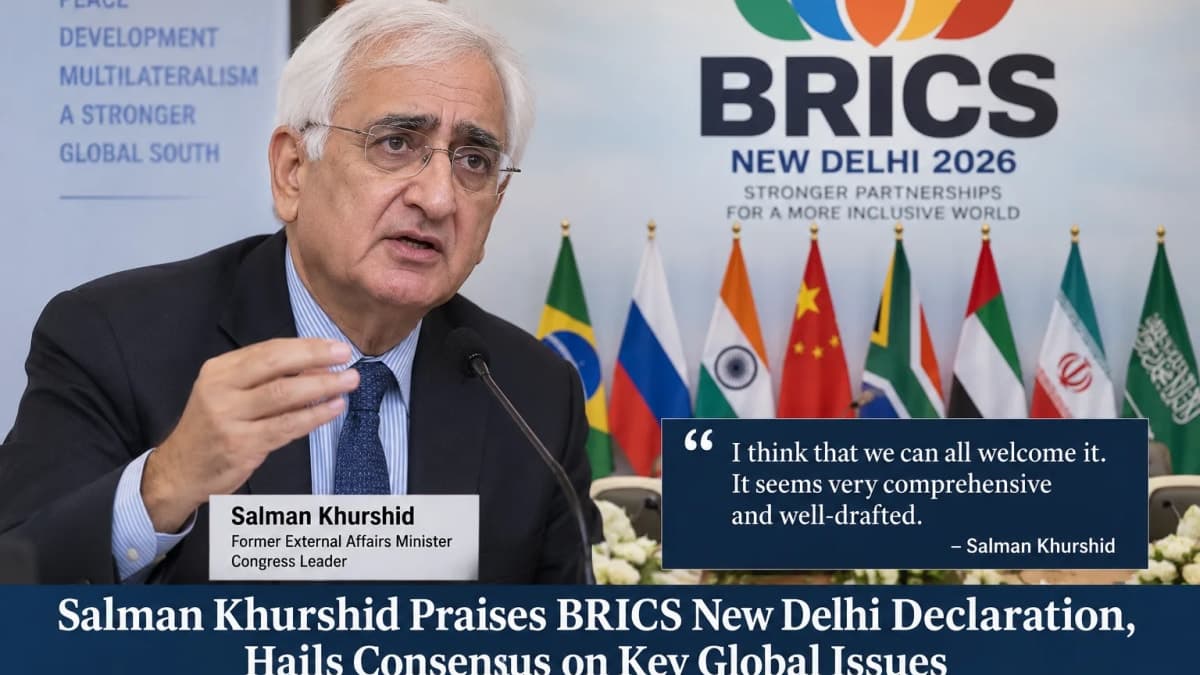
Former External Affairs Minister and Congress leader Salman Khurshid has welcomed the joint declaration adopted at the BRICS summit in New Delhi, praising the grouping for finding common ground despite differences among its members on several sensitive international issues.
Khurshid described the declaration as comprehensive and well drafted. More significantly, he pointed to the consensus behind it — an outcome that required countries with different strategic interests and foreign-policy priorities to agree on language covering security, regional conflicts, terrorism and economic concerns.
“I think that we can all welcome it. It seems very comprehensive and well-drafted,” Khurshid told ANI while responding to the declaration.
His remarks came after BRICS leaders adopted the New Delhi Declaration during the 18th BRICS Summit, held on September 12 and 13 under India's chairmanship.
Consensus Takes Centre Stage
For Khurshid, the significance of the declaration lies partly in the fact that all members were able to accept it.
That is increasingly difficult for an expanded BRICS. The grouping brings together countries whose interests overlap on some questions but diverge sharply on others, particularly regional security and relations with major Western powers.
Those differences were evident in discussions surrounding West Asia. With Iran and the United Arab Emirates both represented in BRICS, negotiators had to navigate competing regional concerns while attempting to preserve a collective position.
The final declaration called for maximum restraint and stressed dialogue, consultation and diplomacy as means of resolving international disputes.
The agreement therefore offered India, as summit host and BRICS chair, a tangible diplomatic outcome: members were able to settle on common language despite a difficult geopolitical environment.
Terrorism Features Prominently in Declaration
Counter-terrorism was another important element of the summit document.
The declaration condemned the terrorist attack in Pahalgam, Jammu and Kashmir, and reiterated a zero-tolerance approach towards terrorism. It also backed action against UN-designated terrorists and terrorist organisations and called for progress on the Comprehensive Convention on International Terrorism.
Khurshid welcomed the treatment of terrorism in the declaration, including its references to the Pahalgam attack and cross-border terrorism.
For New Delhi, such language carries particular weight. India has for years pushed international forums to adopt stronger and more consistent positions against terrorism, including the infrastructure and networks that support it.
BRICS Seeks Common Ground on West Asia
The summit unfolded against continuing instability in West Asia, making the wording of the declaration especially sensitive.
BRICS members expressed concern over the deteriorating regional situation and urged restraint. Rather than endorsing further confrontation, the declaration placed emphasis on diplomacy and negotiated solutions.
The Palestinian issue also featured in the discussions, with the grouping supporting a two-state solution.
Reaching agreement on these issues required accommodation among governments with substantially different regional relationships. The resulting language does not erase those differences, but it establishes a position that every member was prepared to accept.
That distinction is important. BRICS does not function as a political or military alliance in which members are expected to hold identical foreign-policy positions. Its declarations are negotiated among governments whose national interests can differ considerably.
Trade Measures and the Global Economic Order
Economic concerns occupied another part of the declaration.
BRICS members criticised unilateral tariff and non-tariff measures and raised concerns about their effects on international trade. The issue fits into the grouping's wider argument that developing and emerging economies should have a stronger voice in institutions that shape global economic policy.
That agenda has become more prominent as BRICS has expanded.
A larger membership gives the grouping greater economic and geopolitical reach, but it also makes internal coordination harder. Countries enter negotiations with different trade relationships, political priorities and security concerns.
The New Delhi declaration therefore serves two purposes: it records agreed positions on immediate international issues while also showing how much common ground the expanded organisation can still find.
India Uses Chairmanship to Push Global South Agenda
India has used its 2026 BRICS chairmanship to argue for greater representation of developing economies in global governance.
At the summit, Prime Minister Narendra Modi said the Global South should play a larger role in shaping international rules and institutions rather than simply operating within frameworks created elsewhere.
The argument is consistent with India's broader effort to position itself as a voice for developing countries while maintaining working relationships across competing geopolitical blocs.
Hosting BRICS presents its own challenge. India must advance its priorities while helping a diverse collection of governments reach positions acceptable to all of them.
The adoption of a joint declaration gave New Delhi a concrete result from that process.
Why Khurshid's Reaction Matters
Khurshid's response is notable because it came from a senior opposition figure and a former foreign minister with direct experience of international diplomacy.
His assessment concentrated less on domestic political competition and more on the substance of the summit outcome. By describing the declaration as comprehensive and emphasizing its consensus, he acknowledged the difficulty involved in producing a common document from an increasingly diverse grouping.
BRICS has grown well beyond its original five-member structure. Expansion has strengthened its claim to represent a substantial part of the developing world, but greater diversity also complicates decision-making.
That tension will continue to shape the organisation. Its influence will depend not simply on the number or economic weight of its members, but on whether those governments can convert shared interests into workable positions when their priorities differ.
The New Delhi Declaration provides one example of that process. On terrorism, West Asia, trade and global governance, members found enough common ground to produce an agreed text — the achievement at the centre of Khurshid's positive assessment.