MK Stalin Hits Back at CM Vijay Over Assembly ‘Reels’, Reopens MISA-Era Row
Introduction
The political confrontation between Tamil Nadu Chief Minister C. Joseph Vijay and DMK president M.K. Stalin has moved beyond an Assembly exchange into a larger argument over governance, political history and the conduct expected inside the legislature.
Responding to Vijay’s recent remarks in the Assembly, Stalin accused the actor-turned-politician of treating government like a film production and using social-media reels to distract from what he described as administrative failures.
But Stalin’s response was not confined to Vijay’s communication style. He also returned to a much older chapter of Tamil Nadu politics: his arrest under the Maintenance of Internal Security Act during the Emergency and the violence he says he suffered in custody.
The combination turned an argument about Assembly conduct into a dispute over who gets to define the DMK’s political history.
Stalin Targets Vijay’s ‘Reels’ Politics
In a video response released on Thursday, Stalin accused Vijay of placing publicity ahead of governance.
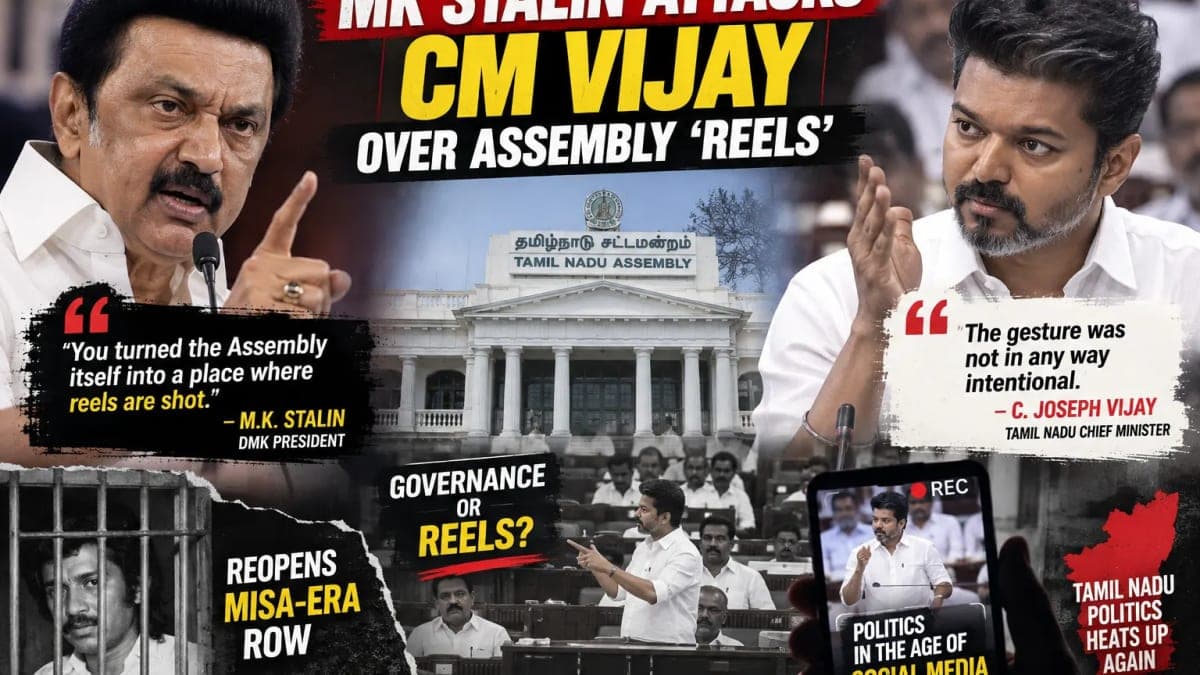
“You turned the Assembly itself into a place where reels are shot,” Stalin said, also accusing Vijay of conducting photoshoots on infrastructure built under the previous government.
Stalin went further, comparing the functioning of the administration to a cinema shoot. He alleged that the government was publishing reels to conceal its shortcomings and misleading a generation through carefully constructed publicity.
Those are political allegations from the DMK leader, rather than independently established findings about the Vijay government’s performance.
The language nevertheless reflects an increasingly important line of attack against Vijay. His background as one of Tamil cinema’s biggest stars gives opponents an obvious political target: the suggestion that the techniques that work in films and mass publicity are being carried into government.
The Dispute Began With Vijay’s MISA Remarks
Behind the argument over reels is a more personal controversy.
During recent proceedings in the Tamil Nadu Assembly, Vijay referred to the Emergency-era Maintenance of Internal Security Act, or MISA, while attacking the DMK. A hand movement he made during the exchange was widely interpreted as a reference to an injury Stalin suffered during his imprisonment.
Vijay subsequently said the gesture was involuntary and “not in any way intentional”.
Stalin has now responded directly.
Addressing the Chief Minister as “Thambi Vijay”, or younger brother Vijay, the DMK president said his party’s opposition to the Emergency and his own imprisonment were matters of historical record.
“History can never be changed,” he said.
Stalin Revisits His 1976 Arrest
Stalin used the controversy to recount events surrounding his detention during the Emergency.
He said his father, then Chief Minister M. Karunanidhi, had organised opposition to the Emergency and MISA. The DMK government was dismissed on January 31, 1976, after which police arrived at the family’s Gopalapuram residence to arrest Stalin under MISA.
Stalin has long maintained that he was assaulted while imprisoned. In his latest response, he again described the physical abuse he says he endured in custody and referred to injuries from the period.
His account shifts the argument away from the gesture itself and towards the historical episode Vijay's remarks invoked.
The DMK has treated its opposition to the Emergency as an important part of its political history. Vijay’s intervention therefore touched not only on Stalin’s personal experience but also on a narrative the party has carried for decades.
Assembly Decorum Becomes Part of the Fight
Stalin also argued that a Chief Minister’s words and body language should reflect the dignity of the office.
That criticism has found support outside the DMK. VCK chief Thol Thirumavalavan criticised Vijay’s gesture as disrespectful, adding another voice to the controversy over his conduct in the House.
The row comes amid an already confrontational Assembly session. DMK legislators recently staged a walkout after Speaker J.C.D. Prabhakar denied Leader of the Opposition Udhayanidhi Stalin an opportunity to respond to corruption allegations made by Vijay against figures from the previous DMK administration.
The latest clash therefore forms part of a wider deterioration in relations between the ruling TVK and the principal Opposition.
Vijay’s Cinema Career Becomes a Political Battleground
Vijay’s transition from cinema to electoral politics inevitably makes his public style part of the political contest.
His screen career gave him enormous visibility before he entered government. His opponents are now trying to turn that strength into a vulnerability by arguing that presentation has taken precedence over administration.
Stalin’s repeated references to reels, photoshoots and cinema are designed around that distinction.
Vijay and his supporters, meanwhile, have used the Assembly to challenge the record of previous DMK governments, including through corruption allegations and references to past controversies. Stalin has rejected those attacks and accused Vijay of distorting history for political purposes.
A Fight Over the Past — and the Government of the Present
The significance of the latest exchange lies in how quickly it moved across different political terrain.
It began with an Assembly gesture. It expanded into a dispute over Stalin’s imprisonment during the Emergency. It then became an argument over whether Vijay is governing Tamil Nadu or merely producing an effective political image of governing it.
For the DMK, revisiting MISA allows Stalin to emphasise a period of political struggle central to his own biography and his party’s history.
For Vijay, the larger challenge is different. As a film star who made the transition to Chief Minister, his administration will repeatedly face scrutiny over whether his considerable skills in mass communication are matched by its record in government.
That is the political fault line Stalin is now trying to exploit.