BJP Turns From Summit Diplomacy to Political Outreach
NEW DELHI: The foreign leaders have left New Delhi and the 18th BRICS Summit has concluded. For the Bharatiya Janata Party, however, the political work around the event is just beginning.
The BJP is preparing to fold the summit into its domestic outreach, presenting India’s hosting of BRICS as evidence of the country’s growing diplomatic weight under Prime Minister Narendra Modi.
That effort comes at a useful point in the political calendar. Assembly elections are due in several states in 2027, and the party is preparing a month-long public outreach programme beginning September 17, Modi’s birthday.
The summit gives the BJP fresh material for a familiar argument: that India has acquired a stronger voice internationally during Modi’s tenure.
The challenge will be turning that claim into something that matters to voters beyond the immediate spectacle of a global summit.
Why BRICS Offers the BJP a Strong Political Visual
India hosted the 18th BRICS Summit in New Delhi on September 12 and 13 under the theme “Building for Resilience, Innovation, Cooperation and Sustainability.”
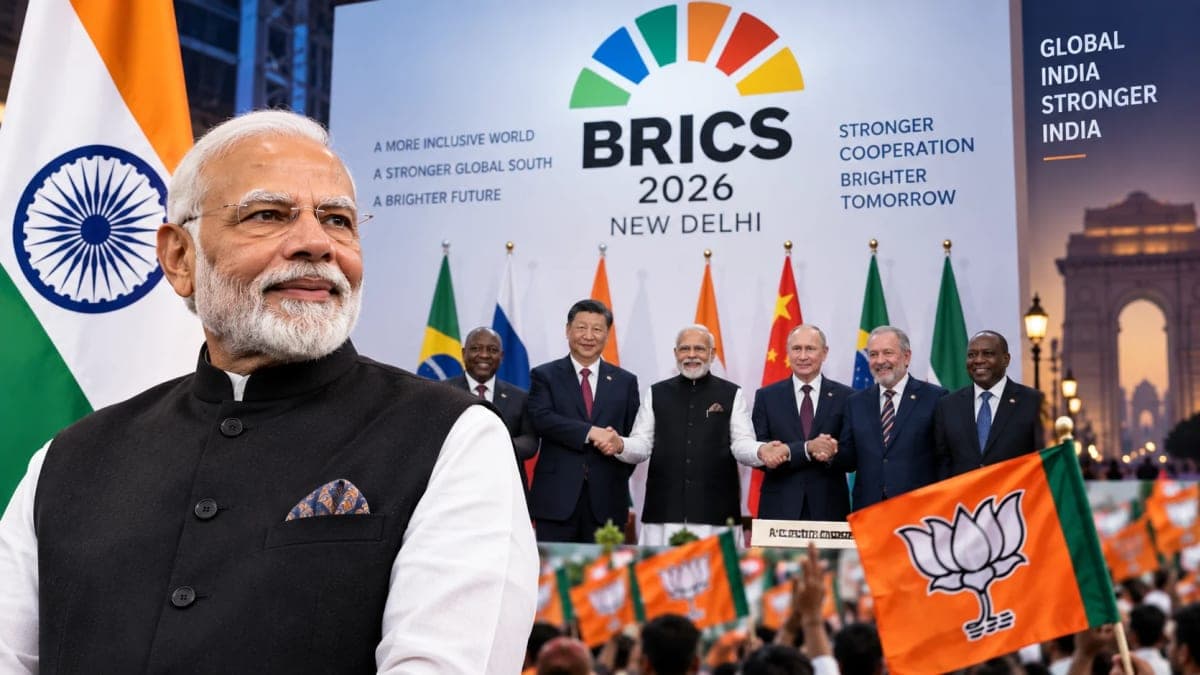
The gathering brought major international leaders to the capital, including Chinese President Xi Jinping and Russian President Vladimir Putin.
For the BJP, images of Modi receiving and negotiating with powerful world leaders have value well beyond foreign-policy circles. They reinforce the political identity the party has built around him as a leader able to command attention internationally.
Senior BJP leader Ravi Shankar Prasad had already described India as a “shining star of BRICS,” linking its international position with its economic performance.
That framing is likely to feature prominently in the party’s post-summit campaign.
It also fits a communication strategy the BJP has used repeatedly: translate complicated diplomatic events into a simpler message about national stature and leadership.
New Delhi Declaration Gives the Campaign Substance
The BJP’s case does not rest only on summit imagery.
BRICS members adopted the New Delhi Declaration, providing India with a concrete diplomatic outcome from a grouping whose members often have sharply different strategic interests.
The declaration covered economic cooperation, international governance, security, technology and stronger representation for developing economies.
For the government, reaching consensus across an expanded BRICS membership supports its argument that India can work with countries that do not necessarily share the same geopolitical outlook.
The BJP can now take that diplomatic outcome into its political messaging without having to rely solely on ceremonial photographs or bilateral meetings.
Terrorism Could Become One of the Main Talking Points
The declaration’s language on terrorism is particularly useful to the BJP.
BRICS leaders condemned terrorism in all its forms and manifestations and said terrorism should not be associated with any religion, nationality, civilisation or ethnic group.
National security has long occupied an important place in the BJP’s electoral politics, so the party has an obvious incentive to give this portion of the declaration greater prominence during its outreach.
There is an important distinction, however. The declaration’s language is a documented diplomatic outcome. Claims about how much credit the BJP or Modi should receive for it belong to the political contest that follows.
Modi’s Global South Pitch Fits a Larger BJP Story
Another theme likely to travel from the summit stage into domestic politics is Modi’s argument about the Global South.
During the summit, the prime minister said developing countries should move from being global “rule-takers” to “rule-shapers.” He also criticised what he called a “pyramid of privilege” in international institutions and argued for reforms that give emerging economies greater influence.
For the BJP, that message serves two audiences at once.
Internationally, it positions India as an advocate for developing economies. At home, it supports the party’s claim that the country is no longer content merely to participate in institutions shaped by established powers.
The New Delhi Declaration’s calls for more representative global governance give the BJP an official multilateral document to place alongside that political narrative.
The Xi Meeting Is More Complicated
Not every part of the summit offers the BJP an uncomplicated political advantage.
Modi’s meeting with Chinese President Xi Jinping was one of its most closely watched events. Xi’s trip was his first to India in seven years and came after a prolonged period of strain in bilateral relations following the 2020 border confrontation.
The two leaders discussed the boundary, economic ties and other issues affecting the relationship. India has continued to stress that peace and tranquillity along the border are essential to the broader relationship.
For the government, renewed high-level engagement can be presented as evidence that India is managing a difficult neighbour through diplomacy while protecting its interests.
Congress sees an opening in precisely the same meeting.
The opposition party has challenged Modi over the border situation, China’s relationship with Pakistan and India's large trade deficit with China. Congress leader Jairam Ramesh has described the government’s approach as “calibrated capitulation.”
That means the Xi meeting is likely to produce competing political narratives rather than an uncontested BJP success.
BJP Wants the Summit to Reach Younger Voters
The party is also looking at the BRICS moment through the lens of younger voters.
International diplomacy now produces highly shareable political content: handshakes, leader-to-leader conversations, motorcades, summit photographs and short clips that can circulate across Instagram, YouTube and other platforms without requiring voters to follow the substance of a lengthy declaration.
That plays to the BJP’s established digital operation.
Political analyst R.K. Verma told The New Indian Express that the summit could help restore excitement around Modi’s leadership, particularly among younger voters. But he also pointed to the limitation of such a strategy: global stature has to be connected with their aspirations.
That is where the BJP’s task becomes harder.
A summit photograph can communicate status. It cannot, by itself, answer questions about jobs, income or economic opportunity.
September 17 Campaign Provides the Next Stage
The party will not have to wait long to test its message.
The BJP is preparing a month-long outreach campaign beginning on September 17, Modi’s birthday, aimed at different sections of society.
BRICS is expected to become one strand of that wider exercise.
The party has several themes available to it: India's international standing, the terrorism language in the New Delhi Declaration, Modi’s advocacy for the Global South and the government’s portrayal of India as an increasingly important economic and diplomatic power.
What matters politically is how those themes are translated.
Voters are unlikely to spend much time parsing the language of a multilateral declaration. A campaign instead has to connect international influence with more tangible ideas such as investment, economic growth, national security, technology and employment.
Congress Is Trying to Deny BJP a Clean Victory Lap
The opposition has already begun contesting the BJP’s interpretation of the summit.
Its criticism has ranged from substantive questions about China to a row over the all-vegetarian menu served at the summit dinner. BJP leaders responded to the latter by accusing Congress of indulging in “menu politics.”
The exchange shows how quickly BRICS has moved from foreign policy into partisan competition.
Congress has an incentive to shift attention away from the optics of Modi alongside world leaders and towards unresolved policy questions, particularly involving China.
The BJP has the opposite incentive: keep the focus on India's ability to host an influential international grouping, produce a consensus declaration and bring competing powers to the same table.
The argument is therefore less about whether the summit happened successfully than about what voters should conclude from that success.
Foreign Policy Has Become Domestic Political Material
The BJP’s approach to BRICS reflects a broader change in Indian political communication.
International engagements were once largely discussed through diplomacy, security and trade. They now routinely enter election campaigns.
The Modi government has been especially willing to connect foreign-policy events with a wider story about national confidence and India's place in the world.
That strategy was visible during India's G20 presidency and in the political communication surrounding major bilateral visits. BRICS offers another opportunity, although in a different geopolitical setting.
The expanded grouping includes China and Russia while also giving India a platform to advocate for developing economies. That allows the BJP to present Modi as a leader capable of dealing with competing centres of global power without placing India firmly inside any one bloc.
But Foreign Policy Does Not Replace State-Level Politics
The political value of BRICS should not be confused with proof of an electoral effect.
Assembly elections are shaped by state-specific factors that international diplomacy cannot erase. Candidate selection, alliances, caste and community equations, welfare programmes, inflation, employment and the performance of state governments can all carry greater weight.
The BJP therefore does not need BRICS to become the dominant election issue for it to be useful.
Its value may instead lie in strengthening an existing perception of Modi: a national leader whose political appeal extends beyond the everyday competition of state politics.
That can reinforce the BJP’s broader campaign without deciding the election on its own.
The Real Test Is Connecting Global Influence With Everyday Gains
The BJP now has a short window in which the summit remains fresh in public memory.
Its strongest argument is straightforward: India hosted an increasingly important international grouping, secured a consensus declaration and placed issues such as terrorism, Global South representation and institutional reform on the agenda.
Its harder task is explaining why any of that should matter to a voter thinking about work, prices, income or local governance.
If the party can connect India's diplomatic reach with investment, jobs, security and economic opportunity, BRICS could become a useful part of its campaign architecture.
If the message stops at photographs of Modi with global leaders, its political reach may be narrower.
Either way, the summit has already moved into India's domestic political contest. The diplomatic meetings ended on September 13. The battle over what they mean has not.