हिंदी में पढ़ें —JantaScope हिंदी
AI NEWS

Bristol Myers Squibb Expands AI Ambitions With Nvidia Supercomputer for Faster Drug Discovery.

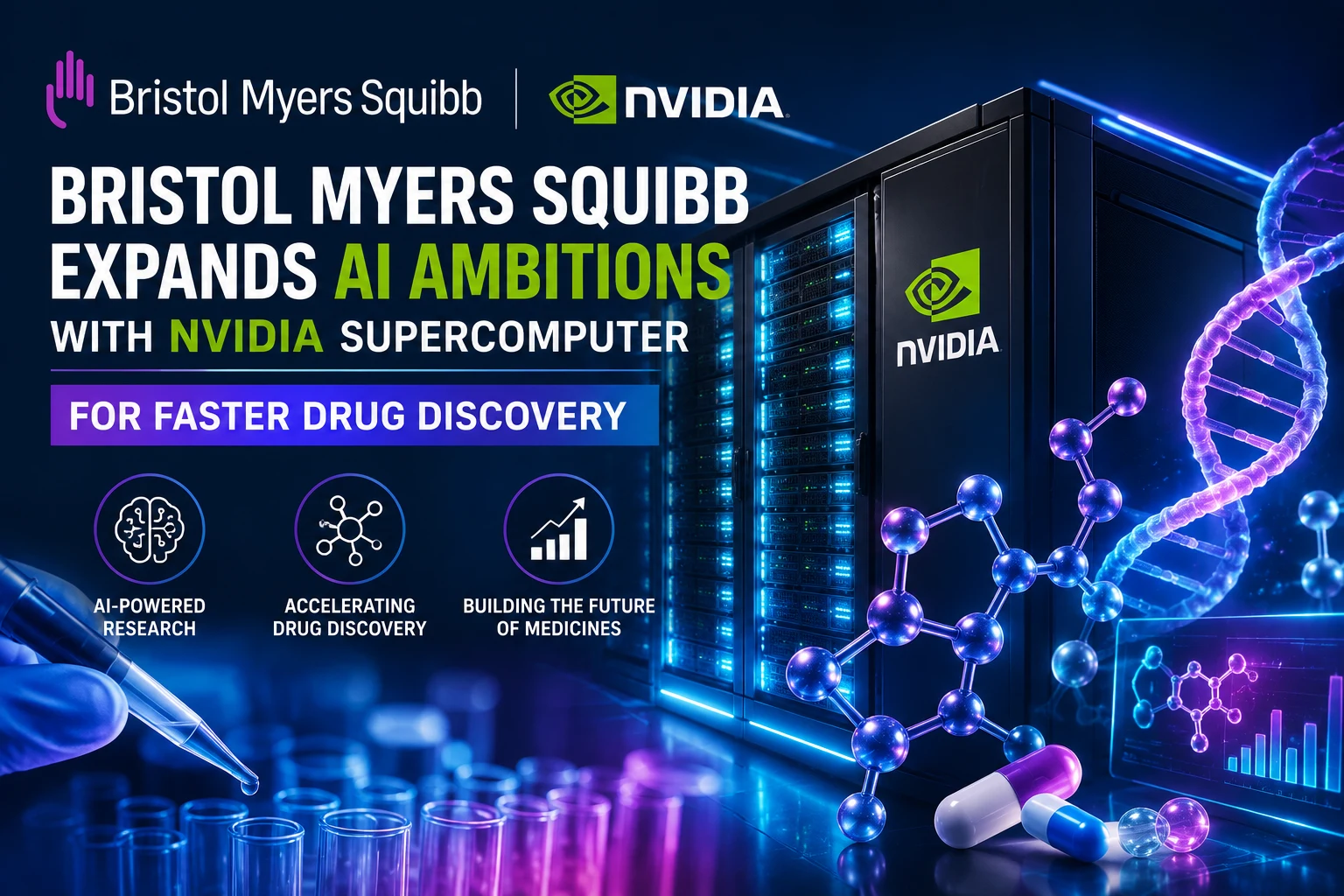
Global pharmaceutical company Bristol Myers Squibb (BMS) has strengthened its artificial intelligence strategy by becoming the first life sciences company to acquire Nvidia’s latest DGX SuperPOD powered by the Vera Rubin architecture. The advanced computing platform is expected to accelerate drug discovery, improve research efficiency, and enable the development of more sophisticated AI models across the company's pharmaceutical pipeline.

Bristol Myers Squibb Expands AI Ambitions With Nvidia Supercomputer for Faster Drug Discovery.

By Jeet Nirmal

Source: Janta Scope

Bristol Myers Squibb Invests in Nvidia’s Latest AI Infrastructure

Bristol Myers Squibb has announced a major investment in next-generation AI computing infrastructure by purchasing Nvidia’s newest DGX SuperPOD system based on the Vera Rubin architecture. The pharmaceutical company said the platform will significantly expand its ability to apply artificial intelligence throughout drug discovery and development.

The acquisition marks a milestone for both companies, with BMS becoming the first organization in the life sciences sector to deploy Nvidia’s newest AI system.


AI to Accelerate Drug Discovery and Research

The company plans to use the enhanced computing capacity to train larger proprietary AI models capable of identifying promising drug candidates more efficiently.

According to Bristol Myers Squibb, AI is already integrated into all of its small-molecule research programs and most large-molecule development efforts. The expanded computing infrastructure will allow researchers to process increasingly complex biological data while reducing the time needed to evaluate potential medicines.

Executives also noted that AI has already helped shorten parts of the company's drug development timeline, with expectations that future advances could further improve research productivity.


Why Nvidia’s Vera Rubin Platform Matters

Nvidia introduced the Vera Rubin architecture as its latest generation of AI computing technology, offering substantial improvements in performance and energy efficiency compared with previous systems.

Bristol Myers Squibb said the new infrastructure delivers dramatically greater computing performance per unit of energy, enabling scientists to run larger AI workloads without proportionally increasing power consumption.

The investment builds on an earlier Nvidia SuperPOD system already used by the company, representing a significant leap in computing capability.

Growing Role of Artificial Intelligence in Pharmaceuticals

Artificial intelligence is rapidly becoming an essential tool across the pharmaceutical industry.

Drug developers increasingly rely on AI to analyze massive biological datasets, predict molecular behavior, identify promising compounds, optimize clinical trial design, and improve the efficiency of research pipelines. These technologies have the potential to reduce both development costs and the time required to bring new medicines to patients.

Major pharmaceutical companies have accelerated investments in AI partnerships and dedicated computing infrastructure as competition intensifies in data-driven drug discovery.


Why This Development Matters

Developing a new medicine traditionally requires years of laboratory research, multiple clinical trial phases, and billions of dollars in investment. By expanding its AI capabilities, Bristol Myers Squibb aims to identify viable drug candidates more quickly and improve decision-making throughout the research process.

If successful, the approach could accelerate the delivery of treatments for complex diseases while making pharmaceutical research more efficient.


Balanced Analysis

The announcement reflects the pharmaceutical industry's growing confidence that advanced AI infrastructure can transform biomedical research. High-performance computing allows researchers to explore far more potential drug candidates than traditional methods alone.

However, AI remains a tool rather than a replacement for scientific validation. Promising AI-generated discoveries must still undergo extensive laboratory testing, clinical trials, and regulatory review before becoming approved medicines. While AI can improve efficiency, it does not eliminate the need for rigorous scientific evaluation.


Conclusion

Bristol Myers Squibb's decision to deploy Nvidia's latest DGX SuperPOD represents another significant step in the convergence of artificial intelligence and pharmaceutical innovation. As AI becomes increasingly embedded in biomedical research, investments in advanced computing infrastructure are likely to play a growing role in shaping the future of drug discovery and accelerating the search for new treatments.


Related

More stories

Fake ChatGPT, Claude and Gemini Apps Are Spreading Malware — Users Warned About AI Impersonation Threats

Cybercriminals are increasingly disguising malicious software as popular AI services such as ChatGPT, Claude and Gemini. Kaspersky says its security systems detected more than 92,000 attacks involving malware or potentially unwanted applications masquerading as AI services between January and early May 2026, highlighting the growing security risks surrounding the rapid adoption of artificial intelligence.

AI NEWS

Fake ChatGPT, Claude and Gemini Apps Are Spreading Malware — Users Warned About AI Impersonation Threats

IIT Madras Builds AI Platform With 185,000 Alloy Records, Targets Faster Discovery of Greener Materials

Researchers at IIT Madras have developed an artificial intelligence-driven platform designed to accelerate the discovery of sustainable, high-performance metallic alloys. The project has produced two databases containing more than 185,000 structured records, extracted from over 10,000 scientific papers, with potential applications spanning electric vehicles, aerospace, renewable energy and marine infrastructure.

AI NEWS

IIT Madras Builds AI Platform With 185,000 Alloy Records, Targets Faster Discovery of Greener Materials

Meta Hires OpenAI Veteran Luke Metz for Superintelligence Labs in Major AI Talent Push

Meta has hired prominent artificial intelligence researcher Luke Metz to join its Superintelligence Labs. Metz, who previously worked at OpenAI and Mira Murati’s Thinking Machines Lab, is expected to report to Alexandr Wang as Meta continues strengthening its team in the intensifying race to develop advanced AI systems.

AI NEWS

Meta Hires OpenAI Veteran Luke Metz for Superintelligence Labs in Major AI Talent Push

Nvidia Is No Longer Just an AI Chip Giant — Its Push Into AI Models Is Getting Much Bigger

Nvidia is expanding beyond the hardware that powered the generative-AI boom and strengthening its position in AI models, particularly through its Nemotron family and a major deal involving AI startup Poolside. The strategy could give Nvidia greater influence across the entire AI technology stack—from computing infrastructure to the models and agents running on top of it.

AI NEWS

Nvidia Is No Longer Just an AI Chip Giant — Its Push Into AI Models Is Getting Much Bigger

Anthropic’s $2 Trillion IPO Dream Could Rewrite Wall Street Records — Here’s Why Investors Are Watching

Artificial intelligence company Anthropic is moving closer to a potential stock-market debut that could become one of the largest IPOs ever. Investors are reportedly discussing a valuation of around $2 trillion or more, highlighting extraordinary expectations surrounding the company behind the Claude AI models.

AI NEWS

Anthropic’s $2 Trillion IPO Dream Could Rewrite Wall Street Records — Here’s Why Investors Are Watching

Meta’s AI Talent War Heats Up Again as OpenAI Veteran Luke Metz Makes the Switch

The battle for the world’s most sought-after artificial intelligence researchers is intensifying again. Meta has hired veteran AI researcher Luke Metz, adding another former OpenAI talent to its expanding Superintelligence Labs operation. The move highlights how competition between leading AI companies is increasingly being fought not only through bigger models and computing infrastructure, but also through the recruitment of a relatively small group of researchers with experience building front

AI NEWS

Meta’s AI Talent War Heats Up Again as OpenAI Veteran Luke Metz Makes the Switch