China’s Pacific Missile Test Deepens Dispute Over Security, Sovereignty and Regional Influence
Introduction
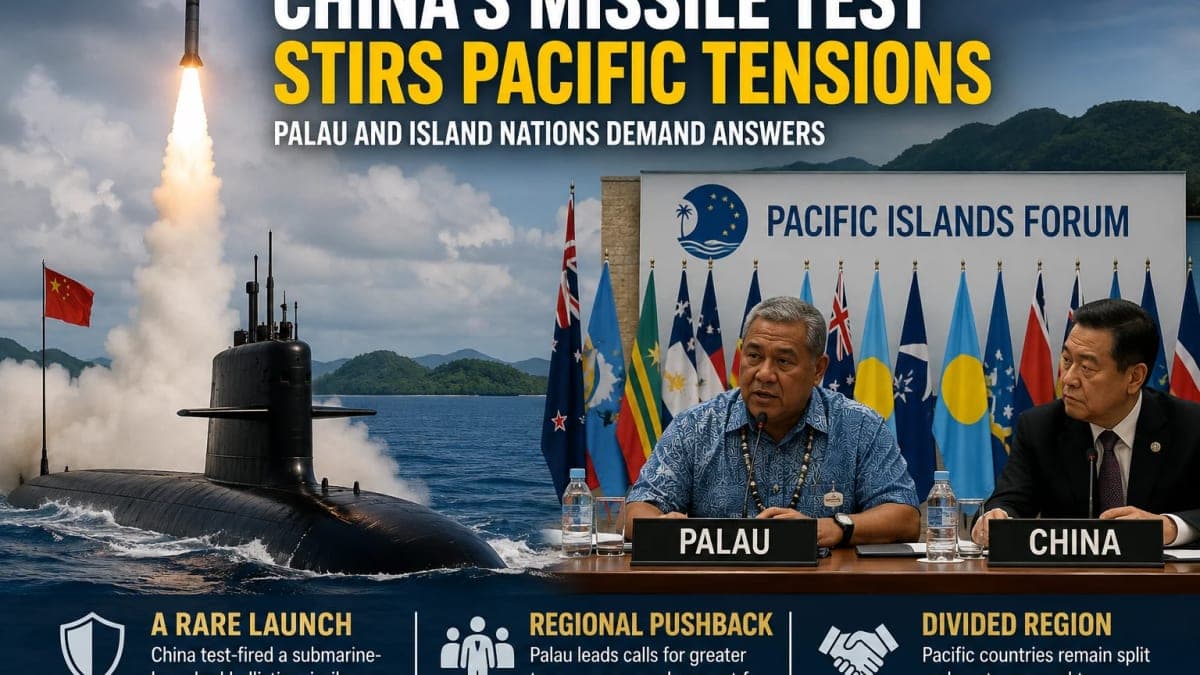
Two months after China fired a long-range ballistic missile into the Pacific, the argument over the launch has moved from military calculations to regional diplomacy.
For Palau, the concern is not simply that China tested a powerful weapons system. President Surangel Whipps Jr. wants Pacific governments to have a meaningful say when major powers conduct military exercises in waters central to the region’s security.
That demand has reached the Pacific Islands Forum, where Palau is seeking a stronger regional position on transparency and advance notification.
China sees the matter differently. Beijing says the July test was conducted safely, complied with international rules and was not directed at any country. It has accused Palau of overstating the episode and trying to rally other governments against China.
The dispute comes at a sensitive moment for the Pacific. China is expanding its regional relationships, the United States and Australia are strengthening their defence cooperation, and island governments are increasingly being asked to navigate strategic competition they did not create.
A Rare Missile Launch Draws Attention
China carried out the test on July 6 from a nuclear-powered People’s Liberation Army Navy submarine.
The long-range ballistic missile carried a dummy warhead, not a nuclear weapon or live explosive payload. It was launched at 12:01 p.m. local time, or 0401 GMT, toward international waters.
Chinese state media described the exercise as part of regular annual military training. Beijing also said relevant countries had received advance notification and stressed that the missile was not aimed at any particular nation.
What made the launch notable was its rarity.
It was China’s first known ballistic missile test into the Pacific since September 2024 and one of relatively few openly acknowledged Chinese long-range maritime missile tests in decades.
Analysts regard the missile system as capable of carrying a nuclear warhead. That does not mean China conducted a nuclear test. The missile used in July carried a dummy warhead, making the exercise a demonstration of the delivery system rather than a nuclear explosion.
The distinction matters, but it has done little to settle the political argument surrounding the launch.
For Pacific Governments, the Issue Is Also About Consultation
Some Pacific governments say the warning provided before the test was inadequate.
Their concern reflects the region’s particular history. Pacific island nations have spent decades dealing with the political, environmental and security legacy of nuclear and military activity carried out by larger powers.
Against that background, the use of Pacific waters for another major weapons test carries significance beyond the technical details of the launch.
Australia, New Zealand, the United States, Japan and Taiwan also raised concerns or criticised the Chinese exercise.
Palau has gone further by trying to turn those concerns into a regional position.
Whipps wants Pacific governments to demand clearer notification of future military tests and greater respect for the sovereignty of countries in the region. Australian Prime Minister Anthony Albanese has also criticised the Chinese launch.
The debate therefore involves two separate questions. One is whether China complied with international rules. The other is whether meeting those rules provides enough consultation for the governments closest to such military activity.
China Rejects Palau’s Case
Beijing has shown little willingness to accept Palau’s framing of the issue.
Chinese officials maintain that the exercise followed international law and established international practices. They have rejected claims that the launch should be viewed as evidence of a broader attempt to expand China’s military influence in the Pacific.
China has instead accused Palau of giving the missile test excessive attention and attempting to influence other regional governments.
The disagreement reflects an imbalance familiar to small Pacific states.
Their territories and surrounding waters occupy an increasingly important strategic position, yet they have limited influence over the military decisions of much larger countries.
Palau’s argument is essentially that geographic proximity should bring greater consultation. Beijing’s response is that a lawful exercise in international waters should not be turned into evidence of hostile intent.
Finding a regional position between those views is proving difficult.
Pacific Countries Are Not United on Beijing
The Pacific Islands Forum is often discussed as a single regional bloc, but its members have very different relationships with China.
Those differences became apparent before the Palau gathering.
At a meeting of Pacific foreign ministers in Fiji in August, members failed to agree on a joint statement criticising the missile launch. Reports indicated that Kiribati and Nauru were among the countries that objected to language critical of Beijing.
The disagreement reflects practical considerations as much as geopolitical ones.
China has become an important source of trade, infrastructure investment and development cooperation for a number of Pacific island nations. Other governments have particularly close security and political relationships with Australia, New Zealand and the United States.
Few countries in the region can afford to treat those relationships as simple choices between competing camps.
That makes agreement relatively easy when Pacific leaders call for greater regional sovereignty in principle. Consensus becomes much harder when that principle has to be applied to a specific major power.
Taiwan Complicates an Already Difficult Meeting
The missile dispute is not the only source of tension involving China at the Pacific Islands Forum.
Taiwan is another.
Palau is one of just three Pacific countries that maintain formal diplomatic relations with Taipei. Beijing regards Taiwan as part of China and opposes governments maintaining official diplomatic ties with the island.
China objected to Taiwanese representatives attending events associated with this year’s forum.
The gathering also attracted attention because several Pacific leaders did not attend personally. Leaders from Fiji, Vanuatu, Samoa and the Solomon Islands instead sent ministers or other senior representatives.
Their absence prompted speculation about whether diplomatic pressure had played a role, although the governments involved offered different explanations.
New Zealand Foreign Minister Winston Peters raised the possibility that outside interference could have influenced some of the absences, but stopped short of directly accusing China.
Beijing dismissed the suggestion as baseless.
The episode illustrates why the missile dispute cannot easily be separated from the wider contest for diplomatic influence across the Pacific.
An ‘Ocean of Peace’ in an Increasingly Strategic Region
Pacific leaders have been developing the idea of an “Ocean of Peace”, a vision intended to give the region’s own governments a stronger role in determining its security future.
That ambition is becoming harder to pursue as military competition grows.
China’s missile launch is one part of that picture. Australia and the United States are also deepening defence ties and expanding their military cooperation.
Under the AUKUS partnership, US Virginia-class submarines are expected to begin rotational deployments at HMAS Stirling in Western Australia from 2027.
Washington and Canberra have also announced an additional $580 million in joint assistance for Pacific island countries.
China has consistently opposed AUKUS, arguing that the agreement risks encouraging an arms race.
For Pacific governments, the challenge is broader than choosing how to respond to Beijing. They must decide how to apply demands for transparency, consultation and restraint to every major military power operating in the region.
The Missile Has Landed. The Political Argument Has Not.
China says its missile fell in international waters after a safe and lawful test. Palau does not dispute that the exercise involved a dummy warhead rather than a nuclear detonation.
Their disagreement lies elsewhere.
Palau and other concerned governments want more influence over military activity that takes place around their region, including earlier and more meaningful notification when powerful weapons systems are tested.
China, meanwhile, does not want a military exercise it considers legitimate to become part of the argument for a larger US and allied security presence in the Pacific.
Both positions feed into a larger problem facing the Pacific Islands Forum.
Its members want the region to have greater control over its own security agenda. But they have different economic relationships, diplomatic priorities and strategic partnerships, making it difficult to agree on how that principle should constrain China, the United States or anyone else.
The July missile launch brought those tensions into unusually sharp focus. The immediate military exercise ended within hours. The argument over who shapes the Pacific’s security environment is likely to last considerably longer.