China’s Spy Chief Warns AI Could Threaten Political Security, Critical Infrastructure and Sensitive Data
Introduction
China’s top intelligence official has delivered one of Beijing’s clearest warnings yet about the national-security risks created by rapidly advancing artificial intelligence.
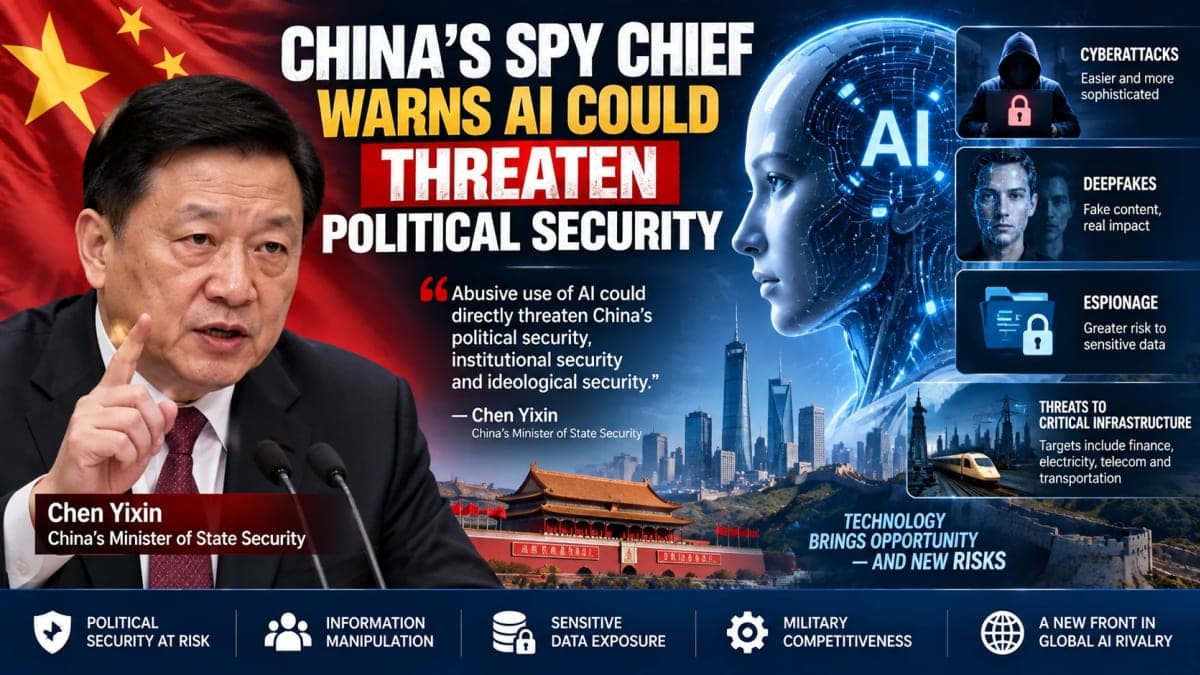
Chen Yixin, China’s Minister of State Security, warned that AI could be exploited by adversaries to undermine political stability, conduct espionage, manipulate information and target critical infrastructure.
In an article published in the state-run China Cyberspace magazine, Chen said abusive use of AI could “directly threaten China’s political security, institutional security and ideological security.”
The warning is significant because China simultaneously considers artificial intelligence a strategic technology essential to economic development, military capability and competition with the United States.
Rather than calling for China to retreat from AI development, Chen’s argument points toward a different strategy: advance the technology while strengthening state oversight and security controls.
Deepfakes and AI-Generated Propaganda Raise Political Concerns
One of Chen’s most politically sensitive concerns involves generative AI's ability to create convincing false information.
AI can now generate realistic images, audio, video and written content at enormous scale. Chen warned that actors with hostile intentions could exploit those capabilities for propaganda and information manipulation.
China's Ministry of State Security has raised concerns about what it describes as “cognitive warfare” — using technologies including deepfakes and AI-generated content to influence public perception and spread political rumours or divisive narratives.
For Beijing, the concern goes beyond ordinary online misinformation.
Manipulated content involving senior officials, government decisions or politically sensitive events could spread rapidly before authorities or the public can establish whether it is authentic.
That makes generative AI not only a technological issue but also an information-security challenge.
AI Could Lower the Barrier to Cyberattacks
Chen also highlighted cybersecurity.
Advanced AI systems can assist users in analysing software, identifying vulnerabilities and automating technical tasks. Those capabilities have legitimate defensive applications, but they can potentially also be exploited by attackers.
Chen argued that AI has substantially reduced some of the technical and financial barriers associated with launching cyberattacks, creating new risks for information infrastructure.
China is particularly concerned about infrastructure connected to sectors such as finance, electricity, telecommunications and transportation.
Those concerns are consistent with China's broader international position on AI governance. Chinese government material has previously warned that frontier AI technologies could create potential threats to critical infrastructure in those same sectors and called for safeguards, risk monitoring and emergency-response systems.
Espionage and Sensitive Data Are Another Major Risk
Artificial intelligence also creates a potentially powerful new tool for intelligence collection.
Chen warned that foreign intelligence organisations could use AI for large-scale data gathering and espionage.
Another concern involves information inadvertently provided to foreign AI systems.
Employees, researchers or organisations entering confidential information into externally operated AI models could potentially expose state information, commercial secrets or personal data.
That issue has become increasingly important globally as businesses and governments integrate generative AI into everyday workflows.
The risk is therefore not limited to a sophisticated cyberattack. Sensitive information can also be exposed simply through how people use AI services.
Political Security Appears at the Centre of Beijing’s AI Concerns
What makes Chen's intervention particularly notable is the prominence given to political and ideological security.
Western AI debates frequently focus on issues such as job displacement, misinformation, discrimination, autonomous weapons and the possibility that increasingly powerful systems could become difficult for humans to control.
China shares some of those concerns, particularly around maintaining human control over AI.
But Chen's warning places additional emphasis on how the technology could affect state security, Communist Party authority and China's information environment.
That distinction offers a revealing view of how different governments may define “AI safety” according to their own political and strategic priorities.
China Still Wants to Move Fast on Artificial Intelligence
The warning should not be interpreted as China turning against AI.
Beijing continues to view artificial intelligence as a critical strategic technology and is promoting its adoption throughout the economy.
Chinese political advisers discussing the country's “AI Plus” initiative in August called for wider AI adoption while simultaneously stressing stronger regulation, continuous risk monitoring and early-warning systems.
They also called for international cooperation and a fair global system of AI governance.
That combination — rapid development alongside stronger controls — is central to understanding China's current strategy.
Beijing wants the productivity, scientific, industrial and military benefits of advanced AI without allowing the technology to create vulnerabilities that threaten national security.
Xi Jinping Has Called for AI to Remain Under Human Control
China's broader AI policy has also emphasised human control.
Official Chinese material discussing global AI governance cites President Xi Jinping as saying that AI should become a trustworthy tool for humanity and that governments must guard against its misuse.
The framework calls for laws and regulations, technical monitoring, risk-warning mechanisms and emergency-response systems, with the objective of ensuring that AI remains under human control.
This means Chen's security-focused warning fits within a broader policy direction rather than standing entirely on its own.
The difference is the explicit emphasis on political stability, espionage and hostile foreign activity.
AI Becomes Another Front in US-China Strategic Competition
The warnings are also unfolding against the backdrop of intense technological competition between China and the United States.
AI models, advanced semiconductors, computing infrastructure, data and talent have increasingly become strategic assets.
Chen argued that AI is changing military competition as well, with algorithms and advanced systems potentially improving sensing, decision-making and targeting capabilities.
At the same time, Beijing has pushed back against arguments that China's AI development itself represents a global threat.
China's Foreign Ministry has criticised what it calls threat narratives and has argued that confrontation could make international AI governance more difficult.
The result is an apparent tension in China's position: Beijing objects when foreign critics portray Chinese AI development as dangerous, while its own security establishment is warning that AI controlled or exploited by foreign adversaries could threaten China.
AI Governance Is Becoming a National-Security Question
Chen's intervention highlights a larger global shift.
Artificial intelligence is no longer being treated solely as a technology-sector issue.
Governments increasingly view advanced AI through the lenses of cybersecurity, military power, critical infrastructure, intelligence gathering, information integrity and geopolitical competition.
China's position illustrates that transformation particularly clearly.
Beijing wants to remain at the forefront of AI innovation, but its security establishment is increasingly focused on controlling how the technology interacts with information, infrastructure and political stability.
That creates a difficult policy balance.
Too much restriction could slow innovation and weaken China's competitiveness. Too little oversight, from Beijing's perspective, could expose the country to new forms of cyberattack, espionage and information manipulation.
What Chen Yixin’s Warning Really Signals
The most important takeaway from Chen's comments is therefore not that China plans to slow or abandon artificial intelligence.
It is that AI security is moving closer to the centre of China's national-security strategy.
Deepfakes and automated propaganda challenge information integrity. AI-assisted cyber capabilities could increase threats to infrastructure. Foreign models can create concerns about sensitive data. And military applications make AI increasingly important to strategic competition.
China is consequently pursuing two objectives at the same time: accelerating AI development and strengthening political and security oversight of that development.
How Beijing balances those objectives could influence not only China's technology industry but also the emerging global debate over who controls increasingly powerful AI systems — and what governments ultimately consider the greatest risks.