How China’s ‘Twin Stars’ CXMT and YMTC Changed the Semiconductor Game
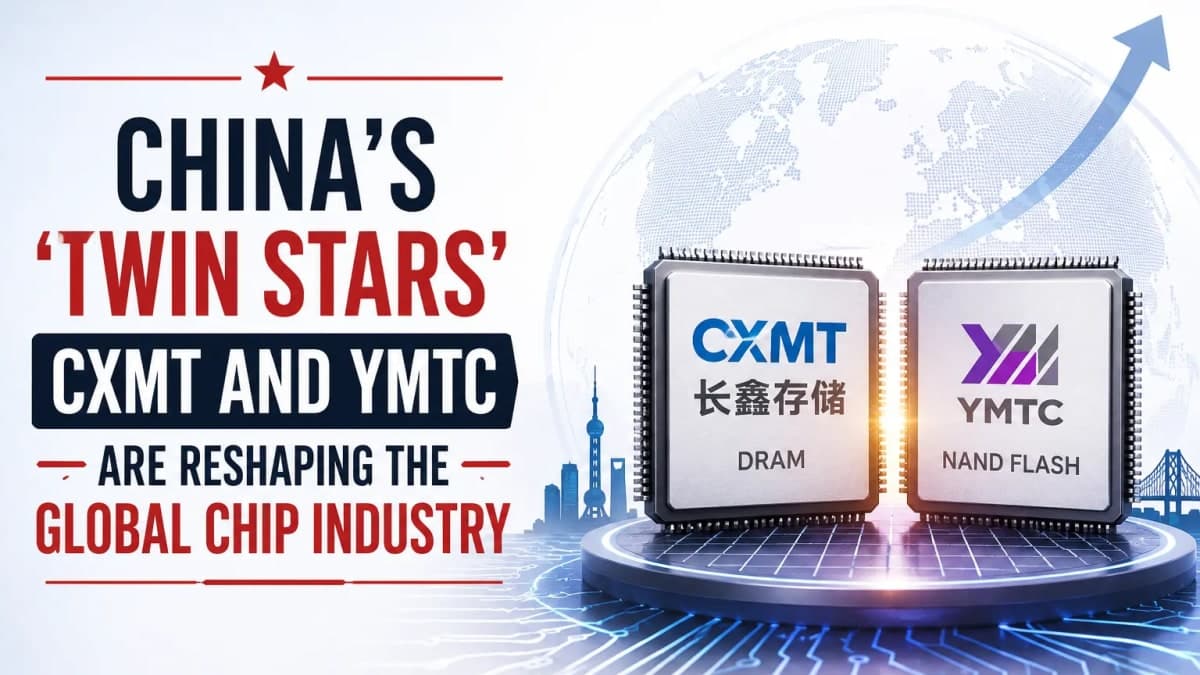
China's ambitions to become a global semiconductor powerhouse have gained significant momentum through the rise of two domestic memory chip companies—CXMT (ChangXin Memory Technologies) and YMTC (Yangtze Memory Technologies). Often referred to as China's "twin stars" of the memory chip industry, the companies have become central to Beijing's strategy of building a more self-reliant technology ecosystem.
Their rapid technological development comes at a time when global semiconductor supply chains are undergoing major changes amid geopolitical tensions, export restrictions, and increasing demand for artificial intelligence, cloud computing, and advanced electronics.
Rather than remaining dependent on overseas suppliers, China has accelerated investment in domestic chip manufacturing, and CXMT and YMTC have become symbols of that effort.
Who Are CXMT and YMTC?
CXMT specializes in DRAM (Dynamic Random Access Memory) chips, which are widely used in smartphones, personal computers, servers, and AI systems. These chips temporarily store data that processors need for fast computing.
YMTC, meanwhile, focuses on NAND flash memory, the technology used for permanent storage in smartphones, laptops, SSDs, and data centers.
Together, the companies cover two of the world's most important memory chip segments, giving China a stronger position across the semiconductor value chain.
Why Their Growth Matters
For years, the global memory chip industry has largely been dominated by companies based in South Korea, the United States, and Japan. China's dependence on imported chips created both economic and strategic challenges.
The emergence of competitive domestic manufacturers offers several potential advantages:
Greater technology self-reliance.
Reduced dependence on overseas suppliers.
Improved resilience against supply-chain disruptions.
Increased competition in global memory markets.
Stronger support for China's AI and cloud computing ambitions.
Their expansion also reflects China's long-term industrial strategy of strengthening advanced manufacturing capabilities.
Impact on Global Competition
The growing capabilities of CXMT and YMTC are changing the competitive landscape of the semiconductor industry.
Established international memory manufacturers now face additional competition, particularly in price-sensitive markets where Chinese companies continue expanding production capacity.
As these companies improve manufacturing efficiency and product quality, they could influence global pricing, customer choices, and future investment decisions across the semiconductor sector.
At the same time, many global technology companies continue balancing supply-chain diversification with concerns related to trade policies and export controls.
Challenges Ahead
Despite rapid progress, China's memory chip industry still faces significant hurdles.
Advanced semiconductor manufacturing requires cutting-edge equipment, sophisticated production processes, and continuous research investments. Export restrictions affecting certain manufacturing technologies may limit access to some advanced tools.
In addition, maintaining competitiveness against long-established global leaders will require ongoing innovation, manufacturing scale, and strong customer confidence.
These factors mean that while CXMT and YMTC have made notable advances, competition in the semiconductor industry remains intense.
What This Means for the Future
The success of CXMT and YMTC highlights the broader transformation taking place in the global semiconductor industry.
Instead of relying on a handful of dominant producers, the market is becoming increasingly diverse as new regional players invest heavily in domestic manufacturing capabilities.
As artificial intelligence, electric vehicles, cloud infrastructure, and high-performance computing continue driving demand for memory chips, the influence of China's leading chipmakers is expected to grow further.
Whether this results in greater competition, lower prices, or a more fragmented semiconductor landscape will depend on future technological progress, international trade policies, and continued investment across the industry.
Conclusion
CXMT and YMTC have emerged as key players in China's semiconductor ambitions, helping strengthen domestic memory chip production while reshaping global competition. Their rise reflects China's broader push toward technological independence and highlights the increasingly strategic importance of semiconductors in the digital economy. Although challenges remain, the two companies have already altered the dynamics of the global memory chip market.