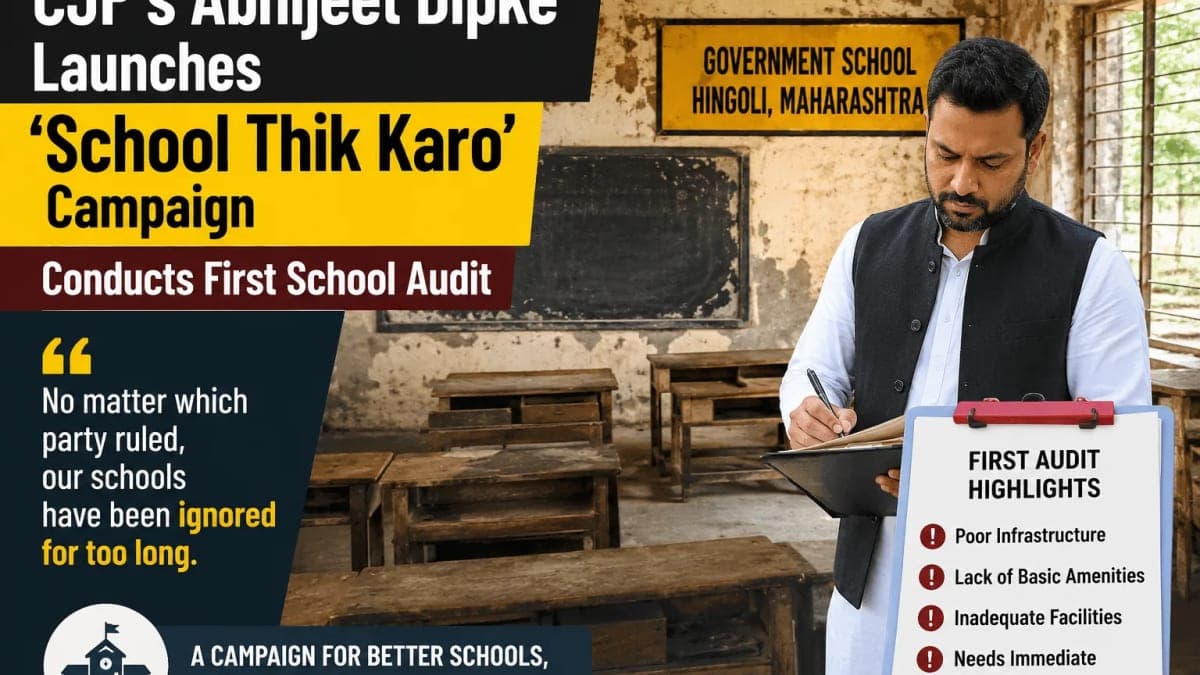
Abhijeet Dipke has launched the “School Thik Karo” campaign in Maharashtra’s Hingoli district, beginning with an audit of a government school and highlighting concerns over basic facilities. Dipke framed the campaign as a broader accountability effort rather than an attack on one political party, arguing that problems in public education have persisted under different governments.
CJP’s Abhijeet Dipke Starts ‘School Thik Karo’ Campaign From Hingoli
Abhijeet Dipke has launched a new grassroots initiative called “School Thik Karo”, putting the condition of government schools at the centre of his latest public campaign.
The initiative began on August 15, 2026, in Hingoli district, Maharashtra. Reports said Dipke started the campaign from his home region and carried out its first school audit, drawing attention to shortcomings in basic amenities at a government school.
The campaign is intended to expand the scrutiny beyond a single school. Its broader idea is to encourage examination of conditions in government schools, particularly in rural areas, and use those findings to demand accountability and improvements.
First Audit Highlights Basic Infrastructure Concerns
During the campaign’s first audit, Dipke pointed to inadequate basic facilities at the government school visited in Hingoli. The exercise is being presented as the starting point for a wider social-audit effort focused on public schools.
The approach could give the campaign significance beyond political messaging. Documenting conditions on the ground can help shift the debate from broad claims about education to specific questions about whether schools have the facilities and resources children require.
However, the campaign’s long-term impact will depend on how consistently such audits are conducted, how findings are documented and whether they result in responses or corrective measures from responsible authorities.
Dipke Says Responsibility Goes Beyond One Political Party
A notable element of Dipke’s message is his attempt to place responsibility for weaknesses in government schooling across political administrations rather than attributing the problem exclusively to the party currently in power.
He argued that public education has suffered from neglect despite different parties having governed over the years. The campaign therefore seeks to make the condition of schools an accountability issue that cuts across partisan boundaries.
That framing could prove important because education in India involves responsibilities at multiple levels of government, and the quality of public schooling can differ considerably across regions.
Why the ‘School Thik Karo’ Campaign Matters
Government schools remain crucial for families that depend on publicly funded education, particularly in rural and economically disadvantaged communities. Conditions such as functioning toilets, safe classrooms, drinking water, adequate teaching resources and sufficient staff directly influence the everyday experience of students.
A campaign built around local audits can potentially make such deficiencies more visible and give communities a clearer way to raise demands with administrators.
At the same time, identifying deficiencies is only the first stage. Meaningful improvement requires official verification, funding, administrative action and sustained monitoring. Public campaigns can create pressure, but durable change ultimately depends on institutions responsible for delivering education.
Independence Day Launch Adds Symbolic Dimension
Launching “School Thik Karo” on Independence Day gives the initiative an additional symbolic message: that access to a functioning, quality public education system is closely connected with opportunity and citizenship.
The campaign was announced as an effort focused particularly on rural government schools, with Dipke seeking wider scrutiny of their condition.
Balanced Analysis: The Test Will Be What Happens After the Audits
The initiative raises a broadly relevant issue regardless of political affiliation: the quality of government schools and the accountability of authorities responsible for maintaining them.
Its credibility, however, will depend on execution. Transparent audit criteria, verifiable evidence, coverage across regions governed by different political parties and clear follow-up on complaints would strengthen the campaign’s claim of being non-partisan.
There is also an important distinction between exposing a problem and solving it. Videos and public audits can generate attention, while improvements to classrooms, staffing and infrastructure require cooperation from education departments and local administrations.
If “School Thik Karo” develops into a systematic, evidence-based exercise rather than remaining primarily a social-media campaign, it could contribute to a wider public conversation about the standards citizens should expect from government schools.