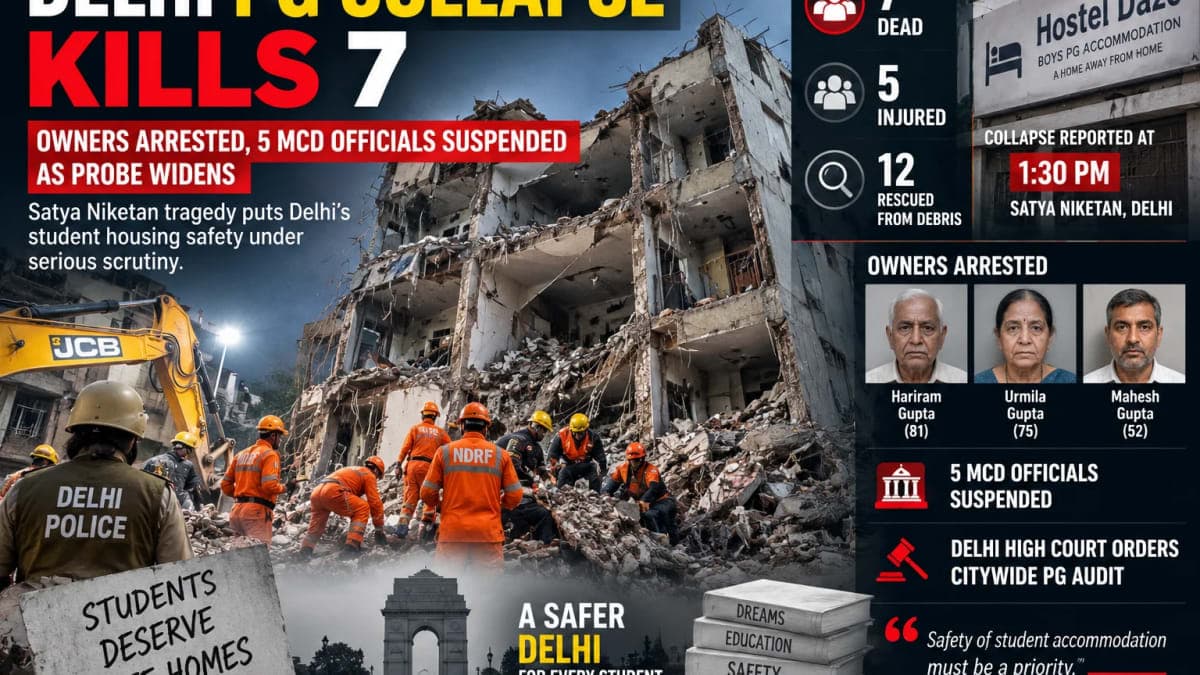
Satya Niketan PG Collapse Kills Seven, Puts Delhi's Student Housing Safety Under Scrutiny
A deadly building collapse near Delhi University's South Campus has moved beyond a rescue operation into a broader examination of how private student accommodation is built, modified and regulated across the capital.
Seven people died and five were injured after a building housing a boys' paying guest accommodation in Satya Niketan collapsed on Sunday, September 6. The structure came down at about 1.30 pm while repair work was underway, trapping students and workers beneath concrete and debris.
The rescue operation continued into Monday and ended after roughly 27 hours. Twelve people were pulled from the wreckage; seven died and five survived with injuries.
Attention has since shifted to the condition of the building, construction activity taking place before the collapse and whether authorities failed to act against structural and regulatory violations.
Police have arrested three members of the family associated with the property. The Municipal Corporation of Delhi has suspended five officials, while the Delhi High Court has ordered a high-level inquiry and an audit of PGs and hostels across the city.
What Happened at the Satya Niketan PG?
The collapsed property was being used as a boys' PG known as Hostel Daze in Satya Niketan, a densely built neighbourhood adjoining Delhi University's South Campus.
Its location made it part of an extensive private housing market serving students studying at nearby institutions, including Sri Venkateswara College, Motilal Nehru College and Atma Ram Sanatan Dharma College.
The building collapsed on Sunday afternoon while repair work was underway.
Emergency teams from multiple agencies, including the National Disaster Response Force, Delhi Fire Service and Delhi Police, worked through the debris in an effort to locate those trapped.
The rescue operation concluded on Monday evening.
The disaster left seven people dead and five injured. Authorities then turned their attention to determining why the structure failed.
Basement Work Becomes a Focus of the Investigation
The precise cause of the collapse has not yet been officially established.
That distinction is important because several possible explanations have emerged since the disaster.
Police said the accused told investigators that construction work had been underway in the basement and claimed that this work caused the collapse. Statements from labourers also confirmed that construction activity was taking place there.
Residents have separately alleged that water had accumulated in the basement following heavy rainfall and may have weakened the structure.
Those accounts remain part of the investigation rather than a final determination of what caused the building to fail.
An early assessment cited by the Hindustan Times, meanwhile, said the property did not have a sanctioned building plan and that work in the basement was unauthorised.
The MCD's reported records described the property at P-14 Satya Niketan as standing on a plot of about 55 square yards, with a basement and floors extending from the ground level to the fourth floor.
The same report said there was no available record of the property previously being booked or sealed.
Three Members of Owner's Family Arrested
Delhi Police arrested Hariram Gupta, 81, his wife Urmila Gupta, 75, and their son Mahesh Gupta, 52, in Bhiwadi, Rajasthan.
Police said the property was registered in Urmila Gupta's name, while Hariram and Mahesh were involved in managing it.
Hariram is a retired Indian Air Force sergeant. Mahesh runs a hardware and paint business.
Police had launched an extensive search after the collapse, including issuing a lookout circular and deploying multiple teams to trace Hariram.
Investigators are also examining the roles of the people operating the PG and the labour contractor connected with work at the property.
The arrests do not establish criminal guilt. The responsibility of the accused and others involved will be determined through the investigation and subsequent legal proceedings.
Five MCD Officials Suspended
The collapse has also brought scrutiny to the Municipal Corporation of Delhi.
Five officials from MCD's South Zone were suspended following the disaster.
They include Deputy Commissioner Rakesh Kumar, Superintending Engineer Ranvir Singh, Executive Engineer Lalit Kumar Goel, Assistant Engineer Sunil Chauhan and Junior Engineer Ashish Kumar.
The suspensions came as questions mounted over how buildings in the neighbourhood were allowed to expand vertically and operate as high-occupancy student accommodation.
The action against the officials does not by itself establish individual responsibility for the collapse. The inquiry will have to determine what inspections were conducted, what violations existed and whether officials knew or should have known about them.
No Sanctioned Building Plan, Early Assessment Says
The regulatory history of the property has become one of the most important parts of the investigation.
According to an early assessment reported by Hindustan Times, MCD officials said there was no sanctioned building plan for the collapsed structure and that the basement construction was unauthorised.
The property also reportedly lacked a fire no-objection certificate.
Fire-safety requirements depend on factors including a building's height, occupancy and use. The wider concern in Satya Niketan is that properties originally built as relatively small residences have increasingly been expanded or converted to accommodate large numbers of students.
The collapsed property stood on a small plot in an area that has changed substantially as demand for accommodation near Delhi University has grown.
That transformation has created a dense ecosystem of PGs, rented rooms, restaurants, shops and other businesses serving students.
The collapse has raised a harder regulatory question: whether building enforcement kept pace with that transformation.
Delhi High Court Orders PG and Hostel Audit
The Delhi High Court has now widened the scope beyond one property.
A bench comprising Chief Justice Devendra Kumar Upadhyaya and Justice Tejas Karia directed the MCD to conduct an audit of PGs and hostels across Delhi within a week.
The court also sought information on the regulatory framework governing PG accommodation and details about the permissions for the collapsed property.
Delhi University was asked to provide information on the number of outstation students and the hostel accommodation available to them.
The court's intervention brings the shortage of formal student housing into the discussion.
Students arriving in Delhi from other parts of India often depend on privately operated PGs and rented accommodation when university hostel capacity is unavailable.
The court observed that responsibility could not be examined only through the conduct of individual property owners, pointing to the roles of civic authorities and the university as well.
Separate responses were sought from authorities, with the case listed for further consideration.
Delhi Moves Against Illegal Extra Floors
The collapse has prompted broader administrative action as well.
Authorities have announced inspections and structural audits targeting buildings suspected of violating construction norms.
Delhi Chief Minister Rekha Gupta directed action against unauthorised fifth floors and unsafe construction. The city government is also moving toward tighter structural-safety requirements for buildings used by the public, including hostels and similar accommodation.
Such measures could have consequences well beyond Satya Niketan.
Private PG accommodation is concentrated around several education and coaching hubs across Delhi, where high rental demand has encouraged intensive use of relatively small residential properties.
A serious audit could therefore identify not only isolated violations but a wider mismatch between the buildings originally permitted in these neighbourhoods and the way some are currently being used.
Satya Niketan Had Seen a Fatal Collapse Before
The latest disaster is not the neighbourhood's first fatal building collapse.
Another structure collapsed in Satya Niketan in April 2022, trapping six people and killing two.
The recurrence adds weight to questions about enforcement in a locality where residential properties have been repeatedly modified to meet demand from students.
Satya Niketan developed into a sought-after rental market largely because of its proximity to Delhi University's South Campus. That demand provides an important source of income for property owners, but it can also create incentives to add rooms and floors to buildings originally designed for much lower occupancy.
For students, meanwhile, location and affordability can take priority when housing choices near campus are limited.
The Investigation Now Has Two Questions to Answer
The first task for investigators is technical: determining what caused the building to collapse.
Basement construction, the age and condition of the structure, water accumulation and alterations to the property are among the issues being examined. Until that investigation is complete, none should be treated as the definitive cause.
The second question is institutional.
If significant violations existed, investigators and the High Court's inquiry will need to establish how long they had been present, whether authorities were aware of them and why enforcement did not prevent a heavily occupied property from operating in unsafe conditions.
That second question is why the Satya Niketan collapse has become more than a story about one building.
Seven deaths have forced Delhi to confront the safety of a private student-housing network on which thousands of young people depend.