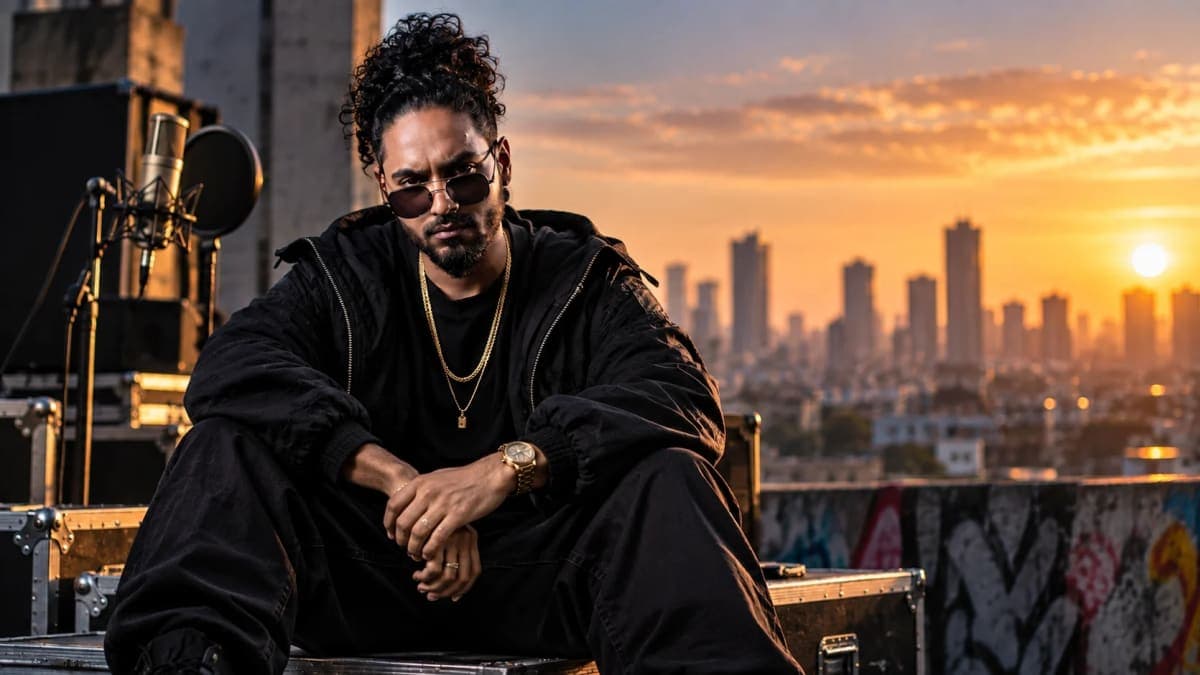
Emiway Bantai’s ‘Safal’ turns his independent journey into the story
For Emiway Bantai, independence has long been more than a description of how he releases music. It has become a defining part of his public identity as an artist.
His latest release, “Safal,” brings that story back into focus. Produced by Memax, the track is part of Red Bull 64 Bars Season 4, presented in collaboration with Def Jam Recordings India. The song was released on August 20, 2026, with its official digital release running for approximately 2 minutes and 48 seconds.
Rather than treating success simply as fame or commercial recognition, Safal looks back at Emiway’s path from being doubted to establishing an independent career in Indian hip-hop. Coverage of the Red Bull 64 Bars release describes the song as reflective but confident, built around his journey while retaining the punchlines, wordplay and cultural references associated with his music.
What is ‘Safal’ about?
The title Safal translates broadly to “successful,” but the song’s context makes the idea more personal.
Red Bull 64 Bars Season 4 is structured around a stripped-back format that places emphasis on the rapper, the beat and the writing. Within that framework, Emiway uses Safal to revisit his progression as an artist and the obstacles that accompanied it.
The track therefore works as more than another entry in his catalogue: it connects his present position with a recurring theme in his career — the decision to build an audience without allowing conventional industry structures to define his path.
That theme is consistent with statements Emiway has made for years.
Independence was a deliberate career decision
Emiway, whose name is Bilal Shaikh, has previously explained that remaining independent was a conscious choice even when opportunities from established companies became available.
Speaking to Mid-Day in 2019, he said he had rejected commercial-label approaches because he wanted to grow independently in India.
“I want to show people that you can make it on your own.”
He also said artists should believe in their work and remain consistent rather than assuming a label is necessary for success.
Those comments predate Safal by several years, but they provide useful context for understanding why the subject of the new track is closely connected to Emiway’s established artistic identity.
From Antop Hill to a major independent hip-hop career
Emiway’s relationship with hip-hop developed during his school years.
In a 2021 interview with Rolling Stone India, he recalled being influenced by Eminem and Lil Wayne. He also credited Mumbai — particularly the slang and street culture he encountered while growing up around Antop Hill — with influencing the language and personality of his music.
His early English-language material did not immediately bring him widespread attention. His trajectory changed as he increasingly began rapping in Hindi and incorporating the language of his surroundings.
Songs including “Aur Bantai” helped establish his identity, while “Machayenge” significantly expanded his reach. Rolling Stone India reported that his social-media popularity subsequently helped turn him into one of the most visible independent names in Indian hip-hop.
Bantai Records became part of the independence strategy
Emiway eventually extended the independent approach beyond his own releases by establishing Bantai Records.
He told Rolling Stone India that his experience as an independent musician made him aware of the work involved in building a career outside traditional structures, and that starting his own label was partly intended to create opportunities for other aspiring artists.
That development is significant when looking at Safal: the career being reflected upon in the track is not simply a story about achieving popularity as a rapper, but about developing an artist-led infrastructure around that career.
‘Safal’ arrives through Red Bull 64 Bars Season 4
Safal is one of the releases featured in the fourth season of Red Bull 64 Bars, which is being presented in collaboration with Def Jam Recordings India.
The season opened with Ahmedabad rapper Dhanji’s “FUNK YOU PAY ME,” produced by Karan Kanchan, followed by Emiway Bantai and Memax’s Safal. Nagpur rapper Naam Sujal subsequently joined the season with “Bajesh Vishay,” produced by Hisab.
Although the artists approach the format differently, the concept places particular emphasis on lyricism and individual identity rather than elaborate song structures.
For Emiway, that makes the platform especially suited to a song built around self-reflection and his career story.
Working independently does not mean avoiding collaborations
Emiway’s emphasis on independence should not be confused with avoiding partnerships altogether.
His career illustrates a distinction between maintaining artistic or business control and refusing to work with outside organisations. Safal itself appears through a Red Bull 64 Bars project involving Def Jam Recordings India, while its release metadata lists Universal Music India.
He has made a similar distinction previously. While discussing another project, Emiway said he had “always worked independently” and that collaborations moved ahead when the arrangement was acceptable on his terms.
That provides useful context for the phrase “on his own terms”: independence in his case has generally been presented as maintaining control over career decisions rather than working entirely in isolation.
‘Safal’ brings the story full circle
More than a decade after his early releases, Safal finds Emiway looking back at the same questions that have followed him throughout his career: whether an artist can build an audience independently, how much control musicians should retain and what success ultimately means.
The circumstances around his career have changed substantially since his earliest songs, but the principle he articulated years ago remains closely connected to his current music.
In that sense, Safal is not simply a song about having become successful. It is a reflection on how that success was pursued — through consistency, audience-building and a continuing insistence on making career decisions on his own terms.
JantaScope Editorial Note
Editorial Note: This article is based on verified information about Safal and previously published interviews with Emiway Bantai. Older comments are used only to provide context on his independent career.