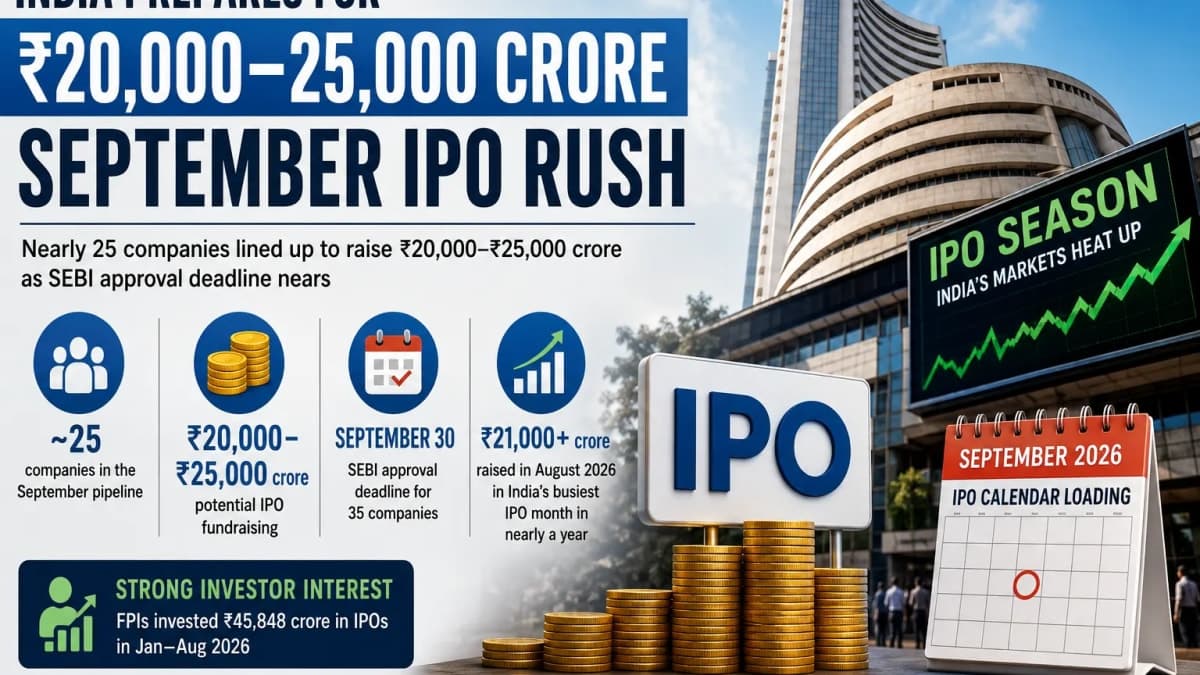
India's primary market is preparing for a surge in activity in September, with companies potentially looking to raise between ₹20,000 crore and ₹25,000 crore through initial public offerings during the month.
Nearly 25 companies are in the September pipeline, according to bankers cited by The Economic Times, with both large and mid-sized businesses preparing to access the public markets.
Several of the planned offerings are expected to exceed ₹500 crore individually.
The acceleration comes after a relatively cautious first half of 2026 and follows stronger IPO activity in recent months. But improving market sentiment is not the only factor driving the rush: a regulatory deadline at the end of September is creating additional urgency for companies whose IPO approvals are approaching expiry.
Nearly 25 Companies Could Enter the Market
September's IPO calendar could become one of the busiest periods for India's primary market in 2026.
Bankers expect nearly 25 companies to be in the pipeline during the month, with their combined fundraising potentially reaching ₹20,000–₹25,000 crore.
The pipeline contains a mixture of large and mid-sized issuers, including several companies planning offerings worth more than ₹500 crore.
The projected amount represents the potential value of offerings currently being prepared rather than a guaranteed fundraising total. IPO schedules can change depending on equity-market conditions, investor demand and decisions by individual issuers.
September 30 SEBI Deadline Adds Urgency
An important reason behind the accelerated IPO calendar is the approaching expiry of regulatory approvals.
In April 2026, the Securities and Exchange Board of India (SEBI) provided a one-time extension to companies whose IPO approvals were scheduled to expire between April 1 and September 30.
Those companies were permitted to use their existing approvals until September 30, 2026.
The extension followed geopolitical tensions and elevated market volatility that had disrupted fundraising plans and made it more difficult for issuers to select suitable windows for launching their IPOs.
Under the normal process, companies generally need to launch their public offerings within the validity period associated with SEBI's observation letter.
Companies unable to complete their IPOs within the permitted period may have to seek fresh regulatory clearance.
35 IPO Approvals Set to Expire
The approaching deadline affects a significant portion of the current IPO pipeline.
According to Prime Database figures reported by The Economic Times, 161 companies currently have valid IPO approvals.
Of those, approvals for 35 companies are scheduled to expire on September 30, 2026.
That creates a strong incentive for eligible issuers to proceed with their offerings before the deadline, particularly if market conditions remain supportive.
However, the approaching expiry should not be interpreted as confirmation that all 35 companies will launch IPOs this month. Companies can still reconsider their plans depending on valuations, demand and broader market conditions.
Improving Market Conditions Bring Issuers Back
The September rush also represents a change in sentiment after companies adopted a more cautious approach earlier in the year.
Sonia Dasgupta, MD & CEO, Investment Banking at JM Financial, said the September pipeline demonstrates the strength of India's capital markets and reflects the release of previously restrained issuer sentiment.
She said issuers are seeking to take advantage of improved market sentiment, stronger recent listings and the approaching expiry of SEBI approvals.
The combination is important.
Companies generally prefer launching IPOs when they believe institutional and retail demand will support their targeted valuations. Strong performances from recent listings can encourage other IPO-ready companies to move ahead rather than wait for another fundraising window.
August Revival Sets the Stage
September's expected activity follows a significant recovery in August.
More than 20 companies raised over ₹21,000 crore through IPOs during August, making it India's busiest IPO month in nearly a year, according to an Economic Times report published in late August.
The recovery followed a quieter first half marked by market volatility and concerns surrounding valuations.
That August fundraising momentum provides important context for September.
If companies successfully raise ₹20,000–₹25,000 crore this month, India's primary market would record another substantial period of capital formation immediately after August's rebound.
September Starts With Multiple Public Issues
IPO activity is already visible as September begins.
Deepa Jewellers opened its IPO for subscription on September 1, with the issue scheduled to close on September 3.
Rays of Belief also opened its public offering on September 1 and is scheduled to close on September 3.
The SME segment remains active as well, with Farm Peace and Fly-Hi Maritime Travels opening their offerings on September 1 on the BSE SME platform.
These offerings represent only the opening phase of what could become a significantly larger September IPO calendar.
Foreign Investors Remain Interested in Indian IPOs
Foreign portfolio investor behaviour provides another important signal for the primary market.
During the first eight months of 2026, foreign portfolio investors invested approximately $4.9 billion, equivalent to ₹45,848 crore, in Indian IPOs.
That exceeded the approximately $4.7 billion, or ₹40,309 crore, invested during the comparable period of 2025.
The continued primary-market participation is notable because foreign investors have simultaneously withdrawn money from India's secondary equity markets amid geopolitical uncertainty.
The divergence suggests foreign investors are differentiating between broad-market exposure and individual new offerings rather than uniformly reducing their exposure to Indian equities.
Why September's IPO Rush Matters
The expected ₹20,000–₹25,000 crore fundraising wave could have implications beyond the companies going public.
A strong IPO month would indicate that India's primary capital market can continue absorbing substantial new equity issuance despite uncertainty in global markets.
For companies, successful offerings provide access to public capital that can potentially be used for expansion, debt reduction and other purposes specified in their respective offer documents.
For existing shareholders, IPOs can also create opportunities for partial exits through offers for sale.
For investors, however, a larger IPO pipeline means greater choice but also creates the need for more selective evaluation.
Strong overall IPO activity does not guarantee strong performance from every newly listed company.
Investors May Become More Selective
The large number of potential offerings could also test the depth of investor demand.
When several major IPOs reach the market within a short period, companies effectively compete for allocations from institutional, high-net-worth and retail investors.
Valuation, profitability, cash generation, corporate governance and the intended use of IPO proceeds can therefore become increasingly important differentiators.
Recent listing gains may support sentiment, but past IPO performance cannot guarantee returns from future offerings.
Investors may consequently differentiate more sharply between companies rather than treating the broader IPO boom as a uniform opportunity.
Could September Become Even Bigger?
There is also speculation that September's fundraising total could become significantly larger if one of India's anticipated mega-IPOs enters the market.
Jio Platforms received SEBI approval for a planned $3.8 billion IPO in late August, according to Reuters.
If completed at that scale, the offering could potentially become India's largest-ever stock-market listing, surpassing Hyundai Motor India's $2.95 billion IPO in 2024.
However, the timing of major offerings remains critical, and investors should distinguish confirmed IPO schedules from market expectations or speculation about possible launch dates.
The ₹20,000–₹25,000 crore estimate for September therefore represents the more immediate pipeline reported by bankers rather than every potential mega-listing that could emerge.
Outlook: A Crucial Month for India's IPO Market
September 2026 is shaping up as an important test for India's primary market.
Nearly 25 potential offerings, a possible ₹20,000–₹25,000 crore fundraising total and the September 30 regulatory deadline have combined to create unusually concentrated IPO activity.
The underlying story, however, is broader than the deadline.
India's IPO market has recovered from the caution seen during the first half of the year, issuers appear increasingly willing to approach public investors, and foreign investors continue allocating capital to selected new offerings.
The next test will be whether investor demand remains strong enough to absorb a crowded pipeline while maintaining discipline on valuations.
If it does, September could strengthen 2026's position as another significant year for India's rapidly expanding primary capital market.