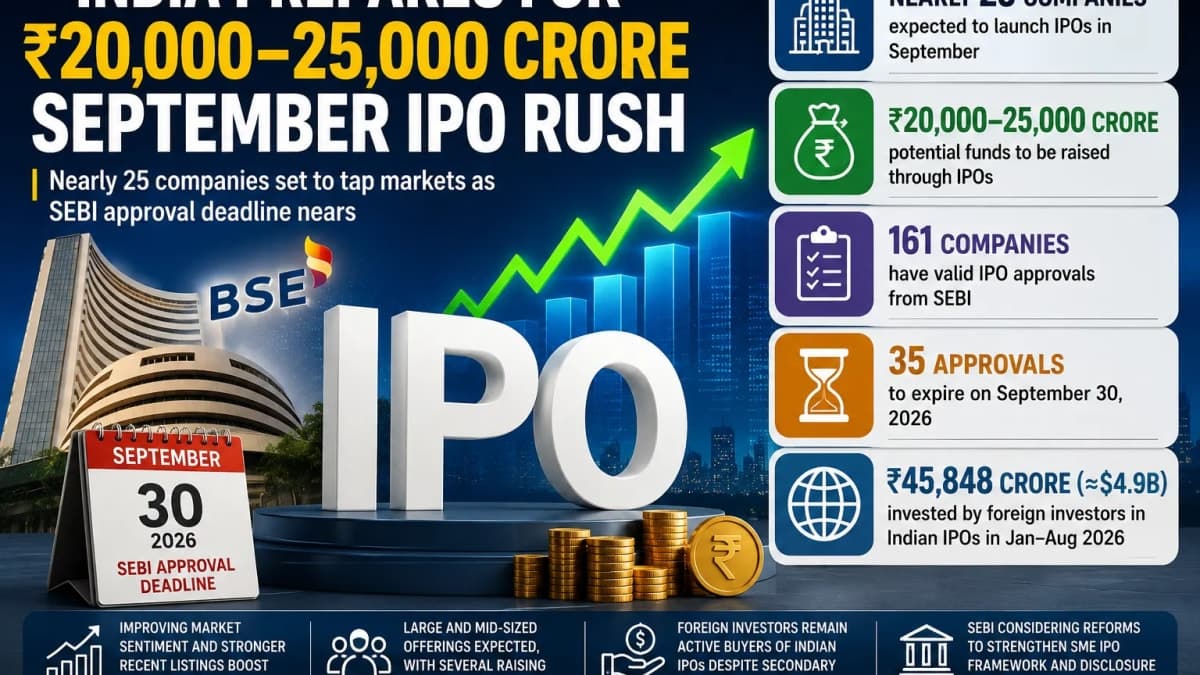
Mumbai, September 1, 2026: India's IPO market is preparing for one of its busiest periods of the year, with nearly 25 companies potentially looking to raise a combined ₹20,000 crore to ₹25,000 crore through initial public offerings in September.
The expected rush comes after a relatively cautious first half of 2026 and reflects improving confidence among companies seeking to tap public markets.
There is also a regulatory clock ticking.
Of the 161 companies currently holding valid IPO approvals, 35 face expiry of those approvals on September 30, 2026, according to Prime Database figures reported by The Economic Times.
That deadline, combined with improved market conditions and recent successful listings, is encouraging companies to move quickly.
The ₹20,000–₹25,000 crore figure, however, represents the potential pipeline rather than confirmed fundraising. IPO schedules and issue sizes can still change depending on market conditions, valuations and investor demand.
Nearly 25 Companies Could Enter the Market
Investment bankers expect nearly 25 companies to be in the September IPO pipeline.
The potential issuers include both large and mid-sized businesses, with several offerings expected to seek more than ₹500 crore individually.
If a substantial portion of the pipeline reaches the market, September could become an important month for India's already active primary market.
The significance is not simply the number of companies.
A concentrated supply of new shares will also test how much capital domestic institutions, foreign investors, high-net-worth individuals and retail investors are prepared to deploy into new listings within a relatively short period.
Why September 30 Has Become a Critical Date
Part of the rush can be traced to a regulatory decision made earlier this year.
In April 2026, the Securities and Exchange Board of India (SEBI) provided a one-time extension to companies whose IPO approvals were due to expire between April 1 and September 30.
Those approvals were allowed to remain valid until September 30, 2026.
The measure came after geopolitical tensions and heightened market volatility disrupted fundraising plans and made companies more cautious about launching public offerings.
Under normal circumstances, companies need to launch their IPOs within the validity period associated with SEBI's observation letter.
Issuers that fail to complete their offerings before their extended approvals expire could face the additional time and regulatory work involved in seeking fresh clearance.
With 35 approvals approaching expiry this month, that has created a strong incentive for eligible companies to complete their fundraising plans.
Improved Market Sentiment Adds Momentum
The deadline is only part of the story.
The IPO pipeline also reflects improving confidence after companies took a more cautious approach during the first half of 2026.
Sonia Dasgupta, Managing Director and CEO of Investment Banking at JM Financial, said the September pipeline demonstrates the strength of India's capital markets and indicates that the restrained sentiment seen among issuers during the first half is beginning to ease.
She said companies are looking to take advantage of improved market sentiment, stronger recent listings and the approaching expiry of SEBI approvals.
The combination is creating a relatively narrow window in which issuers believe they may be able to complete offerings under more favourable conditions.
Foreign Investors Continue to Back Indian IPOs
One of the strongest signals supporting India's primary market is coming from foreign investors.
Foreign portfolio investors have remained active buyers of Indian IPOs even while withdrawing capital from the country's secondary equity markets.
During the first eight months of 2026, foreign portfolio investors invested approximately $4.9 billion, or ₹45,848 crore, in Indian IPOs.
That was higher than the roughly $4.7 billion, or ₹40,309 crore, invested during the corresponding period of 2025.
The contrast is notable.
Foreign investors have been cautious toward already-listed Indian equities amid geopolitical uncertainty, but their continued participation in IPOs suggests they remain willing to selectively back companies entering the public market.
For companies preparing September offerings, continued institutional demand could become particularly important as multiple IPOs compete for investor capital.
September Starts With an Active IPO Calendar
Primary-market activity is already visible as the month begins.
Rays of Belief opened its mainboard IPO for subscription on September 1, with the issue scheduled to close on September 3. The issue size is approximately ₹125 crore.
Deepa Jewellers also opened its IPO on September 1, seeking approximately ₹460 crore.
Other IPO-related activity is continuing across both mainboard and SME platforms, illustrating the breadth of India's current listing pipeline.
Meanwhile, existing issues have also demonstrated strong investor appetite.
For example, the ESDS Software Solution IPO, with an issue size of ₹720 crore, had received overall subscriptions of more than 18 times as it entered its final day on September 1.
Such subscription levels do not guarantee similar demand for upcoming issues, but they provide evidence that investor interest remains available for selected offerings.
A Crowded IPO Calendar Creates Its Own Risks
A ₹20,000–₹25,000 crore pipeline is positive for India's capital markets, but a crowded IPO calendar also presents challenges.
Every new offering competes for a portion of investor liquidity.
Institutional investors must decide how much capital to allocate across different companies, while retail investors may become increasingly selective as multiple issues arrive within short intervals.
That means valuation discipline could become critical.
Companies offering shares at aggressive valuations may find it harder to attract demand when investors have numerous alternatives.
Strong listing performances can encourage participation in subsequent IPOs. Weak debuts can have the opposite effect, particularly when several issuers are waiting to enter the market.
September will therefore test not only investor appetite but also the pricing discipline of companies and their investment bankers.
SEBI Is Also Examining India's SME IPO Framework
The broader IPO boom is occurring while regulators continue examining rules governing smaller public offerings.
SEBI has been considering reforms aimed at increasing institutional participation and strengthening disclosure requirements for companies using India's SME listing platforms.
Among the proposals under consideration are stronger profitability requirements and potentially greater participation from qualified institutional buyers.
The regulatory discussion comes after rapid growth in India's SME IPO market raised concerns around valuations, use of funds and governance standards.
Any changes would affect a different segment of the market from many of September's larger mainboard IPOs, but they underline the challenge facing regulators: encouraging access to capital while maintaining investor protection as the public-market ecosystem expands.
What the IPO Rush Means for India's Capital Markets
The September pipeline reflects a structural change in Indian corporate fundraising.
For companies, public markets increasingly provide an alternative to private capital for funding expansion, reducing debt or allowing existing shareholders to monetise part of their holdings.
For investors, the growing pipeline creates access to businesses that were previously held privately.
And for India's capital markets, a sustained flow of new companies can broaden the range of sectors represented on the exchanges.
But the quality of that growth matters.
A healthy IPO market requires more than large fundraising numbers. Companies must arrive with sustainable businesses, reasonable valuations, transparent disclosures and credible plans for using investor capital.
September Could Become a Major Test of Investor Appetite
The next several weeks will reveal whether India's strong IPO pipeline can translate into completed fundraising.
The ingredients are in place: nearly 25 potential issuers, improving sentiment, continued foreign investor interest and a regulatory deadline encouraging companies to accelerate their plans.
But the projected ₹20,000–₹25,000 crore total should be viewed as an estimate rather than a certainty.
Companies can postpone offerings, alter issue sizes or change pricing if market conditions deteriorate.
That makes September more than simply a busy IPO month.
It will be a significant test of whether India's primary market can absorb a concentrated supply of new shares while maintaining investor demand and valuation discipline.
If that demand holds, September could strengthen 2026's position as another major year for India's rapidly expanding equity capital markets.