For Indian investors, one of the most confusing market signals is appearing again.
Foreign investors are selling Indian equities, while domestic institutional investors are stepping in as buyers.
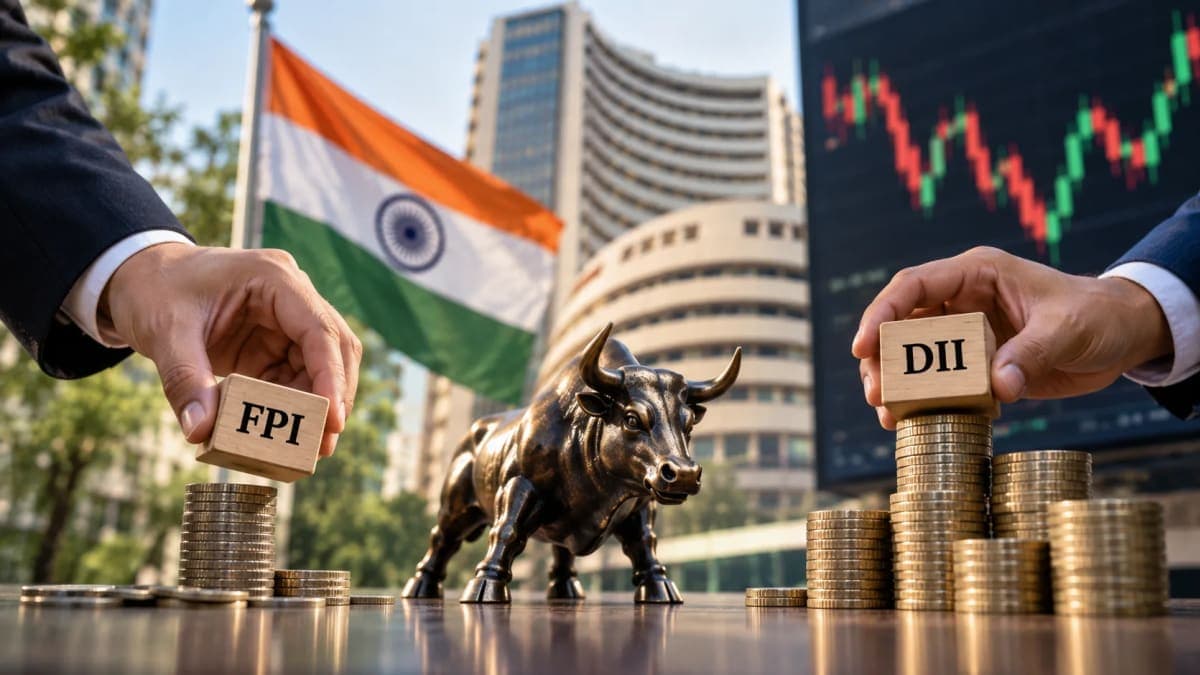
On September 11, for example, foreign institutional/portfolio investors were net sellers of ₹930.90 crore in the cash market, while domestic institutional investors bought a net ₹1,968.17 crore, according to exchange-derived institutional trading data.
At first glance, the arithmetic looks reassuring.
If domestic institutions are buying more than foreigners are selling, shouldn't the market remain strong?
Not necessarily.
India's recent market performance demonstrates why.
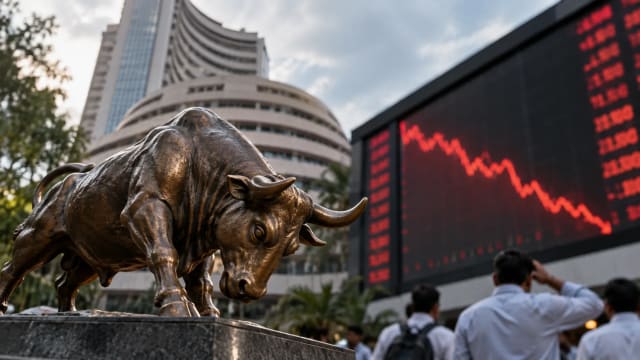
Despite continuing domestic support, the Nifty 50 fell 1.19% to 23,118.60 on September 15, its lowest closing level in five months, while the Sensex declined 1.04% to 74,003.82. Elevated crude oil prices and rising global bond yields weighed heavily on investor sentiment.
Understanding this apparent contradiction reveals something important about how India's stock market has changed.
First, what exactly happens when FPIs sell?
Foreign portfolio investors own shares across some of India's largest listed companies.
When they reduce those positions aggressively, additional shares enter the market for sale.
If there are insufficient buyers at existing prices, stock prices have to decline until buyers are willing to absorb that supply.
That selling can affect major indices disproportionately because large foreign investors often have significant exposure to heavyweight companies in financial services, technology and other large-cap sectors.
But FPIs are only one side of the transaction.
Someone must ultimately buy the shares being sold.
Increasingly, that buyer is domestic India.
DIIs have become India's institutional shock absorber
Domestic institutional investors include institutions such as Indian mutual funds, insurers, banks and other domestic financial institutions.
Their importance has increased because Indian households now channel substantial amounts of savings into professionally managed investment products.
This creates a domestic pool of capital capable of entering the equity market even when foreign investors retreat.
The scale became especially visible earlier in 2026.
During March, for example, SEBI reported that domestic institutional investors remained net equity buyers with monthly inflows exceeding ₹1.43 lakh crore.
The pattern continued during other periods of heavy foreign selling.
In May 2026, market data compiled by Dhan showed foreign institutions selling roughly ₹55,963 crore, while DIIs bought approximately ₹82,668 crore.
That difference helps explain why foreign withdrawals no longer automatically translate into an equally dramatic collapse in Indian benchmark indices.
Domestic liquidity can absorb part of the supply.
But there is an important word here:
Part.
DII buying is a cushion, not a force field.
Why can stocks fall even when DIIs buy more than FPIs sell?
Imagine FPIs sell ₹5,000 crore while DIIs purchase ₹7,000 crore.
It is tempting to conclude that the market should rise because institutional buying exceeds institutional selling.
But stock-market pricing does not work through that simple equation.
FPI and DII numbers represent only particular categories of investors in the cash market.
Retail investors, high-net-worth individuals, proprietary traders and other market participants are also buying and selling.
More importantly, where institutions put their money matters as much as how much they invest.
A DII may buy pharmaceutical, consumer or mid-cap stocks while an FPI sells heavily in index heavyweight banks.
The overall DII number can therefore be positive while the Nifty still falls.
That distinction becomes especially important because India's benchmark indices are market-capitalisation weighted.
Large moves in heavyweight stocks can outweigh gains elsewhere.
September 2026 provides a real-world example
Domestic buying has not prevented the latest correction.
On September 11, FPIs sold ₹930.90 crore while DIIs purchased ₹1,968.17 crore in the cash segment.
Yet broader conditions remained difficult.
Indian equities subsequently fell sharply on September 15, with financials losing about 1.8%, autos around 2%, and broader mid- and small-cap indices falling more than 2%.
Why?
Because institutional flows were not the only variable affecting prices.
Brent crude climbed to around $107.8 per barrel, while the US 10-year Treasury yield moved around the 5% level. Those developments intensified concerns over inflation, interest rates and India's external position.
So even strong domestic liquidity was competing against deteriorating global macroeconomic conditions.
That gives investors a useful lesson:
DII buying can absorb shares. It cannot make macroeconomic risk disappear.
Domestic buying changes the character of an FPI sell-off
This is perhaps the biggest structural change investors should understand.
Historically, large foreign outflows could have an outsized effect on Indian markets because domestic institutional capital was relatively less powerful.
That relationship has become more balanced.
If foreign investors sell ₹10,000 crore and domestic institutions buy only ₹2,000 crore, the market faces a very different liquidity environment from one in which DIIs simultaneously deploy ₹8,000 crore or ₹10,000 crore.
In the second scenario, foreign selling can still push individual stocks lower, but there is substantially more domestic demand available to absorb shares.
This can reduce the severity of the adjustment.
It does not, however, establish a specific floor beneath the Nifty.
The hidden engine behind DII buying: Indian household savings
Why can DIIs continue buying when foreign investors are nervous?
One important reason is that their sources of capital are different.
Foreign portfolio managers allocate money globally.
India competes with US bonds, American equities, China, Japan, other emerging markets and numerous other asset classes for that capital.
When US yields rise or the dollar strengthens, an international fund can simply reduce its India allocation.
Domestic mutual funds operate differently.
They receive money from Indian investors through systematic investment plans, lump-sum investments and other fund flows.
That means domestic institutions can have fresh money available to deploy even while international investors are reducing exposure.
The two groups are therefore responding to different capital flows, mandates, currencies and investment horizons.
That is why FPI selling and DII buying are not contradictory signals.
They can happen simultaneously for perfectly rational reasons.
But there is another important complication
"DII buying" does not necessarily mean that domestic fund managers believe the entire market is cheap.
Institutions continuously receive and deploy money.
Some may be buying selectively because particular stocks have become more attractive after declines.
Others may be adjusting portfolios, responding to inflows, tracking benchmarks or reallocating across sectors.
Therefore:
DII net buying should not automatically be interpreted as a bullish forecast.
Similarly, FPI selling does not automatically mean foreign investors expect an Indian bear market.
Foreign investors can sell India because US Treasury yields have increased, because the dollar has strengthened, because another market has become relatively cheaper or because their global risk limits have changed.
Institutional flow data describes what investors did.
It does not by itself prove why they did it.
What happens if FPIs eventually return while DIIs keep buying?
This is the scenario that can become especially powerful for Indian equities.
Suppose domestic institutions continue receiving strong inflows while foreign investors move from selling to buying.
Instead of domestic capital merely absorbing foreign supply, both pools of institutional capital begin competing for shares.
All else equal, that creates a substantially more supportive demand environment.
There is already evidence that foreign flows can reverse quickly.
FPIs returned as net buyers in July 2026 after four months of selling, investing about ₹20,200 crore in Indian equities during the month.
Foreign participation strengthened further in August before selling returned in September.
That rapid shift demonstrates why investors should be cautious about treating FPI flows as a permanent directional signal.
What if DII buying starts weakening?
This is arguably the more important risk.
The current market structure works partly because domestic capital is absorbing a meaningful portion of foreign selling.
If both FPIs and DIIs became sustained net sellers simultaneously, one of the market's important sources of demand would disappear.
Prices would then depend much more heavily on retail, proprietary and other investors stepping in.
The potential downside pressure could therefore become considerably stronger than under the current FPI-seller/DII-buyer combination.
For investors tracking institutional flows, this makes the direction of both groups more useful than looking at FPI numbers alone.
Four institutional-flow combinations investors should understand
FPI buying + DII buying
Usually the most supportive liquidity configuration because both major institutional groups are adding equity exposure.
FPI selling + DII buying
Domestic institutions are absorbing some foreign supply. This can reduce downside pressure but cannot guarantee rising indices.
FPI buying + DII selling
Foreign capital may support large caps even while domestic institutions take profits or rebalance portfolios.
FPI selling + DII selling
Potentially the weakest liquidity configuration because both institutional groups are withdrawing capital simultaneously.
These are liquidity conditions, however — not automatic buy or sell signals.
Corporate earnings, valuations, interest rates, currencies, oil prices, geopolitics and investor positioning can overwhelm institutional-flow signals.
Why September's market weakness matters
The latest correction provides an unusually clear demonstration of the limits of domestic liquidity.
On September 15, the Nifty reached a five-month closing low even though the broader 2026 story has featured substantial domestic institutional support.
The reason is that investors are simultaneously confronting an oil shock, higher bond yields and currency pressure.
India is particularly sensitive to sustained increases in crude because it is heavily dependent on imported energy.
Higher oil can increase import costs, worsen inflation risks and pressure the rupee.
Meanwhile, higher US Treasury yields increase the return available on comparatively lower-risk dollar assets.
Domestic money can buy shares sold by foreigners.
It cannot neutralise those economic consequences.
JantaScope Analysis: India is becoming less dependent on foreign money — but not independent of it
The deeper story is not that FPI flows no longer matter.
They clearly do.
The more significant structural development is that India's stock market now has a stronger domestic counterweight to foreign capital than it did in earlier cycles.
That changes how foreign selling reaches the market.
Instead of thinking:
FPI selling = stocks must fall
investors should think:
FPI selling + strength of domestic demand + sector positioning + valuations + macro conditions = market impact.
That is a much more useful framework.
September illustrates it well.
Domestic institutions can reduce the liquidity shock created by foreign selling, but when oil prices surge, bond yields rise and investors reduce risk globally, even substantial domestic demand may only cushion the fall rather than reverse it.
For investors, therefore, the most revealing signal may not be FPI selling alone.
It is whether domestic money remains strong enough to absorb it — and what happens when foreign investors eventually change direction.