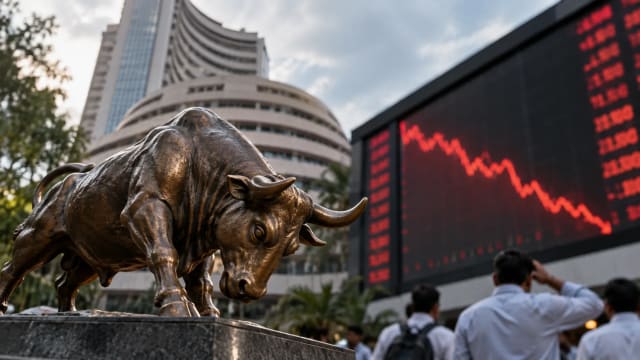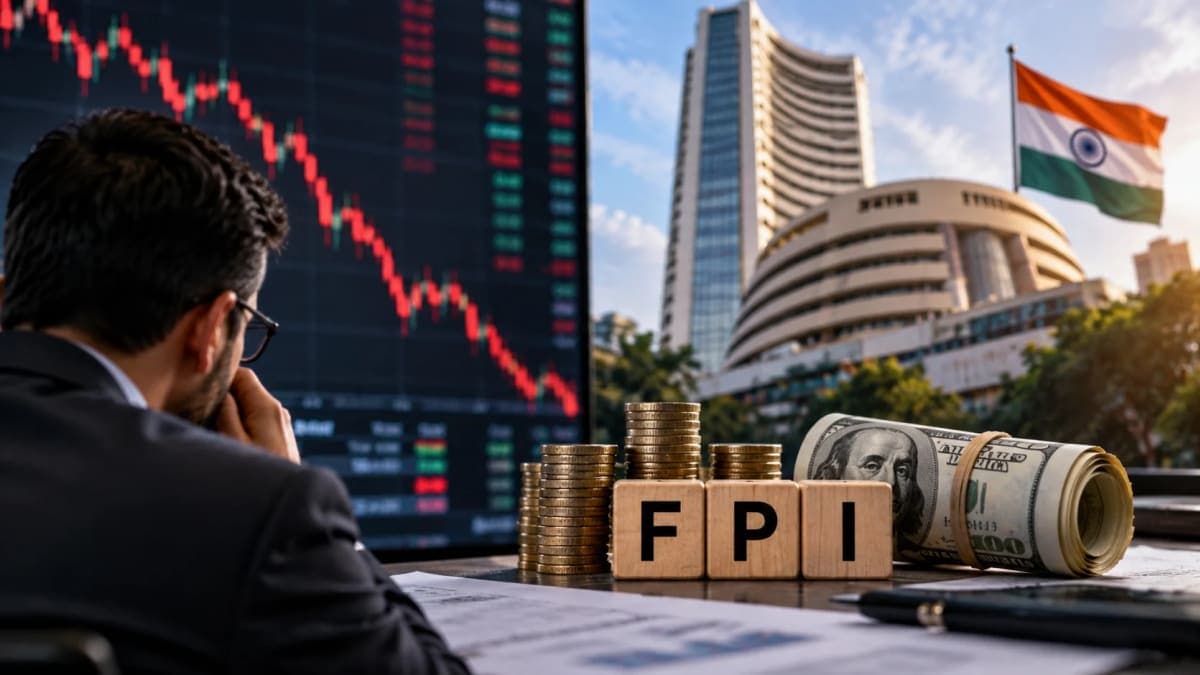
The August comeback did not last
Foreign investors appeared to be returning decisively to Indian equities in August. Within weeks, that optimism has been challenged.
Foreign portfolio investors (FPIs) put roughly $3.1 billion into Indian equities in August 2026, the strongest monthly inflow in nearly two years, according to depository data reported by Reuters. The turnaround followed net buying in July and came after four consecutive months of selling.
But September has brought another reversal.
FPIs had withdrawn ₹13,138 crore from Indian equities through September 11, according to depository data cited in multiple reports. More recent market reporting indicates that September selling has subsequently approached ₹14,475 crore.
The interesting question is not simply why foreigners are selling.
It is what changed between August and September strongly enough to reverse a 23-month-high buying month so quickly?
The answer lies largely outside India's corporate sector.
August's FPI buying was built on improving conditions
August provided foreign investors with a considerably friendlier setup.
Foreign buying was supported by improved valuations, relatively resilient corporate earnings and expectations around the direction of U.S. monetary policy.
Depository data showed the scale of the turnaround: August's foreign equity buying was the strongest in nearly two years.
That followed approximately ₹20,200 crore of equity investment in July, while August ultimately produced an even larger monthly inflow.
In other words, July and August had begun to look like the start of a sustained foreign-investor comeback.
September disrupted that thesis.
The biggest change: oil has surged above $100
For India, crude oil is not merely another commodity price.
India is a major oil importer, which means a sharp increase in crude can affect the economy through several channels: the import bill, inflation, the rupee, corporate costs and expectations for monetary policy.
On September 15, Brent crude was around $107.7 a barrel, after rising nearly 20% during September amid escalating Middle East supply concerns.
That is a radically different macroeconomic environment from the one foreign investors were evaluating during much of August.
India's own crude basket averaged $90.19 per barrel in August and had risen to $109.76 in September, according to government trade data reported by Reuters.
That roughly $20-a-barrel difference helps explain why the investment calculation changed so quickly.
Why expensive oil matters for foreign investors
Higher crude can potentially:
increase India's import bill;
add to inflationary pressure;
weaken the rupee;
squeeze margins at oil-sensitive companies;
keep domestic interest rates higher;
and reduce the relative attractiveness of Indian financial assets.
This doesn't mean every rise in oil automatically causes FPI selling. But when oil moves sharply at the same time as global bond yields and geopolitical risks rise, the combination becomes much more consequential.
The second shock: U.S. Treasury yields crossed 5%
Oil isn't acting alone.
The yield on the benchmark 10-year U.S. Treasury moved above 5%, reaching levels not seen in roughly two decades as investors reassessed inflation and U.S. interest-rate expectations.
This matters enormously for emerging markets.
A U.S. Treasury is generally regarded as one of the world's core low-credit-risk assets. When investors can earn a yield of around 5% on long-duration U.S. government debt, the return required to justify holding riskier emerging-market assets rises.
That changes the relative-value calculation.
An Indian equity does not suddenly become a bad company because Treasury yields rise.
But the question for a global fund manager becomes:
Is the expected return from this Indian stock sufficiently attractive compared with what I can now earn elsewhere for substantially less equity risk?
When the answer becomes less compelling, capital can move.
That's why September's FPI reversal should not be interpreted solely as a judgment on Indian companies.
The rupee adds another layer of risk
The currency is the third piece of the puzzle.
On September 15, the rupee weakened about 0.4% to around ₹95.92 per U.S. dollar, its weakest level in more than a month, as oil and U.S. rate expectations weighed on the currency. Reuters reported that dollar sales through state-run banks, likely on behalf of the Reserve Bank of India, helped limit the decline.
Currency movements matter directly to overseas investors.
Consider a simplified example.
A foreign investor can make 8% on an Indian stock in rupee terms. But if the rupee depreciates 5% against the investor's home currency over the same period, a substantial part of that equity gain disappears after conversion.
That creates an important feedback loop:
Higher oil → pressure on rupee → greater currency risk for FPIs → potential foreign selling → additional pressure on rupee.
The relationship is not automatic or one-directional, because many other forces influence currencies and capital flows, but it helps explain why periods of oil stress can become uncomfortable for Indian markets.
August vs September: the investment equation changed
The reversal becomes clearer when the two periods are put side by side.
FactorAugust 2026Mid-September 2026FPI equity directionStrong net buyingNet sellingAugust FPI buyingAbout $3.1 billion—September selling—At least ₹13,138 crore through Sept. 11; later reporting approaches ₹14,475 croreCrude environmentIndia's crude basket averaged $90.19India's crude basket around $109.76 in SeptemberU.S. 10-year yieldLower than current extremeAbove 5%RupeeRelatively better backdropAround ₹95.92/$ on Sept. 15Global risk environmentMore supportiveHigher oil, yields and geopolitical uncertainty
This is the key to understanding the story.
India did not transform fundamentally between August 31 and September 15. The price global investors are demanding for risk changed.
Strong Indian growth has not prevented the selling
This creates an apparent contradiction.
Foreign investors are selling despite relatively strong domestic economic conditions.
That suggests investors are separating two questions:
Is India's long-term economic story attractive?
and
Is this the right price and macroeconomic environment in which to increase Indian equity exposure today?
Those questions can produce different answers.
Foreign portfolio flows are highly sensitive to currency movements, relative valuations, global interest rates, commodity prices and risk appetite.
An investor can therefore remain constructive on India's long-term economy while reducing short-term exposure.
That distinction is particularly important when interpreting headlines about “foreign investors leaving India.”
September's numbers show a portfolio-flow reversal. They do not, by themselves, establish that global investors have abandoned India's long-term investment case.
Domestic money is cushioning the foreign selling
There is another reason September's FPI numbers should not be viewed in isolation.
Indian institutional investors continue to provide substantial domestic liquidity.
SEBI data show mutual funds made net equity investments of ₹15,348.39 crore over the reported September period through the data compiled up to September 14.
That creates one of the defining features of India's current equity market:
Foreign investors can sell aggressively without automatically producing an equivalent collapse in domestic demand.
The expansion of SIPs and India's mutual-fund industry has increased the importance of domestic institutional capital.
This does not make FPI flows irrelevant. Foreign selling can still affect large-cap stocks, the rupee, market sentiment and valuations.
But the market's dependence on foreign money is different from periods when domestic institutional participation was considerably smaller.
September's market action shows the pressure is becoming visible
The macroeconomic pressure is now showing up in equity prices.
On September 15, the Nifty 50 fell 1.19% to 23,118.6, its lowest close in five months, while the Sensex declined 1.04% to 74,003.82.
Financial and automobile stocks were among the hardest hit, while broader mid- and small-cap indices also declined by more than 2%.
The immediate drivers extended beyond FPI flows: elevated oil prices and rising global bond yields were major sources of investor concern.
That distinction matters.
It would be misleading to say FPI selling caused the entire market decline. Foreign selling is one component of a broader repricing of risk.
The deeper story is the gap between India's fundamentals and global liquidity
This is where September becomes more interesting than a routine “FPIs sold ₹X crore” headline.
Three forces are pulling in opposite directions.
India's domestic growth and investment case can remain constructive.
Domestic institutional liquidity continues to provide substantial support.
But global capital has become more expensive and more risk-sensitive because oil, Treasury yields and geopolitical uncertainty have risen simultaneously.
That makes India's market increasingly a contest between domestic conviction and international risk aversion.
The next phase of FPI flows may therefore depend less on one Indian corporate earnings season and more on whether the global macro shock eases.
What investors should watch next
Rather than trying to predict FPI flows from one daily number, four indicators are particularly useful.
Brent crude: A sustained retreat from above $100 would remove one of the largest external pressures on India's inflation, currency and import bill.
U.S. 10-year Treasury yield: A move back below the current extreme would improve the relative attractiveness of emerging-market risk assets.
USD/INR: Continued rupee weakness raises the currency hurdle faced by overseas investors.
FPI daily and monthly flows: A few days of buying do not necessarily signal a trend reversal. The more useful question is whether foreign investors return consistently after the current global shock.
The CDSL FPI investment database provides daily and monthly foreign-investment data.
Is September selling a temporary reversal or something bigger?
It is too early to answer conclusively.
August demonstrated that foreign capital can return quickly when valuations, earnings expectations and the global backdrop become favourable. September demonstrates the opposite: those flows can reverse just as quickly when the external environment deteriorates.
The evidence available so far supports a relatively precise conclusion:
FPIs have turned sellers again, but the reversal is better explained as a global macroeconomic repricing than as proof that India's underlying investment story has suddenly broken.
Oil above $100, U.S. Treasury yields above 5%, rupee weakness and geopolitical uncertainty have changed the risk-reward equation that looked substantially more attractive only weeks ago.
Whether September becomes another prolonged foreign sell-off will depend heavily on whether those pressures persist.
For Indian investors, that is arguably the most useful insight from the numbers.
Don't watch the FPI figure alone.
Watch what is causing it.