हिंदी में पढ़ें —JantaScope हिंदी
Finance

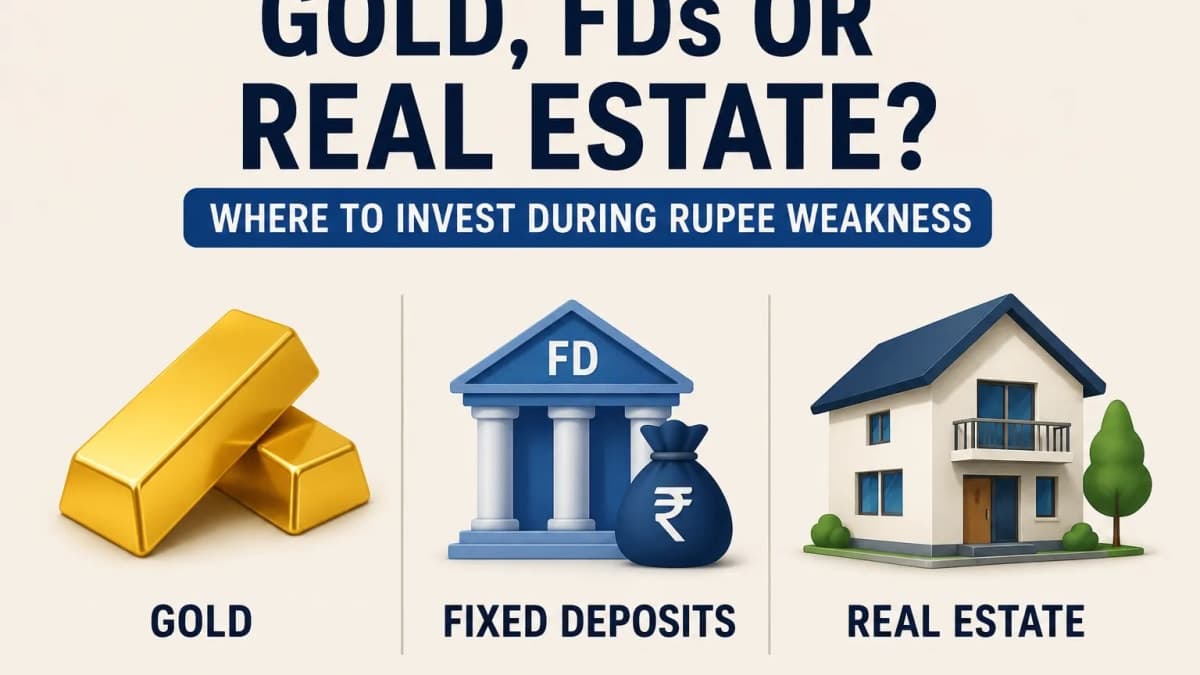
Gold, Fixed Deposits or Real Estate? Experts Reveal Where Investors Should Put Money During Rupee Weakness

As the Indian rupee faces pressure against major global currencies, investors are reassessing their investment strategies. Financial experts suggest balancing safety, growth, and inflation protection by diversifying across gold, fixed deposits (FDs), and real estate rather than relying on a single asset class.

Gold, Fixed Deposits or Real Estate? Experts Reveal Where Investors Should Put Money During Rupee Weakness

By Jeet Nirmal

Source: Janta Scope

The weakening rupee has sparked fresh debate among investors about the best place to park their money. While a weaker currency can increase inflationary pressures and impact purchasing power, experts believe investment decisions should depend on an individual's risk appetite and financial goals.

Gold is often considered a safe-haven asset during periods of currency weakness and economic uncertainty. Rising gold prices can help protect wealth when the rupee loses value against foreign currencies.

Fixed Deposits remain a preferred choice for conservative investors seeking stable and predictable returns. Although FDs offer safety and guaranteed income, their returns may struggle to beat inflation over the long term.

Real estate continues to attract investors looking for long-term wealth creation and potential rental income. However, property investments require significant capital and may be less liquid compared to gold and bank deposits.

Financial planners recommend a diversified approach, combining gold for protection, FDs for stability, and real estate for long-term growth. Such a strategy can help investors manage risks while taking advantage of opportunities created by changing economic conditions.

Related

More stories

India’s Q2 Economic Indicators Signal Strong Momentum Ahead of Festive Season

India ended the July-September quarter with encouraging signals across manufacturing, industrial production, tax collections, digital payments and parts of the automobile market. The data point to resilient economic activity ahead of the festive season, although inflation, energy costs and uneven rural-facing demand remain important risks.

Finance

India’s Q2 Economic Indicators Signal Strong Momentum Ahead of Festive Season

India-US Trade Deal Not Imminent, USTR Says as Negotiations Enter Final Stretch

India and the United States are continuing negotiations on a bilateral trade agreement, but an immediate breakthrough should not be expected, US Trade Representative Jamieson Greer said. His comments came after discussions with Indian Commerce and Industry Minister Piyush Goyal at the G20 Trade Ministers’ Meeting in Milwaukee. Both sides say negotiations are progressing, although unresolved issues remain.

Finance

India-US Trade Deal Not Imminent, USTR Says as Negotiations Enter Final Stretch

Finance Ministry Sees India’s Q2 FY27 GDP Growth at 7.3%, but Global Risks Cloud Outlook

India’s Finance Ministry expects real GDP to grow around 7.3% in the July–September quarter of FY27, extending the economy’s strong start to the fiscal year. The estimate is notably above the Reserve Bank of India’s 6.4% projection for the quarter, although the ministry has warned that oil prices, trade uncertainty and tighter global financial conditions remain important risks

Finance

Finance Ministry Sees India’s Q2 FY27 GDP Growth at 7.3%, but Global Risks Cloud Outlook

FPI Outflows Cross ₹1 Trillion in H1 FY27 as Global Pressures Weigh on Indian Markets

Foreign portfolio investors remained cautious toward Indian markets during the first half of FY27, with net selling reaching ₹1.29 trillion. Financial services, oil and gas, automobiles and telecom faced significant withdrawals, while selected consumer and services sectors continued to attract overseas capital.

Finance

FPI Outflows Cross ₹1 Trillion in H1 FY27 as Global Pressures Weigh on Indian Markets

RBI FX Swaps Open Cheaper Dollar Funding Route for Some Indian Companies

The Reserve Bank of India’s large-scale dollar-rupee swap operations are reshaping currency-market pricing and creating an unusual funding opportunity for some Indian companies. Higher forward premiums mean eligible corporates may be able to borrow in rupees and convert that liability into dollars through currency swaps at a lower effective cost than borrowing directly overseas.

Finance

RBI FX Swaps Open Cheaper Dollar Funding Route for Some Indian Companies

Finance Ministry Estimates India’s Q2 GDP Growth at 7.3% as Momentum Moderates

India’s Finance Ministry expects the economy to grow by 7.3% in the July–September quarter of FY2026-27, according to its nowcasting model. The estimate points to continued economic expansion after 7.8% real GDP growth in April–June, although the ministry has also highlighted risks from geopolitical tensions, trade uncertainty, rising oil prices and tighter global financial conditions.

Finance

Finance Ministry Estimates India’s Q2 GDP Growth at 7.3% as Momentum Moderates