Goldman Sachs Sees Fresh Opportunity in Indian Banking Stocks
Global investment bank Goldman Sachs has turned increasingly positive on Indian banks, highlighting the potential for a cyclical recovery in earnings and profitability across parts of the sector.
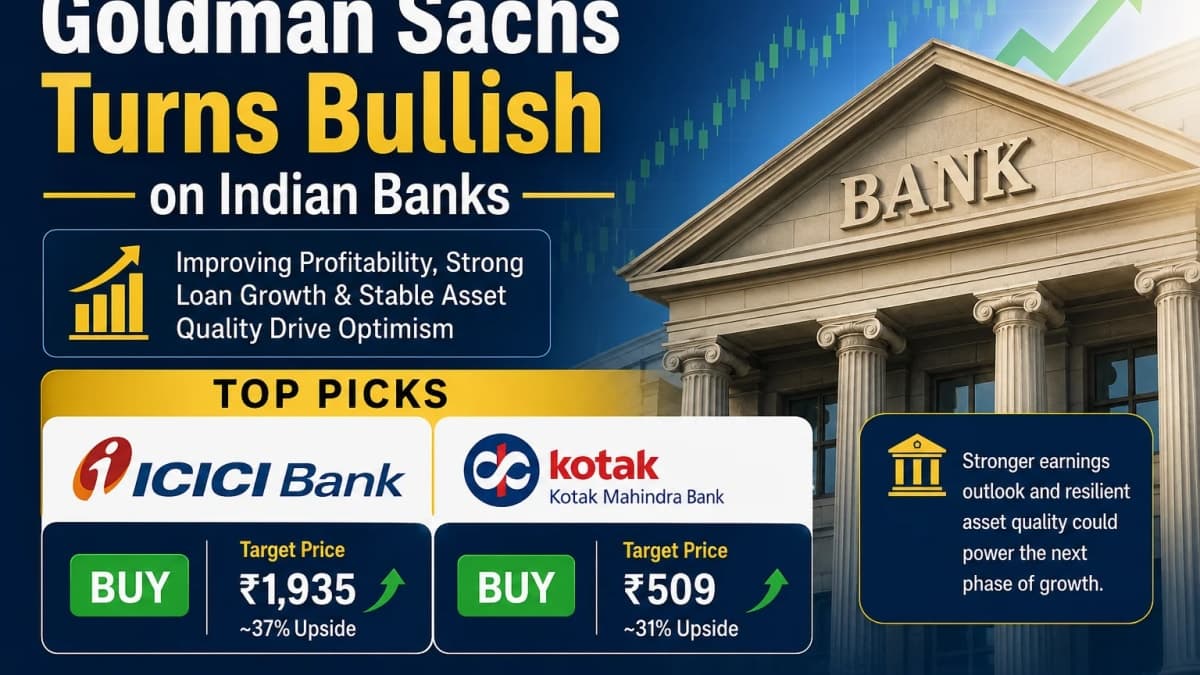
The brokerage has initiated coverage on 14 Indian banks with a mix of Buy, Neutral and Sell recommendations. Its assessment focuses on factors including earnings growth, franchise strength, valuations and the normalisation of return on assets, or ROA. Among private-sector lenders, ICICI Bank and Kotak Mahindra Bank have emerged as two of its most attractive ideas.
The call comes at an important time for banking stocks. Investors have spent recent years weighing slower deposit mobilisation, pressure on lending spreads and questions over how quickly profitability can improve. Goldman Sachs’ latest view suggests that some of those pressures may now be moving toward a more favourable phase.
Why Goldman Sachs Is Positive on Indian Banks
One of the central arguments behind the bullish outlook is the prospect of continued credit expansion. Goldman Sachs expects loan growth for banks to remain around 14–15% during FY26–FY29, although that would represent a moderation from the roughly 18% year-on-year pace recorded in June 2026.
The brokerage also sees improving liquidity conditions and the potential for better net interest margins as supportive for banking profitability. Stable asset quality adds another layer to the argument, because lower stress in loan books can help lenders protect earnings and keep credit costs under control.
Together, these factors could allow investors to focus increasingly on earnings growth and return ratios rather than primarily on concerns about margin compression.
ICICI Bank Emerges as a Major Goldman Sachs Pick
ICICI Bank is one of the standout names in Goldman Sachs’ new coverage.
The brokerage has assigned the lender a Buy rating with a target price of ₹1,935, representing potential upside of roughly 37% from the reference price used in the report. Goldman Sachs views ICICI Bank as a strong long-term earnings compounder, supported by the strength of its franchise and profitability outlook.
The optimism arrives as ICICI Bank is also expanding its access to overseas funding. On August 21, its board approved doubling the bank’s overseas borrowing limit to $5 billion, while Indian lenders more broadly have been tapping international debt markets amid changes surrounding the Reserve Bank of India’s foreign-exchange swap facility.
For investors, the attraction of ICICI Bank lies not simply in credit growth but in whether it can combine expansion with disciplined underwriting, healthy margins and consistently strong returns.
Kotak Mahindra Bank Also Makes the Preferred List
Kotak Mahindra Bank is another major beneficiary of Goldman Sachs’ positive stance.
Goldman Sachs has placed a Buy recommendation on Kotak Mahindra Bank, with reports on the brokerage call indicating a target price of around ₹509, implying approximately 31% upside from the reference level used in the assessment.
The stock also showed strength in the latest trading session. Kotak Mahindra Bank shares rose 1.08% on August 21, outperforming the relatively flat broader market.
Kotak’s potential recovery is particularly important because the market will be watching whether the lender can translate its strong franchise and balance-sheet position into faster growth and improving returns.
Private Banks Could Regain Investor Attention
One broader theme behind Goldman Sachs’ assessment is the relative performance of private and public-sector banks.
Private banks have faced a period of de-rating despite generally supportive economic growth. Goldman Sachs has pointed to slower deposit growth, spread compression and a more difficult operating environment as factors that contributed to weaker investor sentiment toward the segment.
Meanwhile, public-sector banks benefited from improved asset quality and relatively inexpensive starting valuations.
If profitability at large private banks improves while credit quality remains stable, the valuation gap could create room for renewed investor interest.
There are already signs of selective strength. Private-bank stocks gained about 1.3% over the latest week even as the broader Indian benchmarks posted weekly declines amid higher crude oil prices, bond yields and geopolitical concerns.
What Could Challenge the Bullish Banking Outlook?
The positive thesis is not without risks.
Indian banks still need to balance loan expansion with deposit growth. Aggressive competition for deposits can increase funding costs, while a sharper-than-expected decline in lending yields could put pressure on net interest margins.
Global conditions are another potential challenge. Higher oil prices, rising bond yields or persistent geopolitical uncertainty could affect inflation, interest-rate expectations and investor appetite for Indian equities. Recent market trading has already reflected some of those concerns.
Asset quality also remains crucial. Although current conditions are relatively supportive, rapid lending growth can eventually create credit-quality problems if underwriting standards weaken.
Why Goldman Sachs’ Banking Call Matters
Banking is one of the most influential sectors in India’s equity market and a key transmission channel for economic growth. A stronger banking system can support investment, household borrowing and business expansion, while improving bank profitability can have a meaningful impact on benchmark stock indices.
Goldman Sachs’ preference for ICICI Bank and Kotak Mahindra Bank therefore represents more than a short-term stock call. It reflects a broader expectation that selected lenders can benefit as profitability normalises and credit growth remains healthy.
At the same time, the brokerage’s mix of Buy, Neutral and Sell ratings across its 14-bank coverage universe shows that the outlook is not uniformly bullish. The next stage of performance could depend increasingly on individual banks’ ability to grow deposits, defend margins, control credit costs and deliver sustainable returns.
Balanced Analysis
Goldman Sachs’ bullish stance provides a positive signal for Indian banking stocks, particularly established private-sector lenders with strong franchises. ICICI Bank appears well positioned if it can sustain its combination of loan growth, profitability and asset quality, while Kotak Mahindra Bank could offer greater re-rating potential if its growth and return metrics strengthen.
However, brokerage target prices are forecasts rather than guarantees. Changes in interest rates, liquidity, deposit competition, economic growth or credit quality could materially alter earnings expectations.
For investors, the key question is therefore not simply whether the banking sector will grow, but which lenders can convert that growth into consistently higher returns without taking excessive balance-sheet risk.