Google Selects Four Indian Startups for DeepMind Climate AI Accelerator
Introduction
Google has selected four Indian startups for the inaugural Google DeepMind Accelerator: AI for the Planet, putting Indian climate-tech companies alongside organisations from across the Asia-Pacific region working on environmental challenges with artificial intelligence.
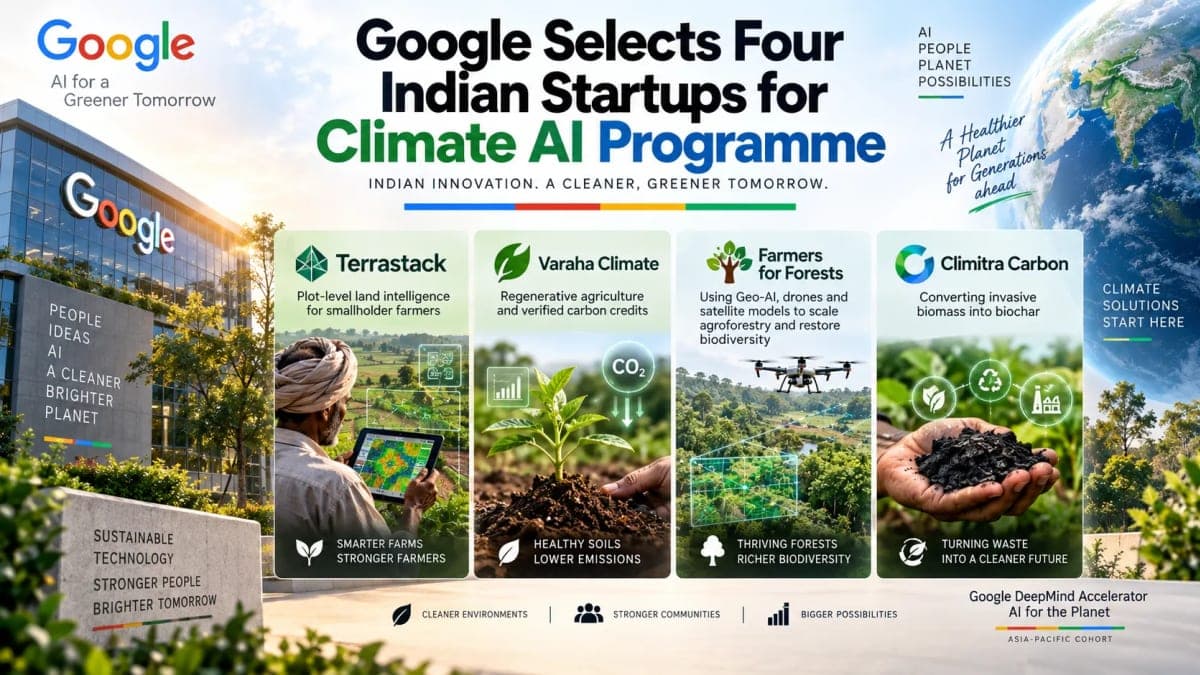
The four selected Indian companies are Terrastack, Varaha Climate, Farmers for Forests and Climitra Carbon.
They are part of a broader cohort of 16 organisations across Asia-Pacific and are developing solutions involving artificial intelligence, satellite intelligence, remote sensing, geospatial technology and drones.
Their work targets practical environmental challenges ranging from helping smallholder farmers understand individual plots of land to scaling agroforestry, restoring biodiversity and converting invasive biomass into biochar.
The selection also provides a broader signal about India's emerging climate-tech ecosystem: AI is increasingly being applied not only to digital services but also to physical challenges involving land, agriculture, forests and carbon.
Meet the Four Indian Startups Selected by Google
The four companies operate in different parts of the climate-technology ecosystem, although their work shares an important theme — using data and AI to better understand and manage physical environments.
Terrastack
Terrastack is using technology to provide plot-level land intelligence for smallholder farmers.
Accurate information at the individual-farm level can be important because agricultural conditions can vary significantly even within relatively small geographical areas.
By applying data-driven tools to land intelligence, technologies of this kind can potentially help agricultural stakeholders make more informed decisions based on local conditions rather than relying only on broad regional information.
Google identified Terrastack as one of the companies helping empower smallholder farmers through plot-level intelligence.
Varaha Climate
Varaha Climate works at the intersection of agriculture and carbon markets.
Its work includes supporting regenerative agricultural practices and generating verified carbon credits.
The underlying challenge is significant: climate projects need reliable ways to establish whether environmental interventions are producing measurable results.
Technology involving satellite observations, remote sensing and AI can potentially improve the monitoring and verification of such projects across large areas.
Varaha Climate's inclusion in the accelerator highlights the increasing overlap between agricultural technology, carbon measurement and artificial intelligence.
Farmers for Forests
Farmers for Forests focuses on agroforestry and ecological restoration.
The organisation is applying Geo-AI, drone technology and satellite models to help scale agroforestry and biodiversity restoration.
Agroforestry integrates trees and shrubs into agricultural landscapes, creating opportunities to combine agricultural activity with environmental restoration.
The use of geospatial intelligence can help organisations monitor large areas, understand changes in vegetation and potentially improve decisions about where restoration efforts could have the greatest impact.
Climitra Carbon
Climitra Carbon is working on another climate challenge: converting invasive biomass into biochar.
Biochar is a carbon-rich material produced by heating biomass under conditions with limited oxygen.
Its potential climate value comes partly from its ability to store carbon in a relatively stable form while creating possible applications in soil management.
Google says Climitra Carbon is among the Indian participants applying advanced technologies to environmental problems, including the use of AI and related tools for climate solutions.
What Is Google DeepMind Accelerator: AI for the Planet?
The programme is the inaugural Google DeepMind Accelerator: AI for the Planet, bringing together 16 organisations from across Asia-Pacific.
Rather than treating artificial intelligence solely as a general-purpose digital technology, the programme focuses on applying AI to environmental problems.
That includes challenges where conventional monitoring can be difficult because of the enormous geographical scale involved.
Agricultural land, forests and carbon projects can cover thousands of individual locations. Satellites, drones and AI-based analysis can make it possible to gather and interpret information across these areas more efficiently.
This is where the four Indian participants fit into the broader programme.
Their projects connect AI with real-world environmental data rather than focusing primarily on consumer-facing generative AI applications.
Why AI Could Matter for Climate Technology
Climate and environmental projects often face a fundamental data problem.
To understand whether an intervention is working, organisations may need to answer questions such as:
How is a particular piece of agricultural land changing?
How many trees have survived a restoration programme?
Has vegetation increased?
How much biomass is available?
Are regenerative agricultural practices producing measurable environmental improvements?
Can carbon-removal claims be independently verified?
Traditionally, answering such questions across large territories can require substantial amounts of fieldwork.
Satellite imagery, drones, remote sensing and machine-learning systems can potentially complement that work by analysing much larger geographical areas.
AI can identify patterns within imagery and environmental datasets that would be extremely time-consuming to analyse manually.
That does not eliminate the need for reliable ground-level measurements or verification, but it can provide another layer of intelligence for organisations operating at scale.
Google's Wider Climate-Tech Push in India
The accelerator is not Google's only recent climate-technology initiative involving India.
Earlier in 2026, Google announced a collaboration with the Office of the Principal Scientific Adviser to the Government of India to establish the Google Center for Climate Technology on the government's Manthan platform.
The initiative is intended to support research and development around decarbonisation and climate technology.
Google has said the centre will provide access to sustainability-focused AI models and APIs while supporting research and talent development.
The selection of four Indian companies for AI for the Planet therefore sits within a wider effort to connect artificial intelligence with climate and sustainability initiatives in India.
From Generative AI to 'Physical' Climate Problems
Much of the recent public discussion around artificial intelligence has focused on chatbots, content generation and workplace automation.
Climate technology presents a different test.
Here, AI systems must often interact with information describing the physical world — satellite images, agricultural plots, vegetation, weather conditions, biomass and ecosystems.
That changes what success looks like.
A useful climate AI system cannot be judged only by how convincingly it generates an answer. Its output may need to contribute to decisions involving real land, farmers, forests or carbon projects.
Accuracy, reliable data and verification therefore become particularly important.
The four Indian companies selected for Google's programme illustrate this shift from AI operating mainly on digital information toward AI being applied to measurable environmental challenges.
Why the Selection Matters for India's Climate-Tech Ecosystem
India offers a significant environment for testing climate technologies because challenges involving agriculture, water, extreme weather, emissions and land use exist at enormous scale.
At the same time, the country has a rapidly developing AI and startup ecosystem.
Combining those two factors creates an opportunity for Indian companies to develop technologies that could potentially be relevant beyond the domestic market.
The four startups selected by Google are still working in distinct areas and their participation in an accelerator does not by itself guarantee commercial or environmental success.
The important development is that their technologies have been selected for a programme specifically designed around applying advanced AI to environmental problems.
What Happens Next
Participation in the accelerator gives the companies an opportunity to develop their technologies with access to Google's AI expertise and ecosystem.
The more important test, however, will come outside the accelerator.
Climate technologies ultimately have to demonstrate that they can produce useful and measurable results in real-world conditions.
For Terrastack, that could mean improving the quality and usefulness of land intelligence available to farmers.
For Varaha Climate, reliable measurement and verification will remain central to carbon-related projects.
Farmers for Forests faces the challenge of translating geospatial technology into scalable restoration outcomes.
Climitra Carbon must demonstrate how effectively its approach to invasive biomass and biochar can operate at scale.
Those outcomes will determine whether AI becomes merely an additional technology layer or a genuinely transformative tool for climate action.
For now, Google's selection of four Indian organisations among 16 Asia-Pacific participants provides another indication that India's climate-tech companies are becoming part of the wider global effort to apply artificial intelligence to environmental challenges.