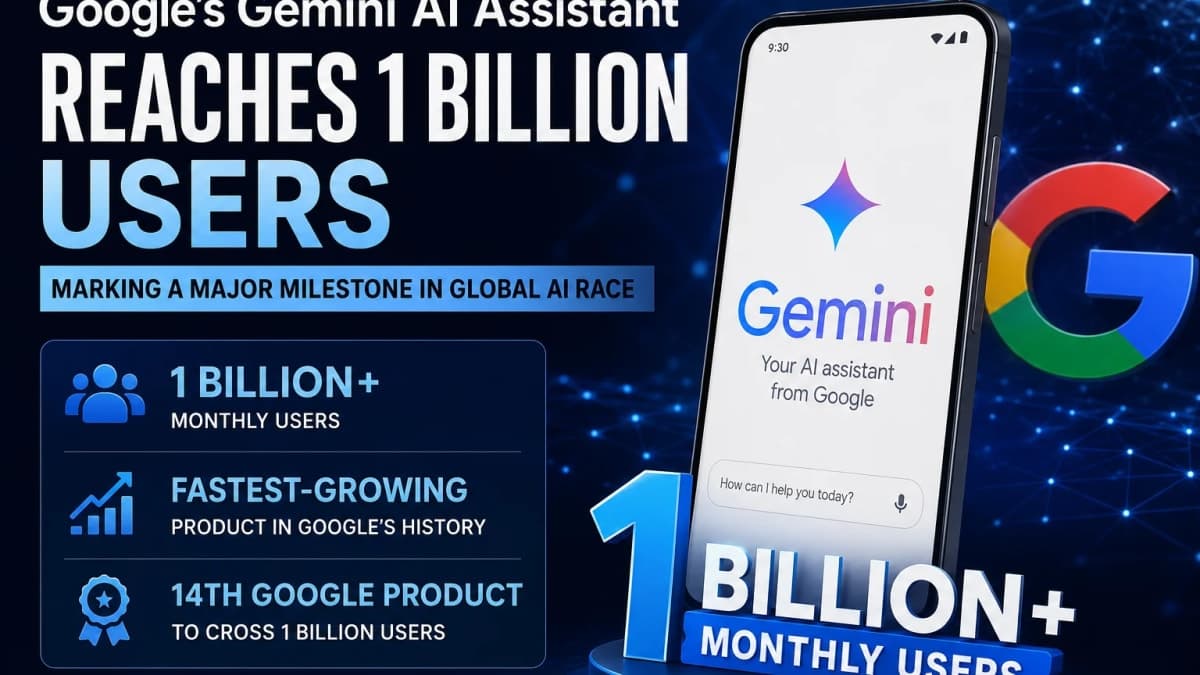
Gemini Reaches the One-Billion-User Milestone
Google has reached a significant milestone in its artificial intelligence strategy, with the Gemini app now used by more than one billion people each month.
Google CEO Sundar Pichai announced the achievement on August 11, 2026. According to the company, Gemini has become the fastest-growing product in Google's history and is the 14th Google product to reach the one-billion-user level.
The figure is particularly notable because it refers specifically to the Gemini app rather than combining users from Google's other AI-powered services. Google has separately integrated Gemini technology into products including Search, Workspace and Android.
Gemini’s Rapid Growth Shows the Scale of AI Adoption
Gemini's journey to one billion monthly users illustrates how quickly generative AI assistants have moved into mainstream technology use.
At the beginning of 2026, Google reported that the Gemini app had more than 750 million monthly active users. By July, that figure had climbed to around 950 million, before crossing one billion in August.
The rapid expansion gives Google an enormous audience for future AI services and provides the company with an opportunity to connect Gemini more deeply with its existing ecosystem of consumer and productivity products.
Google's advantage is not limited to the standalone assistant. Its presence across Android, Search, Gmail, Workspace and other widely used services gives the company multiple routes through which users can encounter AI-powered features.
Voice and Multimodal Features Are Becoming Important
Google's data also provides clues about how people are interacting with AI.
According to the company, 63% of Gemini users speak directly to the assistant, demonstrating that AI interaction is increasingly moving beyond traditional text prompts.
Gemini Live is also being used with cameras and screen sharing. Google says roughly one in five Gemini Live interactions goes beyond voice, allowing people to show the assistant what they are seeing or share their screens while seeking assistance.
These patterns indicate that the next stage of competition among AI assistants may increasingly involve voice, images, video, screen understanding and real-time assistance rather than conventional chatbot conversations alone.
Why the One-Billion Figure Matters
Reaching one billion monthly users gives Gemini something particularly valuable in the AI industry: massive distribution.
Building increasingly capable AI models remains important, but technology companies are also competing over which assistants become part of users' everyday digital routines.
A large active-user base can help Google introduce new AI capabilities rapidly while potentially creating opportunities around subscriptions, productivity tools, enterprise services and other AI-powered products.
The milestone also shows that consumer generative AI is developing into a mass-market technology category rather than remaining primarily an experimental tool used by technology enthusiasts.
Competition With ChatGPT Intensifies
Gemini's growth comes amid increasingly intense competition between Google and OpenAI.
ChatGPT had already crossed the one-billion monthly-user level earlier in 2026, according to reports, meaning two of the world's largest general-purpose AI assistants have now reached enormous global audiences.
The comparison, however, should be treated carefully. Companies may measure active users differently, and raw audience size does not necessarily indicate which AI system has stronger engagement, better capabilities or greater commercial performance.
What the numbers do demonstrate is that competition for consumer AI users has reached a scale comparable with some of the world's biggest internet platforms.
Google’s Wider AI Strategy
Gemini is central to Google's broader effort to integrate artificial intelligence throughout its products.
The company has been introducing Gemini-powered functionality across Search, Android and productivity applications while continuing to develop more capable AI models. Google has also made AI Mode available within Search, giving users another way of accessing generative AI outside the standalone Gemini app.
That ecosystem could become an important competitive advantage. Google does not necessarily have to persuade every consumer to download a completely separate service because AI functionality can increasingly appear inside products people already use.
At the same time, that distribution strength places pressure on Google to ensure its AI systems are reliable, useful and transparent as they reach larger audiences.
Balanced Analysis: A Huge Audience Does Not End the AI Race
Crossing one billion monthly users is a major achievement, but user numbers alone will not determine leadership in artificial intelligence.
Google still has to convert widespread adoption into sustained engagement and commercially valuable services while continuing to improve model quality. Reliability, privacy, operating costs, safety and the ability to provide genuinely useful assistance will remain important measures of success.
Competitors are also continuing to develop new models and AI experiences, meaning technological leadership can shift quickly.
Gemini's milestone therefore represents an important victory for Google's AI strategy rather than a conclusion to the competition. The more significant long-term question is how effectively Google can turn its enormous reach into habitual AI usage and sustainable business growth.
Why This Development Matters
The one-billion-user milestone demonstrates how rapidly AI assistants are becoming integrated into everyday computing.
The industry is moving from an early phase focused largely on demonstrating what generative AI can do toward a new phase centred on distribution, user retention, multimodal interaction and practical applications.
For consumers, stronger competition could produce more capable AI tools and faster innovation. For technology companies, however, the challenge is becoming more demanding: reaching users is no longer enough. They must persuade those users to keep returning and eventually build sustainable businesses around AI.
Gemini's billion-user achievement shows that Google has successfully built enormous reach. Whether that scale translates into lasting leadership will depend on what the company does with it next.