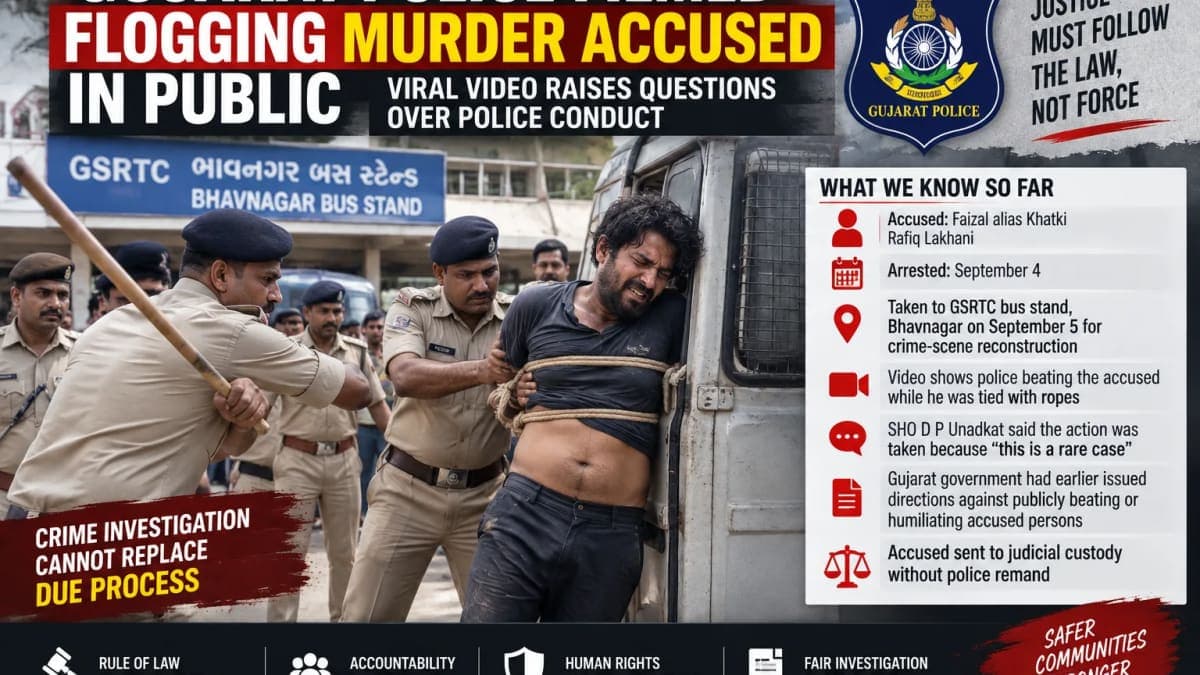
A murder investigation in Gujarat's Bhavnagar has developed into a controversy over police conduct after videos showed officers publicly beating the accused during a reconstruction of the crime scene.
The accused, identified as Faizal alias Khatki Rafiq Lakhani, was taken to the GSRTC bus stand in Bhavnagar on Saturday, September 5, after being arrested in connection with the death of his partner, Kajal.
Videos circulating online show Lakhani restrained with ropes as police move him through the bus-stand premises. He is seen being held against a police vehicle and other structures while being struck with batons.
Police Inspector D P Unadkat, SHO of Nilambaug police station, acknowledged that the incident occurred during the reconstruction and defended the action, describing the murder investigation as a “rare case.”
The episode has raised a larger legal and institutional question because Gujarat authorities had already issued directions against police publicly beating or humiliating accused persons.
What the Viral Video Shows
The footage emerged after police brought Lakhani back to the location where the alleged attack on Kajal had taken place.
Videos show the accused tied with ropes and surrounded by uniformed personnel. At different points, he is restrained against structures at the bus stand and struck repeatedly with a baton.
The footage spread rapidly across social media, transforming what had begun as a murder investigation into scrutiny of the methods used by police after the arrest.
The public nature of the episode is particularly significant. This was not footage alleging mistreatment inside a police station away from public view; the beating was recorded during an official crime-scene reconstruction at a public transport facility.
Police Inspector Defends Action
Unadkat did not deny the police action when questioned about the footage.
“We did it because this is a rare case,” he said.
He argued that the killing had affected public confidence in the police and that officers wanted to send a message to people involved in criminal activity.
The inspector said public reaction to the killing had created a perception that law and order had deteriorated and that police were unable to prevent violent attacks.
“When you do this, miscreants remain scared of police,” Unadkat told The Indian Express while explaining the action.
The comments are significant because they frame the beating not as accidental force used to control an uncooperative suspect, but as a deliberate deterrent.
That justification does not, by itself, establish that the police action was legally permissible.
What Is Faizal Lakhani Accused Of?
Police arrested Lakhani on September 4 in connection with the death of Kajal, with whom he had been living.
According to police, the confrontation occurred at the main gate of the GSRTC bus stand on September 3.
Investigators allege that Lakhani confronted Kajal and their acquaintance Ravi alias Boda Rajendra Gohel, suspecting that the two had developed a relationship while he was in prison in another case.
Police allege that he assaulted both of them.
The confrontation was captured by CCTV cameras in the area.
Kajal suffered serious injuries and was taken to Sir Takhtasinhji General Hospital in Bhavnagar, where she died.
Police subsequently arrested Lakhani on a murder charge.
Those allegations form part of the criminal case against him. His guilt must ultimately be determined through the judicial process.
Accused Reportedly Has Previous Criminal Cases
Police have said Lakhani has previously faced criminal cases.
Reports citing investigators describe a history involving offences including violence and other serious allegations.
The police have referred to that history while explaining why they considered him a habitual troublemaker and why they wanted the reconstruction to send a wider deterrent message.
Previous allegations or criminal cases, however, are separate from determining guilt in the present murder case.
That distinction becomes especially relevant when examining punishment imposed outside a court process.
Gujarat Had Already Warned Police Against Public Punishment
The controversy comes against the backdrop of explicit directions within Gujarat concerning the treatment of accused persons.
During proceedings arising from a suo motu public interest litigation before the Gujarat High Court, the court was informed about a state Home Department circular restricting police personnel from subjecting accused persons to public humiliation or physical punishment.
The instructions covered conduct such as forcing accused persons to perform sit-ups, making them crawl on their knees, kicking them or beating them with sticks in public.
The circular warned that officers or employees engaging in such conduct could face strict disciplinary action and that supervisory officers could also be held accountable.
That makes the Bhavnagar footage particularly consequential: the debate is not occurring in the absence of prior guidance on police behaviour.
DGP Had Also Issued Directions
The episode follows other incidents in Gujarat that prompted scrutiny of public punishment by police.
According to The Indian Express, Gujarat Director General of Police K L N Rao issued instructions on May 12 stating that practices involving the public humiliation or punishment of accused persons damage police credibility and undermine public trust.
The Bhavnagar incident therefore raises questions about how consistently those directions are being enforced at the ground level.
It also shifts the issue beyond the conduct of an individual officer. If senior police leadership has already prohibited such practices, repeated incidents raise questions about supervision, accountability and compliance.
A Similar Controversy Had Emerged Days Earlier
The Bhavnagar episode was not the first recent incident involving the public treatment of accused persons in Gujarat.
Just a week earlier, police had faced scrutiny after accused persons in another case were publicly paraded.
The recurrence matters because it suggests the debate is not limited to one murder investigation or one police station.
Whether these incidents result in disciplinary proceedings will be important in determining how seriously existing instructions against public punishment are implemented.
Crime-Scene Reconstruction and Punishment Are Different Functions
Crime-scene reconstruction has a legitimate investigative purpose.
Police may take an accused person to a relevant location to understand the sequence of events, identify evidence or verify aspects of an investigation.
It is not, however, a substitute for judicial punishment.
An accused person remains subject to the criminal justice process, in which allegations are investigated, charges are prosecuted and guilt is determined by a court.
That distinction is central to the controversy surrounding the Bhavnagar video.
The seriousness of the murder allegation against Lakhani and the legality of the police treatment shown in the video are two separate questions. Condemnation of the alleged killing does not automatically settle whether police were entitled to physically punish the accused in public.
Accused Sent to Judicial Custody
After his arrest and the reconstruction exercise, Lakhani was sent to judicial custody without police remand, according to The Indian Express.
The murder investigation will now proceed through the criminal justice system.
Separately, scrutiny is likely to continue over the actions captured in the viral footage.
The People's Union for Civil Liberties (PUCL) has issued a legal notice over the incident, adding a civil-rights dimension to the controversy.
At the time of the initial reporting, senior police officials had not provided a detailed public response on whether disciplinary action would be initiated over the beating.
Why the Video Raises a Wider Question
The Bhavnagar case involves two serious but distinct issues.
The first is the death of Kajal and the prosecution of the person accused of killing her. Police have a responsibility to investigate that case thoroughly and place evidence before the courts.
The second concerns the limits of police authority after an arrest.
Public anger over a violent crime does not replace due process, just as the presumption of innocence does not prevent police from conducting a lawful and rigorous investigation.
The viral footage has brought those principles into direct tension.
The central question now is not simply why officers beat Lakhani. Inspector Unadkat has publicly explained the deterrent rationale behind the action.
The larger question is whether that rationale can be reconciled with existing directions explicitly restricting police from using public physical punishment and humiliation against accused persons — and what accountability follows when those boundaries are crossed.