HDFC Bank Completes $1.75 Billion Overseas Bond Issue
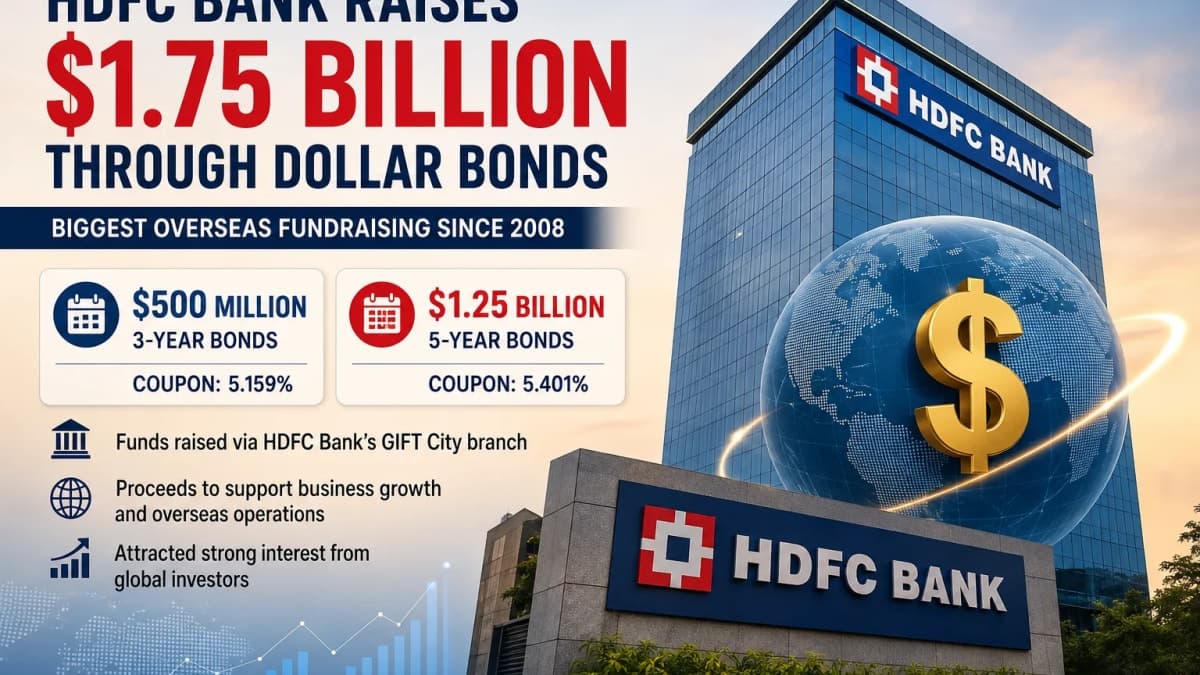
HDFC Bank has completed a major international fundraising exercise, raising $1.75 billion through senior unsecured dollar-denominated bonds issued via its GIFT City branch.
The transaction stands out for its size and comes at a time when Indian lenders are increasingly looking beyond domestic funding markets to diversify their borrowing sources and secure foreign-currency liquidity.
The fundraising was structured in two maturities. HDFC Bank raised $500 million through three-year notes carrying a coupon of 5.159%, while another $1.25 billion was raised through five-year notes carrying a coupon of 5.401%. Both tranches are scheduled to settle on August 26, 2026.
Biggest Overseas Fundraising Since the Global Financial Crisis
The scale of the transaction makes the deal particularly significant. Reports describe the $1.75 billion issue as HDFC Bank's largest overseas fundraising since the 2008 global financial crisis, while the offering attracted interest from investors across major international markets.
The successful transaction also demonstrates the ability of a major Indian lender to access substantial pools of international capital despite the sensitivity of global bond markets to interest rates, US Treasury yields and changing investor risk appetite.
Why HDFC Bank Is Raising Dollars
HDFC Bank has said the overseas bond proceeds will support its business growth. Raising funds in dollars can also help a bank diversify its liability base and obtain foreign-currency resources for international lending and other eligible banking activities.
The timing is notable because Indian banks have been accelerating overseas fundraising. The Reserve Bank of India's decision to bring forward the closure of a foreign-exchange swap facility associated with foreign-currency deposit mobilisation has encouraged lenders to move faster in securing dollar funding. Reuters reported that Indian banks were expected to raise billions of dollars through bonds and loans as they responded to the revised deadline.
This broader environment means HDFC Bank's transaction is not an isolated fundraising event. Instead, it forms part of a wider push by Indian lenders to strengthen access to international capital.
GIFT City's Growing Role in International Fundraising
Another important feature of the transaction is that the bonds were issued through HDFC Bank's GIFT City branch.
GIFT City's International Financial Services Centre has increasingly become a gateway connecting Indian financial institutions with global capital markets. Large overseas transactions conducted through the financial hub reinforce its role in India's ambition to build a globally competitive international financial centre.
For HDFC Bank, using its GIFT City operation also provides a platform through which the lender can manage foreign-currency financing and expand international banking activity.
What the Bond Pricing Tells Investors
The coupons on the bonds provide an indication of the price HDFC Bank must pay to access international capital.
The three-year tranche carries a 5.159% coupon, while the larger five-year tranche carries a 5.401% coupon. Interest is payable semi-annually.
International bond pricing is influenced not only by an issuer's credit profile but also by benchmark US Treasury yields, global liquidity conditions, currency-market expectations and investors' appetite for emerging-market debt.
The transaction therefore provides HDFC Bank with substantial dollar liquidity, but that funding comes with an interest expense that the lender will need to manage against the returns generated from deploying those funds.
Why the $1.75 Billion Deal Matters
The fundraising carries significance beyond the headline number.
First, completing a transaction of this scale indicates that HDFC Bank retains meaningful access to international institutional investors. That access can be strategically valuable when domestic and overseas funding conditions move in different directions.
Second, overseas bonds broaden the bank's funding mix rather than leaving it entirely dependent on domestic deposits and rupee borrowing.
Third, the deal adds to evidence that large Indian banks are becoming increasingly active participants in global debt markets.
HDFC Bank itself has an extensive domestic franchise. As of June 30, 2026, its distribution network included 9,694 branches and 20,958 ATMs across 4,175 cities and towns, highlighting the scale of the institution tapping international markets.
Balanced Analysis: Opportunity Alongside Currency and Funding Risks
The transaction has several potential advantages for HDFC Bank.
A larger and more diversified funding pool can give the lender greater flexibility to support foreign-currency lending and future business expansion. A successful large bond placement can also strengthen the bank's presence among global fixed-income investors.
However, overseas borrowing is not without risks.
Dollar-denominated debt exposes issuers to international interest-rate conditions and requires careful management of foreign-exchange exposure. Changes in US Treasury yields or global credit spreads can affect refinancing costs when existing debt matures.
The real economic benefit of the transaction will therefore depend on how efficiently HDFC Bank deploys the proceeds and manages the associated funding and currency risks.
Outlook
HDFC Bank's $1.75 billion bond sale represents an important milestone in its international funding strategy and comes during a period of heightened overseas borrowing activity among Indian banks.
For the wider banking sector, the transaction demonstrates that major Indian lenders can access large amounts of global capital when market conditions and investor demand are supportive.
For HDFC Bank, the next test will be converting the newly raised dollar liquidity into profitable growth while maintaining disciplined management of funding costs, currency exposure and asset quality.
This article is based on reporting published by The Economic Times.