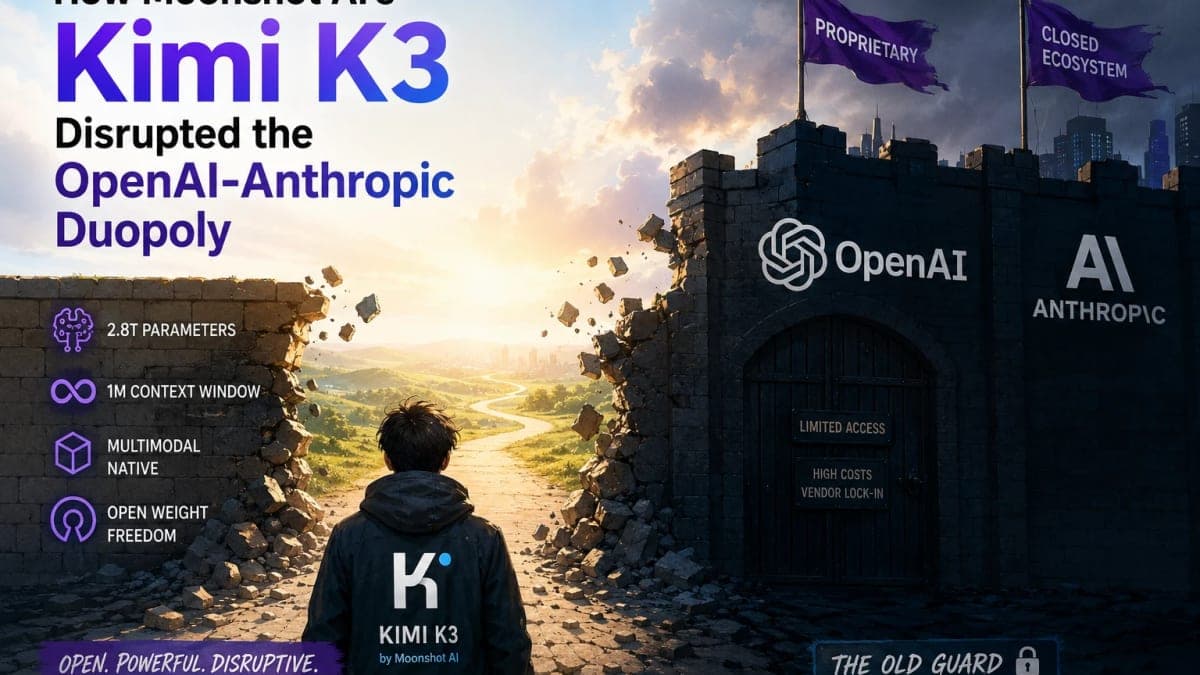
Kimi K3 Challenges the Established AI Order
For much of the recent generative-AI boom, OpenAI and Anthropic have occupied a privileged position at the top of the market.
OpenAI’s GPT family and Anthropic’s Claude models became reference points for coding, reasoning, enterprise work and AI agents. Their strongest systems were generally accessed through proprietary applications and paid APIs, reinforcing the idea that frontier AI would be controlled by a small group of heavily funded American laboratories.
Moonshot AI’s Kimi K3 has complicated that picture.
The Beijing-based company introduced Kimi K3 on July 16, 2026, describing it as a natively multimodal model with 2.8 trillion parameters and a context window capable of processing up to one million tokens. The company says the system is designed for long-duration coding, deep reasoning and complex professional tasks.
Why Kimi K3 Attracted So Much Attention
A Model Built at Frontier Scale
The headline number behind Kimi K3 is its 2.8-trillion-parameter scale.
Parameters are numerical values learned during model training. Although a larger parameter count does not automatically guarantee superior intelligence, it provides an indication of the model’s technical scale and the resources required to build it.
Moonshot has described Kimi K3 as the world’s largest open-source AI system. By comparison, OpenAI and Anthropic do not publicly disclose the exact parameter counts of their most advanced models.
One-Million-Token Context Window
Kimi K3’s one-million-token context window is intended to help the model work with unusually large quantities of information in a single session.
That could include extensive software repositories, research papers, contracts, financial documents or long chains of earlier instructions. In practical terms, a larger context window can make a model more useful for tasks that require tracking information across many files or over a prolonged workflow.
However, context length alone does not prove that a model can reliably understand or retrieve every detail contained within that window.
Native Multimodal Capabilities
Moonshot says Kimi K3 is natively multimodal, meaning it was designed to work with more than text alone.
Such models may analyse combinations of documents, images, charts, interfaces and other visual information. This is increasingly important as AI systems evolve from conversational chatbots into agents expected to complete real workplace assignments.
Benchmark Claims Put Pressure on U.S. Leaders
Moonshot’s internal evaluations reportedly place Kimi K3 above many leading American systems on a range of tests, with the model trailing only certain top-tier offerings from OpenAI and Anthropic while outperforming them on selected benchmarks.
These claims helped create the impression that the frontier separating Chinese and American AI models had narrowed sharply.
That does not mean Kimi K3 has conclusively surpassed OpenAI or Anthropic. Company-selected benchmarks can favour a model’s strengths, and performance may vary considerably across coding, mathematics, factual accuracy, visual understanding and agentic work.
Full confidence will require independent evaluations after researchers and developers gain broader access to the model.
The Open-Weight Strategy Changes the Competitive Equation
The most disruptive aspect of Kimi K3 may not be its benchmark position. It may be Moonshot’s plan to release the model’s full weights.
Model weights contain the learned numerical structure that allows an AI system to generate responses. When weights are made available, developers can run the model on their own infrastructure, customise it, fine-tune it for specialised industries and study how it behaves.
OpenAI and Anthropic generally keep the weights of their leading systems private. Customers access them through controlled products and cloud APIs.
Moonshot’s approach therefore presents a different value proposition: advanced capability combined with greater user control.
If Kimi K3 performs close to proprietary frontier systems while remaining downloadable and customisable, companies may have more bargaining power when choosing AI providers. Developers could avoid dependence on a single vendor, keep sensitive data on private servers and adapt the technology for local languages or specialised workflows.
Why This Breaks the OpenAI-Anthropic “Party”
Frontier Performance Is No Longer a Two-Company Conversation
Kimi K3 reinforces the idea that top-level AI development is becoming more geographically and commercially diverse.
OpenAI and Anthropic remain highly influential, but Moonshot’s release shows that Chinese laboratories can produce systems that are at least credible contenders in the same discussion.
That weakens the perception that only a handful of American companies can build frontier models.
Open Models Could Push Prices Down
Proprietary AI providers usually charge customers according to usage.
A strong open-weight alternative can place downward pressure on those prices by giving enterprises and cloud providers the option to host their own systems.
Self-hosting still requires expensive hardware, engineering expertise and security controls. Nevertheless, access to the weights creates an alternative that closed-model providers must consider when setting prices and licensing terms.
Developers Gain More Control
Open-weight systems allow organisations to modify model behaviour, integrate proprietary data and deploy AI in environments where sending information to an external provider may be unacceptable.
This flexibility could matter in banking, healthcare, government, defence, legal services and industrial operations.
China’s AI Ecosystem Looks More Competitive
Kimi K3 arrived alongside new model announcements from other Chinese companies, including Alibaba.
The rapid succession of releases suggests that China’s AI industry is not relying on a single breakthrough company. Instead, several laboratories are trying to compete through large models, lower costs and more open distribution.
Background: Moonshot AI’s Rapid Rise
Moonshot AI was founded in Beijing in 2023 and gained early attention through the Kimi chatbot.
Its initial products focused heavily on long-context processing, allowing users to analyse large documents and extended conversations. The company later expanded into coding, multimodal reasoning and AI-agent capabilities.
Kimi K3 builds on that strategy by combining very large scale with long-context performance and a planned open-weight distribution model.
The company’s rise also reflects China’s growing ability to develop competitive AI products despite U.S. restrictions on access to advanced semiconductor technology.
Kimi K3 Also Triggered an Intellectual-Property Dispute
The model’s success has not come without controversy.
Michael Kratsios, director of the White House Office of Science and Technology Policy, publicly alleged that Moonshot used large-scale model distillation involving Anthropic’s Claude Fable system while developing Kimi K3.
Distillation is a common training technique in which one model learns from the outputs of another. The dispute concerns allegations that Moonshot conducted this process covertly and at a scale that violated proprietary rights.
Anthropic has supported the U.S. government’s concerns and has characterised illicit distillation as an intellectual-property and national-security problem. Moonshot’s reported conduct remains an allegation, and the publicly available evidence has not independently established the full details of how Kimi K3 was trained.
Why the Distillation Debate Matters
The controversy illustrates a larger unresolved issue in the AI industry.
Leading models are trained partly on information created by other people and organisations. At the same time, those AI companies increasingly argue that their own model outputs and technical systems deserve protection from competitors.
Distillation can support innovation by producing smaller and more efficient models. It can also become controversial when companies repeatedly query a rival’s system in order to reproduce its capabilities.
The Kimi K3 dispute could therefore influence future rules covering API access, model training, intellectual property and international technology competition.
What Kimi K3 Means for Businesses
Enterprises evaluating AI systems may now have a broader set of options.
A company could continue using proprietary models from OpenAI or Anthropic for convenience, support and dependable cloud access. Alternatively, it could examine Kimi K3 or another open-weight system for greater control and potentially lower long-term costs.
The correct choice will depend on several factors:
Real-world accuracy
Infrastructure expenses
Cybersecurity requirements
Data residency rules
Customisation needs
Licensing conditions
Technical support
Regulatory exposure
Headline benchmark results should not replace testing on an organisation’s actual workload.
Challenges Facing Kimi K3
Independent Evaluation Is Still Essential
Moonshot’s benchmark claims must be verified by neutral researchers.
Models that perform strongly on public tests may still produce factual errors, struggle with uncommon tasks or behave inconsistently in lengthy workflows.
Running a Huge Model Is Expensive
Open weights do not mean free operation.
A model with trillions of parameters may require substantial computing infrastructure, memory and energy. Many smaller businesses may still prefer a hosted service rather than operating the model themselves.
Licensing Details Could Affect Adoption
Developers need clarity about commercial usage rights, redistribution, modification and liability.
An open-weight model may still include licence restrictions that limit how it can be used.
Geopolitical Concerns May Restrict Access
Governments may scrutinise the use of Chinese AI models in sensitive industries because of cybersecurity, data and national-security concerns.
The dispute over alleged distillation could add further legal and political uncertainty.
Balanced Analysis
Kimi K3 represents a meaningful challenge to the dominance of OpenAI and Anthropic, particularly because Moonshot combines frontier-scale claims with an open-weight strategy.
Its release expands the range of credible AI suppliers and may encourage lower prices, greater transparency and faster innovation across the industry.
At the same time, it is too early to declare a decisive change in leadership. Moonshot’s benchmark results require independent confirmation, and the cost of running such a large model may limit practical adoption.
OpenAI and Anthropic also retain significant advantages, including mature developer ecosystems, enterprise partnerships, safety infrastructure and widely used consumer products.
The most accurate conclusion is not that Kimi K3 has defeated the American leaders. It is that the frontier AI market is becoming harder for any two companies to control.
Why This Story Matters
Kimi K3 matters because competition in AI affects far more than chatbot rankings.
The companies that control leading AI models may influence software development, scientific research, education, defence, media and the future structure of employment.
A strong Chinese open-weight model could accelerate global access to advanced AI while challenging the economics of proprietary platforms.
It could also intensify debates about intellectual property, chip restrictions and national security.
Conclusion
Moonshot AI’s Kimi K3 has disrupted the OpenAI-Anthropic establishment by demonstrating that a Chinese startup can build a model with frontier-scale ambitions and promise broader access through open weights.
Whether Kimi K3 ultimately matches its most ambitious claims will depend on independent testing, deployment costs and the outcome of growing political and intellectual-property disputes.
Even before those questions are settled, the model has already changed the conversation. The frontier of AI no longer appears to be an exclusive party controlled by two American laboratories.