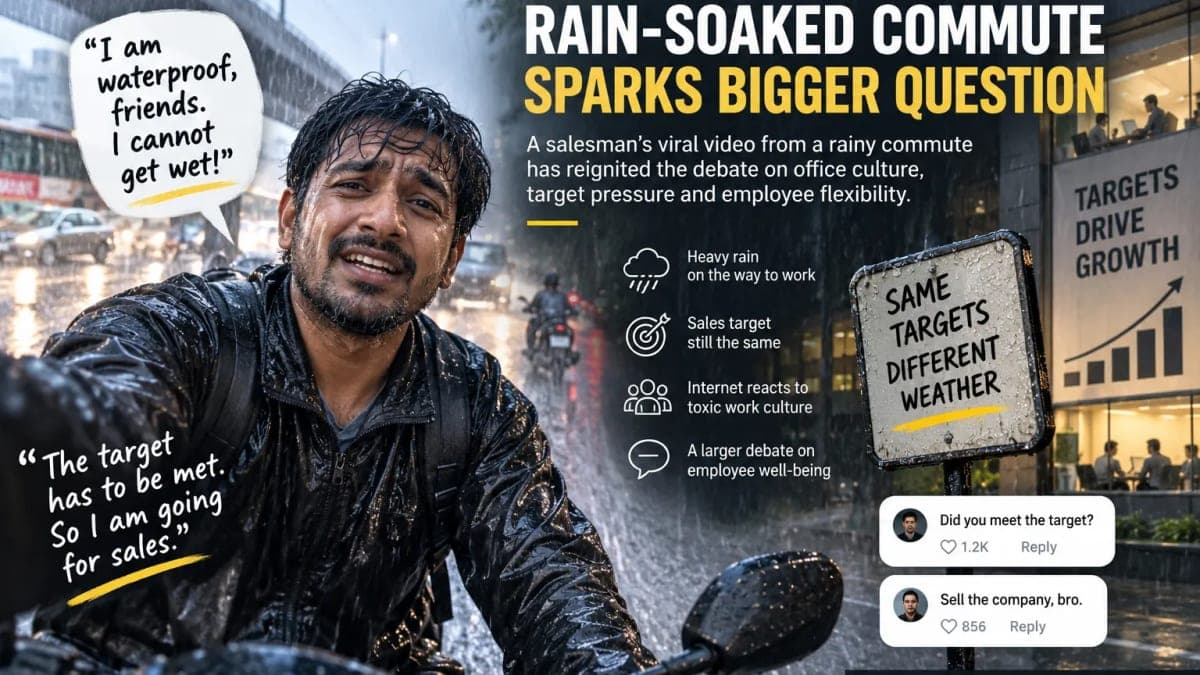
Salesman’s Rain-Soaked Commute Sparks Conversation About Targets and Workplace Flexibility
A salesman soaked by heavy rain on his way to work had a simple explanation for why the weather was not keeping him home: the sales target still had to be met.
Rather than complain directly, he filmed the journey and leaned heavily on sarcasm.
“I am going to work. I work in sales. The target has to be met. So I am going for sales,” he said in the video, which later circulated widely online.
Then came the line that shaped much of the reaction to the clip.
“I am waterproof, friends. I am a waterproof person, I cannot get wet.”
The joke was obvious. The rain was affecting him; the expectations of the working day apparently were not.
That contrast turned an otherwise ordinary monsoon commute into a discussion about how employers handle attendance, performance targets and flexibility when bad weather makes getting to work considerably harder.
A sales target becomes the punchline
The man repeatedly returned to his target as he travelled through the rain.
“The target must be met,” he said.
His commentary then became more pointed.
“We will sell so much that the company will go up, and we will go down. It will be really fun! The company must have sales.”
The remarks conveyed frustration without spelling it out. His criticism was aimed at the gap between a company’s performance requirements and the conditions an employee may have to navigate to meet them.
There are limits, however, to what can be concluded from the video.
Available reporting does not identify the salesman or his employer. It also does not establish whether a manager explicitly ordered him to travel in the rain, whether alternative working arrangements were available or what safety policies his company had in place.
The clip captures one worker’s experience and his view of it. It does not establish the employer’s side of the story.
Viewers recognise the frustration
The sarcasm carried into the comments.
“Did you meet the target?” one person asked.
“Sell the company, bro,” another wrote.
Others treated the video more seriously, using it to criticise rigid attendance requirements and the pressure employees can face to meet performance targets even when travel becomes difficult.
That response helped move the conversation beyond one salesman.
For office employees who can perform most of their duties remotely, severe weather can make working from home an obvious alternative. Field sales is more complicated. Meeting clients, visiting businesses or working within a territory may require an employee to be physically present.
The choice is therefore not always as simple as allowing someone to open a laptop from home.
But remote work is not the only form of flexibility available to an employer.
Flexibility can mean more than working from home
Bad-weather policies can involve delayed reporting times, postponed meetings, rescheduled field visits or temporary adjustments to targets and assignments.
Whether any of those choices were available in this case is unknown.
That missing context matters because criticism of a particular employer would require evidence about what the company actually asked the salesman to do. The video provides no such detail.
What it does provide is a useful illustration of the tension managers face in roles where physical presence remains part of the job.
Targets do not automatically disappear when the weather deteriorates. Neither do the practical risks and disruption employees encounter while trying to reach them.
A sensible workplace policy has to account for both.
Why ‘I am waterproof’ travelled online
There was nothing elaborate about the salesman’s argument.
He did not deliver a speech about employee rights or name the company he worked for. Instead, he took an obviously false proposition — that he could not get wet — and repeated it while visibly travelling through the rain.
That gave the video its humour and its criticism at the same time.
His line about the company going “up” while employees go “down” pushed the joke further, presenting the sales target as something that continued to matter even as the conditions surrounding the employee became increasingly uncomfortable.
It is easy to see why that resonated with people familiar with target-driven jobs.
Performance metrics can give companies a clear way to measure results. Problems arise when those numbers are treated without enough regard for circumstances that employees cannot control.
An individual commute becomes a broader workplace question
The video does not provide evidence for sweeping conclusions about Indian office culture, nor does it establish that the salesman’s employer acted improperly.
Its significance is narrower and more relatable.
A worker had a target. Heavy rain made reaching work difficult. From his perspective, the expectation to deliver remained unchanged.
His response was not to refuse the journey but to document it with sarcasm.
That leaves the most useful question for employers less about whether targets matter and more about how rigidly they should be applied when conditions change.
For workers whose jobs genuinely require them to be on the road, flexibility may not always mean staying home. Sometimes it means recognising that an ordinary target is being pursued on a day that is anything but ordinary.