IBM CEO Questions the Economics Behind Massive AI Spending
The global artificial intelligence boom has triggered an extraordinary race to build data centers, secure advanced chips and expand computing capacity. Technology companies are investing heavily to prepare for rising demand for generative AI and increasingly powerful models.
However, IBM Chairman and CEO Arvind Krishna has raised an important question about this investment race: Can the financial returns generated by AI realistically justify the enormous amount of money being spent on infrastructure?
Krishna's argument does not dismiss the potential of artificial intelligence. Instead, it focuses on the economics of building AI infrastructure at the enormous scale currently being discussed across the technology industry.
A 1-Gigawatt AI Data Center Could Cost Around $80 Billion
One of the most striking parts of Krishna's calculation concerns the cost of building large-scale AI computing capacity.
According to his estimate, developing and equipping approximately one gigawatt of AI data-center capacity could require roughly $80 billion in investment.
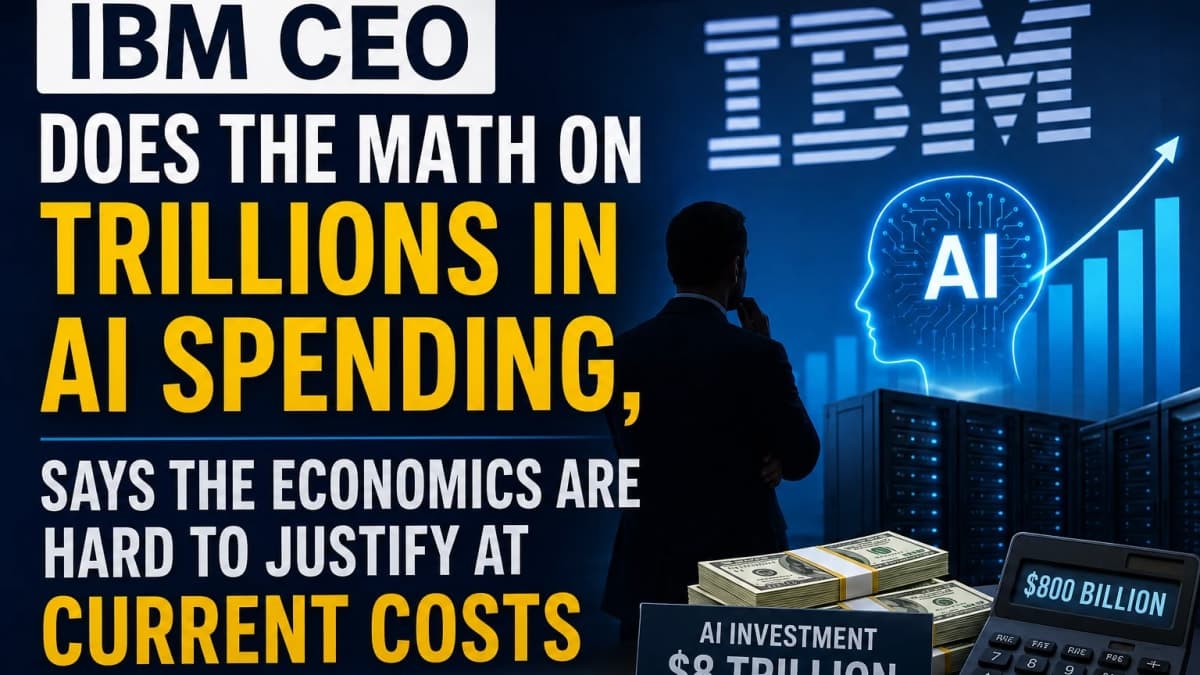
If industry-wide computing commitments eventually approach around 100 gigawatts, applying that estimate across the entire capacity would imply capital expenditure of approximately $8 trillion.
The figure illustrates how dramatically the economics of AI change when computing infrastructure is expanded on a global scale.
$8 Trillion Investment Could Require Enormous Annual Profits
Krishna's calculation becomes even more significant when the cost of capital is considered.
If approximately $8 trillion were invested in AI infrastructure, the industry could potentially need around $800 billion in annual profit simply to support a roughly 10% return on that capital.
Generating profits at that scale would require AI products and services to become extraordinarily valuable across businesses and the broader economy.
This is at the center of the debate surrounding today's AI infrastructure boom. The technology may be transformative, but companies still have to demonstrate that the revenue and profits generated by AI can eventually support the enormous capital required to build and operate the underlying infrastructure.
Rapidly Changing AI Hardware Adds Another Risk
The economics become more complicated because AI hardware can become outdated relatively quickly.
Advanced processors represent one of the largest expenses in modern AI data centers. Yet the industry continues to introduce more powerful and efficient generations of chips.
If companies need to upgrade significant amounts of hardware every few years, the financial challenge extends beyond the initial construction of a data center. Businesses must also account for replacement cycles, power requirements, cooling systems and continued infrastructure expansion.
That could make achieving attractive long-term returns considerably more difficult.
Is the AI Investment Boom Becoming a Bubble?
Krishna's comments feed into a broader debate about whether the technology industry is spending too aggressively on artificial intelligence.
Supporters of today's investment argue that AI could eventually transform productivity across industries, automate significant amounts of knowledge work and create entirely new categories of software and digital services.
Under that scenario, today's massive infrastructure investments could resemble earlier investments in foundational technologies such as telecommunications networks, cloud computing and the internet.
Critics, however, question whether AI revenue will grow quickly enough to match the extraordinary pace of capital expenditure.
If demand falls short of expectations, companies could find themselves operating expensive infrastructure that does not generate sufficient returns.
IBM Is Not Turning Away From AI
Krishna's concerns should not be interpreted as IBM rejecting artificial intelligence.
IBM itself continues to invest in AI technology and computing infrastructure, particularly for enterprise applications. Its strategy has focused heavily on helping businesses deploy AI in areas where companies can identify practical productivity gains and measurable economic value.
The distinction is important. Krishna's argument is less about whether AI will matter and more about how much companies should spend today based on assumptions about future demand.
Why This Debate Matters for the Technology Industry
The AI race has increasingly become an infrastructure race.
More powerful models require large amounts of computing capacity, while serving AI applications to millions of users can create significant inference costs. As adoption expands, companies need additional chips, electricity, networking equipment and data-center capacity.
That creates a difficult strategic decision.
Companies that invest too little could lose ground if AI demand accelerates dramatically. But companies that invest too aggressively risk tying up enormous amounts of capital in infrastructure before the business model has fully matured.
Krishna's calculation highlights this tension.
Balanced Analysis: Today's Math Could Change
The concerns surrounding AI infrastructure economics are significant, but they do not necessarily mean that today's investments will ultimately prove unsuccessful.
Technology costs can decline rapidly.
More efficient processors, improved AI architectures, smaller specialized models and better data-center designs could significantly reduce the cost of training and running AI systems. At the same time, widespread enterprise adoption could create new sources of revenue that are difficult to measure today.
If AI generates major productivity improvements across industries, the economic value created could eventually justify infrastructure spending that currently appears extraordinarily large.
The opposite scenario is also possible.
If AI monetization develops more slowly than expected while companies continue spending aggressively on hardware and data centers, returns could fall below expectations. Rapid hardware depreciation would add further pressure.
The key question, therefore, is not simply whether AI will become important.
It is whether AI can create enough economic value, quickly enough, to justify the unprecedented infrastructure being built around it.
Conclusion
Arvind Krishna's calculation highlights one of the biggest unresolved questions surrounding the artificial intelligence boom.
Technology companies are preparing for a future in which AI requires enormous computing capacity. But building that future could require trillions of dollars in capital, and investors will eventually expect those investments to produce sustainable returns.
If AI adoption, productivity improvements and revenue grow rapidly, today's spending could become the foundation of the next major computing era.
But if monetization fails to keep pace with infrastructure costs, the industry could discover that technological ambition has moved faster than economic reality.
For the AI industry, the challenge is increasingly clear: building powerful technology is only one part of the equation—the financial math also has to work.
This article is based on reporting published by Yahoo!Finance.