IIT Madras Uses AI to Transform Alloy Research
Artificial intelligence is moving beyond chatbots and software applications into laboratories where scientists are trying to solve complex engineering problems.
Researchers at the Indian Institute of Technology Madras have developed an AI-based framework that turns large volumes of published materials-science research into structured information that scientists and engineers can search and analyse.
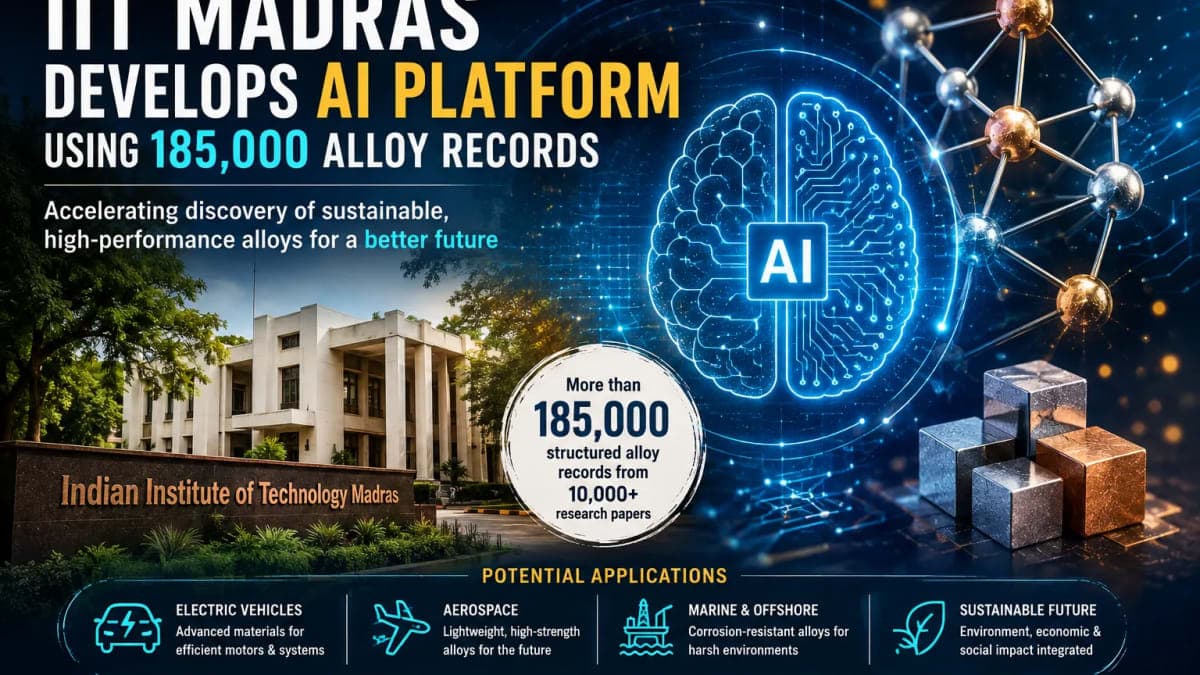
The initiative has generated two databases containing more than 185,000 structured alloy records. The underlying information was collected and organised from more than 10,000 scientific research papers using large language models, or LLMs.
The research was published in the journal Advanced Science, while IIT Madras has made the extracted dataset and code available for use.
What Problem Is IIT Madras Trying to Solve?
Developing a new alloy can be a lengthy process.
Researchers need to understand how different combinations of metals behave under specific manufacturing, temperature, mechanical and environmental conditions. A huge amount of this knowledge already exists, but it is scattered across thousands of scientific publications.
Important experimental results can be buried in paragraphs, tables and other parts of research papers. Manually collecting and standardising such information takes considerable time and makes large-scale comparisons difficult.
The IIT Madras project attempts to automate much of this knowledge-gathering process.
Its AI pipeline extracts information such as alloy composition, manufacturing processes and testing conditions, converting previously fragmented scientific information into structured datasets.
More Than 350 Material Properties Covered
Scale is not the platform's only notable feature.
The framework can capture information covering more than 350 material properties, while retaining the experimental conditions associated with measurements.
This additional context is important because the same material can behave differently depending on how it is manufactured or tested.
Instead of merely creating a catalogue of alloy names and compositions, the system therefore aims to preserve information researchers need when comparing potential materials.
The platform also employs Retrieval-Augmented Generation (RAG) during information extraction, retrieving relevant examples to improve the extraction of information from scientific text and tables.
What Is Alloy Tattvasar?
The databases and supporting tools are being made available through the Alloy Tattvasar platform, along with software resources for researchers, startups and industry users.
IIT Madras describes the resulting datasets as the world's largest publicly available multicomponent alloy databases.
Making such resources publicly accessible could be particularly valuable because materials research is not limited to large corporations.
Universities, smaller research laboratories and startups could potentially use the accumulated information to narrow down promising materials before committing resources to physical experiments.
Sustainability Is Built Into the Approach
One of the more significant aspects of the research is that the system does not evaluate materials solely according to conventional engineering performance.
The researchers have integrated environmental, economic and social indicators alongside materials-performance information.
That approach could allow researchers to search for alloys that provide desirable mechanical or functional properties while also performing better against sustainability-related criteria.
This matters as manufacturers increasingly face the challenge of balancing performance, cost, resource availability and environmental impact.
Potential Applications in Electric Vehicles
Electric vehicles could be one important beneficiary.
EV manufacturers require materials for motors, structural components and other systems where characteristics such as weight, strength and magnetic performance can influence overall efficiency.
The IIT Madras researchers demonstrated their database in the search for soft magnetic materials, which have applications in electric motors and transformers.
Finding improved materials could ultimately contribute to more efficient electric power systems, although moving from a promising database result to a commercially manufactured component still requires extensive validation.
Aerospace Could Benefit From Lighter Alloys
Weight is particularly important in aviation.
Reducing structural mass without compromising safety or durability can contribute to lower energy consumption.
The researchers used their system to identify promising high-entropy alloys for lightweight structural applications relevant to the automotive and aerospace industries.
An AI-assisted database can help researchers explore a much wider range of candidate compositions before selecting the most promising ones for laboratory testing.
Corrosion-Resistant Materials for Marine Infrastructure
The platform also has potential applications in environments where corrosion is a major engineering challenge.
The researchers demonstrated the database's use in identifying promising corrosion-resistant alloys for areas including marine infrastructure, offshore engineering, chemical processing and energy systems.
Materials that last longer in harsh environments can potentially reduce maintenance requirements, replacement costs and resource consumption.
Why 185,000 Structured Records Matter
The significance of the database lies not simply in its size but in what structured scientific information can enable.
Materials research traditionally combines theory, computer simulation and physical experimentation. AI does not remove the need for those processes.
Instead, a sufficiently organised database can help researchers decide where to experiment first.
If existing knowledge can be searched and compared more efficiently, scientists may be able to eliminate less-promising candidates earlier and concentrate laboratory resources on materials with stronger potential.
It could also reduce unnecessary repetition of experiments whose results already exist somewhere in scientific literature. IIT Madras has specifically highlighted reducing duplicated experiments and accelerating materials innovation as potential benefits of the work.
AI Does Not Replace Laboratory Testing
The development also needs to be viewed with appropriate caution.
An AI-generated materials database is only as useful as the quality and consistency of the scientific information it extracts.
Research papers can use different experimental methods, terminology and reporting standards. Even when extraction is accurate, correlations discovered in historical data do not automatically prove that a proposed alloy will perform successfully in industrial conditions.
AI can therefore help researchers narrow the search space, but physical experiments, engineering validation and manufacturing tests remain essential before new materials can enter commercial products.
That distinction is particularly important in safety-critical sectors such as aerospace and energy infrastructure.
Who Developed the Platform?
The research was carried out by Aravindan Kamatchi Sundaram, Mohit Chakraborty, Sai Mani Kumar Devathi and B. Pabitramohan Prusty, under the guidance of Dr Rohit Batra of IIT Madras' Department of Metallurgical and Materials Engineering.
The project received support from the Anusandhan National Research Foundation (ANRF), the Defence Research and Development Organisation's Directorate of Industry and Academia (DRDO-DIA) and IIT Madras' Wadhwani School of Data Science and AI.
Computational resources were provided by the Robert Bosch Centre for Data Science and AI at IIT Madras.
What's Next for the IIT Madras AI System?
The project is expected to expand beyond its current capabilities.
Researchers plan to enable the system to extract information from figures and microstructural images, rather than focusing primarily on text and tables.
They also plan to incorporate life-cycle assessment methodologies, which could provide deeper analysis of a material's environmental impact.
Perhaps most significantly, the same framework could eventually be expanded beyond metallic alloys to other major classes of engineering materials, including polymers, ceramics and composites.
Why This Development Matters for India
India is expanding manufacturing capabilities in sectors including electric mobility, defence, aerospace, renewable energy and advanced engineering.
Many of these industries depend on specialised materials.
A domestic platform that combines AI with materials science could help researchers and companies make better use of existing scientific knowledge while reducing some of the time required to identify promising materials.
The IIT Madras project also illustrates a broader shift in artificial intelligence: rather than using generative AI only to create text or images, researchers are increasingly applying the technology to organise scientific knowledge and support specialised discovery.
The 185,000-record alloy database is therefore important not merely because of its scale. Its bigger test will be whether researchers and industry can translate its structured knowledge into materials that are cheaper, more sustainable or better performing in real-world applications.
This article is based on reporting published by TOI.