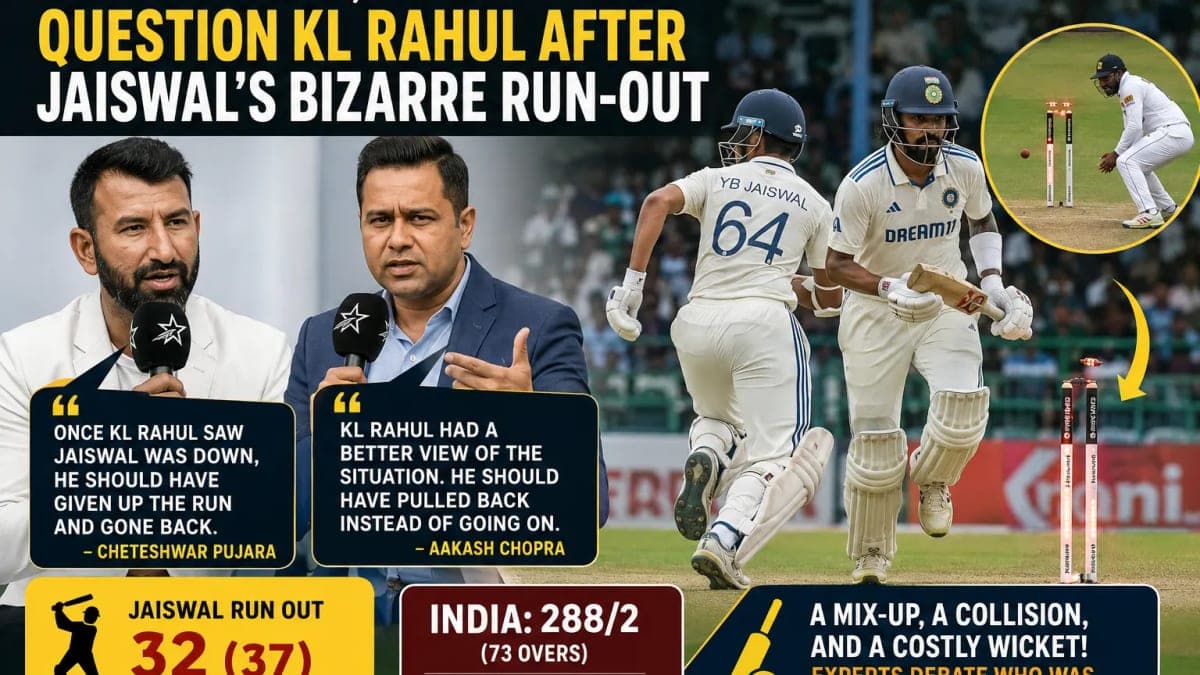
What Happened During Jaiswal’s Run-Out?
India had made a promising start when the confusion unfolded in the 11th over. KL Rahul pushed a delivery from Sri Lankan spinner Keshara Nuwantha towards mid-on and moved out of his crease looking for a single.
At the non-striker’s end, Jaiswal collided with Nuwantha as the bowler attempted to stop the ball. The collision caused Jaiswal to lose his balance and fall.
Rahul initially hesitated after noticing the situation. Jaiswal then got back to his feet, but the communication between the two openers broke down. Eventually, both batters found themselves heading towards the same end, leaving Sri Lanka with the opportunity to complete the run-out.
Jaiswal was dismissed for 32 from 37 deliveries, having struck five boundaries. India were 47/1 following his departure.
Cheteshwar Pujara Questions Rahul’s Decision
Former India Test specialist Cheteshwar Pujara felt Rahul could have handled the unusual situation differently.
His assessment centered on the moment when Rahul became aware that Jaiswal had fallen. Pujara suggested that once Rahul saw his batting partner struggling to complete the run, abandoning the single and returning to his own crease would have been the safer decision.
The broader point was about protecting wickets in Test cricket. A single run carries relatively little value compared with the cost of losing a well-set opening batter, particularly when an unexpected incident has disrupted the running between the wickets.
Aakash Chopra Places Greater Responsibility on KL Rahul
Former India opener Aakash Chopra was even more critical of Rahul’s role in the dismissal.
Chopra’s reasoning was that Rahul had a clearer view of the incident because he had remained on his feet, while Jaiswal had been knocked off balance. From that perspective, Rahul had more opportunity to recognize the danger and retreat rather than continue with the run.
The incident ultimately highlighted how quickly confusion can turn into a wicket when communication between batting partners breaks down.
Jaiswal Misses Opportunity After Promising Start
The dismissal was particularly frustrating for India because Jaiswal had looked comfortable during his 32-run innings.
Run-outs have also occasionally interrupted the left-hander’s Test career. The Galle dismissal was reported as his third run-out in Test cricket, following previous instances against Australia at Melbourne in 2024 and West Indies in Delhi in 2025.
This latest incident, however, was unusual because it involved not simply a poor call between the wickets but also Jaiswal’s accidental collision with the bowler.
India Still Enjoy Strong Opening Day in Galle
Despite the early setback, India remained firmly in control of the opening day.
Devdutt Padikkal led the batting effort with an unbeaten 131, while Rishabh Pant finished the day unbeaten on 27. India reached 288/2 after 73 overs at stumps on the rain-affected first day.
Rahul himself made a significant contribution, scoring 77 before retiring hurt after suffering cramps.
That broader match situation means the run-out did not derail India’s innings, although it denied Jaiswal an opportunity to capitalize on his encouraging start.
Why the Run-Out Matters
The episode provides an example of how running between the wickets depends on awareness as much as speed.
Ordinarily, responsibility for a run-out can be relatively straightforward to identify from the initial call. This incident was more complicated. Jaiswal’s collision with the bowler unexpectedly changed the situation after Rahul had already considered the single.
That helps explain why opinions have varied. Pujara and Chopra believed Rahul had the better opportunity to prevent the dismissal, while former India captain Ajay Jadeja acknowledged mistakes from both batters and emphasized that they failed to properly look at and communicate with each other during the confusion.
Balanced Analysis
It would be simplistic to describe the dismissal entirely as an ordinary calling error. Jaiswal’s collision with Nuwantha created an unpredictable situation that required both batters to make decisions within seconds.
Rahul arguably had an advantage because he remained upright and could observe more of what was happening. That supports the criticism that returning to his crease might have been the safer option.
At the same time, Jaiswal’s movements after getting back to his feet contributed to the uncertainty. The dismissal therefore serves less as evidence of a major technical problem and more as a reminder that clear communication and immediate situational awareness can be decisive—even during an otherwise dominant batting performance.


