RBI’s Dollar Swap Facility Attracts $72.85 Billion
The Reserve Bank of India’s special foreign-exchange initiative has delivered a major injection of dollars into the Indian financial system.
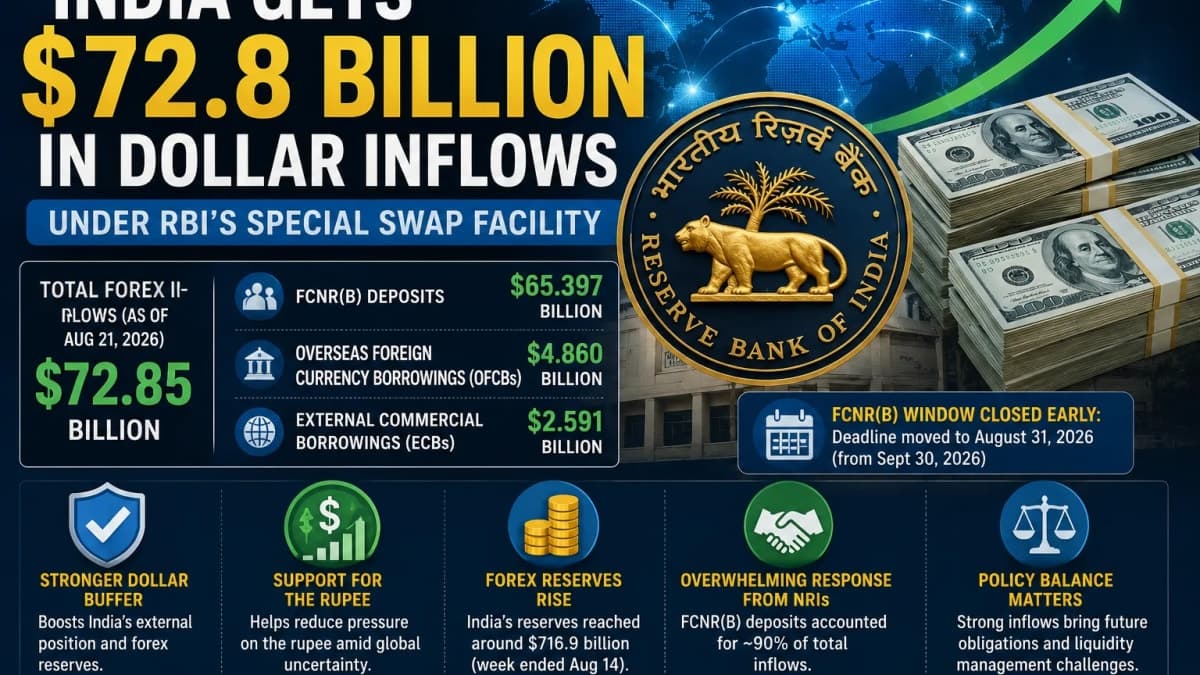
According to the latest RBI figures, authorised dealer banks reported total forex inflows of $72.848 billion through August 21, 2026 under the special USD-INR swap facility.
The inflows were divided across three channels:
FCNR(B) deposits: $65.397 billion
Overseas Foreign Currency Borrowings (OFCBs): $4.860 billion
External Commercial Borrowings (ECBs): $2.591 billion
That means FCNR(B) deposits accounted for roughly 90% of the total mobilisation, making overseas Indian deposits the dominant source of funds attracted by the programme.
What Is RBI’s Special USD-INR Swap Facility?
The RBI introduced the special facility on June 8, 2026, covering eligible FCNR(B) deposits, ECBs and overseas foreign-currency borrowings.
Under the arrangement, banks can mobilise eligible foreign-currency funds and swap them with the RBI under preferential terms. The mechanism lowers hedging costs and encourages banks to bring additional foreign currency into India.
For FCNR(B) deposits, banks raise money in foreign currencies from non-resident Indians. Because these deposits are denominated in foreign currencies rather than rupees, banks need to manage exchange-rate exposure. The RBI swap arrangement reduces that risk and associated cost, making such fundraising more attractive.
Inflows Accelerate Rapidly
The pace of mobilisation has been particularly notable.
Total inflows stood at approximately $40.8 billion on July 31, increased to about $56.85 billion by August 13, and then reached $72.85 billion by August 21.
That represents an increase of roughly $32 billion in just three weeks.
FCNR(B) deposits were responsible for much of that acceleration, rising from about $36.7 billion at the end of July to $52.3 billion on August 13 and $65.4 billion by August 21.
RBI Shortens FCNR(B) Window After Strong Response
The exceptionally strong inflows also prompted the central bank to modify the programme.
The FCNR(B) component had originally been scheduled to remain available until September 30. However, the RBI decided to bring the deadline forward to August 31, 2026, citing the encouraging response and resulting foreign-exchange inflows.
Banks can undertake swaps against eligible FCNR(B) deposits with the RBI until September 11.
The ECB and OFCB portions of the programme are scheduled to remain available until December 31, 2026.
Why the $72.8 Billion Inflow Matters
The inflows arrive at an important time for India's external finances.
A large supply of foreign currency can give the RBI greater flexibility in managing periods of heavy dollar demand. India, as a major importer of crude oil and other commodities, can face pressure on its currency when global energy prices rise or international investors move money toward dollar-denominated assets.
The programme has also coincided with a sharp improvement in foreign-exchange reserves. India's reserves reached about $716.9 billion in the week ended August 14, following several consecutive weeks of increases.
The additional buffer can strengthen the country's ability to absorb external financial shocks.
Support for the Rupee — But Not a Guarantee
One objective of encouraging dollar inflows is to improve foreign-currency availability and reduce pressure on the rupee.
However, a large forex reserve does not guarantee that the currency will appreciate.
The rupee continues to be influenced by crude-oil prices, global interest rates, foreign investment flows, import demand, geopolitical developments and movements in the US dollar.
Indeed, the rupee remained under pressure in mid-August despite the large policy-driven inflows, demonstrating that the swap programme is only one part of a much broader currency-market environment.
The 2013 Comparison
The scale of the latest mobilisation is particularly striking when compared with an earlier episode.
A similar FCNR(B) programme introduced during the 2013 rupee crisis mobilised roughly $26 billion. The current FCNR(B) inflows alone have already exceeded $65 billion, substantially surpassing that earlier programme.
However, the circumstances are different, so the two episodes should not be treated as direct equivalents. The comparison primarily demonstrates the extraordinary size of the response to the latest facility.
Strong Inflows Also Create Policy Trade-Offs
The success of the programme does not come without complications.
When the RBI absorbs dollars through swaps, the transaction can affect domestic rupee liquidity and create future obligations associated with the central bank’s forward foreign-exchange position. Excessive liquidity can complicate monetary-policy management, particularly when the central bank is also trying to maintain control over inflation and financial conditions.
These considerations help explain why maintaining an attractive facility indefinitely may not necessarily be desirable, even when it is generating substantial foreign-currency inflows.
Balanced Analysis: A Strong Buffer With Future Costs to Watch
The $72.85 billion mobilisation is a significant outcome for the RBI’s special swap programme. It demonstrates banks' ability to attract substantial foreign-currency funding when regulatory and hedging conditions are favourable.
For India, the immediate advantages include greater dollar availability, stronger external buffers and additional room for the RBI to manage volatility during periods of global uncertainty.
But the headline figure should not be interpreted as $72.85 billion of permanent, cost-free capital.
FCNR(B) deposits and overseas borrowings ultimately carry repayment obligations, while the associated swap transactions can influence domestic liquidity and the RBI's forward position. Analysts have consequently highlighted trade-offs associated with allowing the programme to expand indefinitely.
The RBI’s decision to close the FCNR(B) window earlier than originally planned suggests the central bank believes the facility has already generated a sufficiently strong response.
The longer-term test will be whether these inflows translate into a more resilient external position while allowing the RBI to manage the liquidity, currency and repayment implications that accompany such a large mobilisation.
This article is based on reporting published by TOI.