Four New Indic AI Models Aim to Make AI More Accessible Across India
Artificial intelligence in India is taking another step beyond English-first applications.
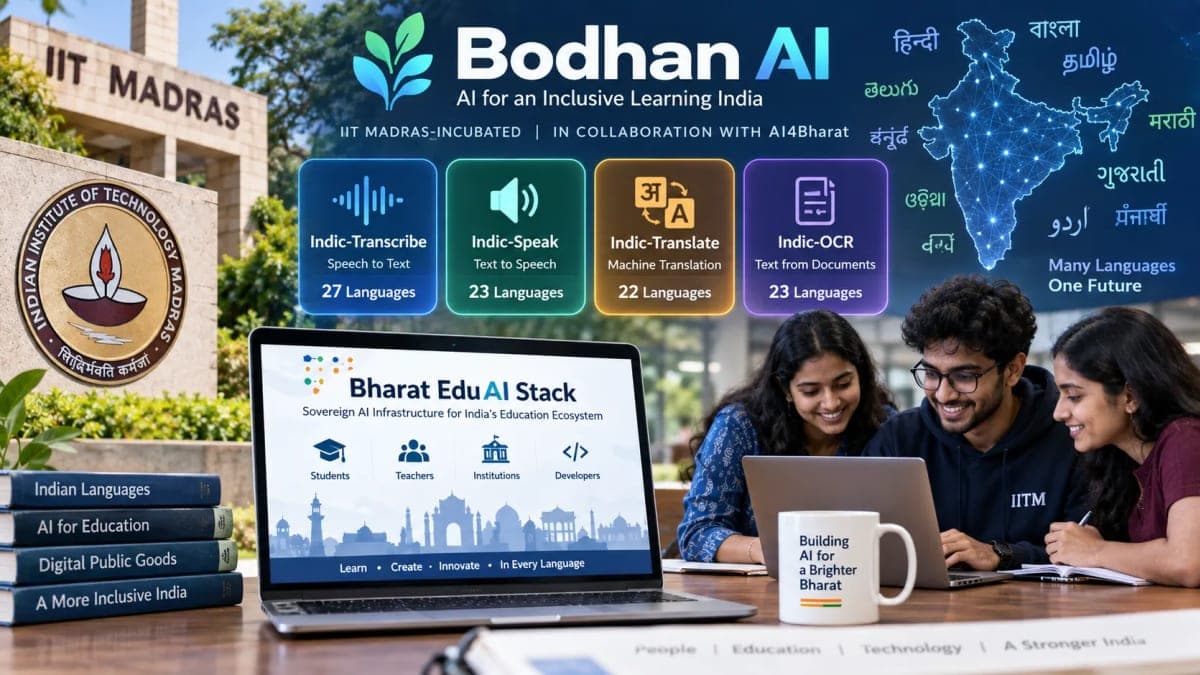
Bodhan AI, an IIT Madras-incubated Centre of Excellence in AI for Education, has unveiled four open foundational AI models designed to work across India's diverse languages.
Developed in collaboration with AI4Bharat, the new suite covers four critical AI capabilities: automatic speech recognition (ASR), text-to-speech (TTS), machine translation and optical character recognition (OCR).
The models are intended to become building blocks that researchers, startups, educational institutions and technology developers can use to create multilingual applications instead of developing every underlying language capability from scratch.
The initiative is particularly significant for education, where language remains one of the biggest barriers to delivering the same digital experience to students across different parts of India.
What Are the Four AI Models?
Bodhan AI's release covers four separate capabilities rather than one general-purpose chatbot.
1. Indic-Transcribe — Speech to Text
Indic-Transcribe is designed for automatic speech recognition.
It converts spoken language into written text and supports up to 27 languages, making it the broadest of the four models in terms of reported language coverage.
The technology could be used to transcribe classroom lectures, student voice responses and educational recordings or to build voice-driven applications for users who may find typing difficult.
The model family also addresses regional accents and dialects—an important challenge for speech recognition in a linguistically diverse country such as India.
2. Indic-Speak — Text to Speech
Indic-Speak performs the opposite task: converting written text into speech.
The model supports 23 languages and is designed to generate spoken output from Indian-language text.
In education, that capability could make digital lessons more accessible to students who prefer listening to content or need audio-based learning support.
It could also become a foundation for multilingual AI tutors and other voice-based educational applications.
3. Indic-Translate — Machine Translation
Indic-Translate, also referred to as Bodhan-Translate in reporting around the release, provides machine-translation capabilities covering 22 languages.
The model is designed to help translate educational and other content while handling the complexity of Indian scripts and multilingual usage.
This capability could become particularly useful when educational material exists in one language but needs to be made available to students studying in another.
4. Indic-OCR — Reading Documents and Images
Indic-OCR tackles another major problem: extracting text from documents and images.
Its reported coverage extends to 23 languages.
OCR technology can turn scanned textbooks, worksheets, notes and other documents into machine-readable text.
More detailed technical information released around the model indicates that printed-text recognition covers English and all 22 scheduled Indian languages, while handwriting recognition currently has narrower language coverage.
That distinction is important: support for printed documents should not be interpreted as equivalent handwriting performance across every supported language.
Four Models at a Glance
ModelCapabilityReported Language CoverageIndic-TranscribeSpeech recognition / ASRUp to 27 languagesIndic-SpeakText-to-speech / TTS23 languagesIndic-TranslateMachine translation22 languagesIndic-OCRDocument and image text recognition23 languages
The numbers represent the reported coverage of individual models; they should not be interpreted as evidence that every model offers identical performance across every language.
Why “Open” Matters
One of the most significant aspects of Bodhan AI's strategy is how these models are intended to be distributed.
They are being positioned as Digital Public Goods, with open-weight models and APIs that can allow other organisations to experiment with and build on the underlying technology.
That approach differs from relying exclusively on proprietary AI services controlled by individual commercial vendors.
For universities, startups, state governments and education-technology developers, open models can potentially provide greater flexibility to adapt AI systems to specific languages, curricula and deployment environments.
Open weights, however, do not automatically mean zero infrastructure costs. Organisations running large models themselves still need computing resources, technical expertise and appropriate safety and privacy controls.
Part of the Bharat EduAI Stack
The four models are not being presented as standalone experiments.
Bodhan AI describes them as an early output of the broader Bharat EduAI Stack.
The initiative is envisioned as sovereign digital public infrastructure for India's multilingual education ecosystem—a common technological layer upon which different educational services can be developed.
Instead of every state, university or EdTech company independently building speech recognition, OCR, translation and speech-generation technology, the stack could provide reusable foundational capabilities.
Bodhan AI describes its broader principle as “AI for India, governed in India.”
NVIDIA Technology Behind the Models
NVIDIA is also an important technology collaborator in the initiative.
According to information released around the launch, the models have been trained and optimised using NVIDIA Nemotron open models and NVIDIA NeMo technologies.
For speech recognition, Bodhan AI has also post-trained NVIDIA Nemotron 3.5 ASR for Indian languages, including regional accents and dialects.
The models are being served using technologies including NVIDIA TensorRT-LLM and vLLM inference microservices.
Bodhan AI and NVIDIA are also collaborating on datasets, training methods and evaluations for future Indian-language foundational models.
The models themselves, however, are part of Bodhan AI's broader public-infrastructure initiative; NVIDIA's role should therefore be understood as a technology collaboration rather than treating the release simply as an NVIDIA product launch.
IIT Madras Director: AI for India Needs More Than Translation
IIT Madras Director Prof. V. Kamakoti said developing AI for India requires going beyond simply adapting existing models to Indian languages.
He said:
“Building AI for India requires going beyond adapting existing models to Indian languages. It requires developing foundational capabilities that understand the richness and diversity of our languages, contexts and educational needs.”
That distinction highlights one of the central challenges facing Indian AI development.
India is not simply a multilingual country. Its AI systems must handle different scripts, accents, transliterated words, English mixed with regional languages and highly varied educational contexts.
Why Indic AI Is a Difficult Technical Problem
A Hindi-speaking student, for example, may naturally insert English technical terms while asking a question.
Another student may type Hindi using the Roman alphabet instead of Devanagari.
A textbook page could contain regional-language paragraphs alongside English terminology, mathematical equations, diagrams and tables.
Speech adds another layer of difficulty because pronunciation and accents can change significantly between regions.
Building AI systems that work reliably in such conditions requires more than literal word-by-word translation.
This is where a combination of speech recognition, OCR, translation and speech generation could become especially useful.
Student Tutor Bot for Classes 6 to 12
Bodhan AI has also introduced applications showing how these underlying models could be used.
Its Student Tutor Bot is aimed at students in Classes 6 to 12 and is aligned with NCERT and SCERT curricula.
Students can ask questions through text or voice across 22 Indian languages.
The system is designed to use textbook material to generate explanations, examples and assessments.
It can also guide students through problems step by step and includes an interactive digital canvas for diagrams, calculations and other learning activities.
This illustrates the broader strategy behind the foundational-model release: Bodhan AI is not only building individual language models but attempting to create reusable infrastructure upon which educational AI applications can operate.
Teacher Assistant Bot Targets Classroom Work
A separate Teacher Assistant Bot has been developed as an AI workspace for educators.
Teachers can use it to help create lesson plans, quizzes, worksheets, homework and revision material by specifying factors such as grade, subject, topic, difficulty and assessment requirements.
Student work can also be uploaded for evaluation against specified marking criteria.
Importantly, Bodhan AI says AI-generated material does not automatically become a classroom decision.
Teachers can review, edit, regenerate or discard generated outputs.
That human-in-the-loop design is particularly important in education, where incorrect AI-generated information can directly affect learning and assessment.
Privacy and Sovereign AI Are Part of the Strategy
Another important component of the project is data governance.
Bodhan AI says its architecture will incorporate data-anonymisation protocols and compliance with applicable national education-data frameworks.
Its hosted API infrastructure is also being developed around a sovereign deployment model, intended to give institutions greater control over how AI capabilities and data are deployed.
The emphasis on sovereign infrastructure reflects a wider debate in India and elsewhere over whether critical AI systems should depend entirely on foreign commercial APIs.
For education, the issue is particularly sensitive because applications may process information involving students, teachers and institutional records.
Why These Models Could Matter Beyond Education
Although Bodhan AI is focused primarily on education, the underlying capabilities have potentially wider applications.
Speech recognition can power regional-language voice interfaces. OCR can digitise archives and government documents. Translation can improve access to information across languages, while text-to-speech technology can support accessibility applications.
Because the models are being made available as reusable building blocks, developers could potentially adapt them for public-interest applications outside the classroom as well.
The immediate mission, however, remains education.
Open Models Are Only the Beginning
The release is significant, but language coverage alone does not determine whether an AI system is successful.
The bigger test will be accuracy, reliability, latency, cost and real-world performance across languages, dialects and noisy environments.
A model performing strongly in Hindi or English, for example, does not automatically guarantee the same quality for languages with smaller digital datasets.
OCR performance can similarly vary between clean printed textbooks, old scanned documents and handwritten student answers.
Independent evaluations and real-world deployments will therefore be important for determining how effectively the four models perform across India's linguistic diversity.
Why the Launch Matters for India's AI Ambitions
India's AI challenge is different from that of predominantly English-speaking markets.
A digital education system that works exceptionally well in English but poorly in regional languages risks reinforcing an existing access gap.
Bodhan AI's approach attempts to address that problem at the infrastructure level.
Instead of building another single AI assistant, the organisation is creating speech, translation, OCR and voice-generation components that other developers can potentially combine into their own products.
If those models prove reliable at scale, the Bharat EduAI Stack could provide a shared technological foundation for multilingual AI-powered education.
That makes this launch more than another set of AI models.
It is an experiment in whether open, locally governed AI infrastructure can help make advanced AI useful across India's linguistic diversity rather than primarily for its English-speaking population.