Indian Bond Market Faces Sharp Weekly Sell-Off
India's government bond market came under significant pressure in the week ending August 21, marking its worst weekly performance of the current financial year.
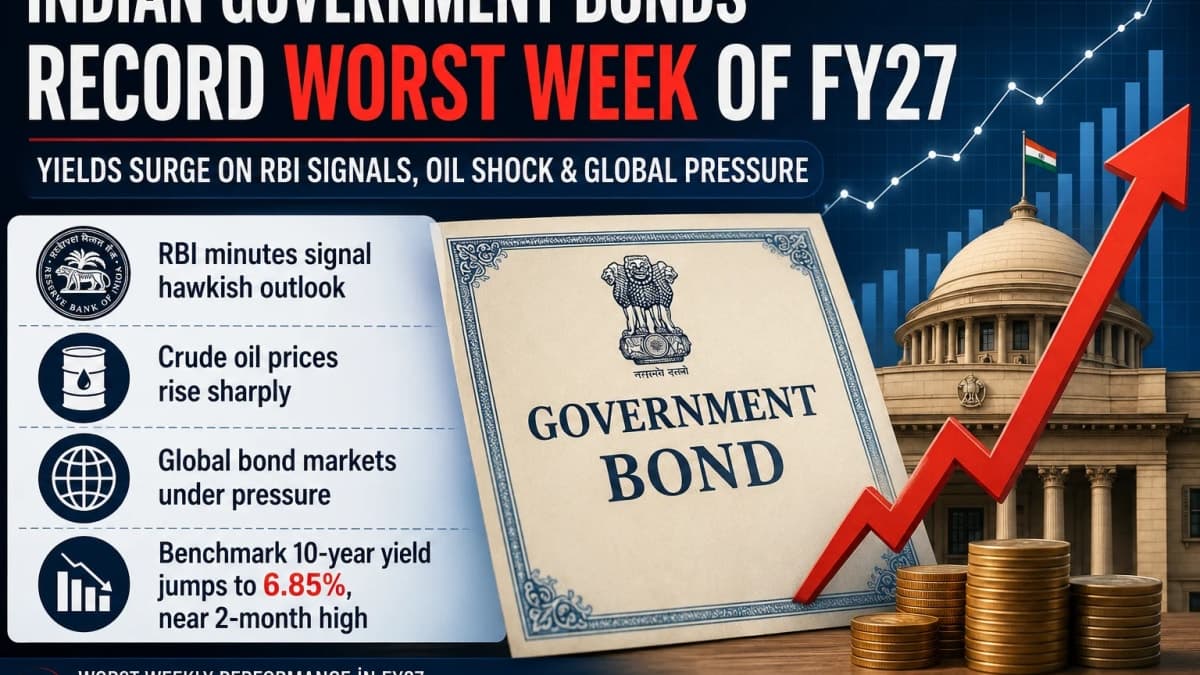
The yield on the benchmark 6.94% government bond maturing in 2036 finished Friday at 6.8495%, close to a two-month high. Over the week, the benchmark yield increased by 9.5 basis points, its biggest weekly rise since the week ended April 3. Because bond prices and yields move in opposite directions, the jump in yields reflected a decline in bond prices.
The weakness was not driven by a single development. Instead, investors had to absorb a combination of changing expectations around RBI policy, reduced optimism over domestic liquidity, higher energy prices and a broader rise in global borrowing costs.
RBI Policy Signals Change Market Expectations
A major source of pressure came from the minutes of the Reserve Bank of India's August monetary policy meeting.
Investors interpreted the minutes as considerably more hawkish than the initial policy announcement. That encouraged traders to reconsider assumptions about the future path of interest rates and revived discussion about whether the central bank's next significant policy move could eventually be a rate increase rather than another reduction.
That shift matters for government securities because expectations about future policy rates influence yields across the bond market. When investors believe interest rates could remain higher for longer, or rise further, existing bonds carrying lower yields become relatively less attractive, putting downward pressure on their prices.
Interest-rate derivatives reflected the changing outlook as well. During the week, the one-year overnight indexed swap rate increased by 17 basis points to 5.9025%, while the two-year rate climbed 20 basis points to 6.1250%. The liquid five-year swap rate advanced 17 basis points to 6.42%.
Early Closure of RBI-Linked Facility Adds Pressure
Another important factor was the RBI's decision to bring forward the closure of a discounted hedging facility linked to foreign-currency deposits.
The facility had supported foreign-currency inflows and helped improve liquidity conditions, contributing indirectly to demand for government debt. Its earlier-than-expected closure forced traders to reassess how much support the bond market could continue receiving from those flows.
The impact was particularly noticeable in shorter and medium-duration securities.
The five-year government bond yield rose about 13 basis points during the week, its largest weekly increase since early May. That part of the yield curve had benefited significantly from liquidity expectations surrounding the facility.
Crude Oil Surge Raises India's Inflation Risk
External conditions added another layer of pressure.
Brent crude climbed as much as 6% for a second consecutive week, reaching around $93.4 per barrel, amid renewed geopolitical uncertainty involving the United States and Iran.
Higher oil prices are particularly important for India because the country relies heavily on imported crude.
A sustained increase in energy prices can raise transportation and production costs, contribute to inflation, pressure the rupee and complicate the RBI's monetary-policy decisions.
That means an oil shock can affect government bonds through several channels simultaneously: higher inflation expectations, concerns over interest rates and changes in India's external balance.
Global Bond Sell-Off Adds to Domestic Stress
India's bond market was also operating against an increasingly difficult global backdrop.
Inflation concerns and fiscal pressures contributed to selling in major international debt markets, sending some longer-dated government bond yields to levels not seen in decades.
When yields rise sharply in major markets such as the United States, emerging-market bonds can face additional pressure as investors compare returns across countries.
Higher international yields can therefore reduce the relative appeal of Indian debt unless domestic yields also adjust upward, particularly for overseas investors considering currency and hedging risks.
Why the Bond Market Move Matters
The sharp weekly rise in yields extends beyond professional bond traders.
Government bond yields serve as important reference points for borrowing costs throughout the economy. Persistent increases can eventually influence corporate bond pricing, bank funding conditions and other forms of credit.
For the government, higher yields can also make future borrowing more expensive if elevated rates persist during upcoming debt issuances.
For debt mutual funds and other fixed-income investors, rising yields can cause mark-to-market losses on existing bond holdings, particularly in portfolios with greater duration exposure. At the same time, higher yields can improve the prospective income available to investors purchasing bonds at newer, more attractive levels.
Is the Sell-Off a Longer-Term Warning?
The week's decline does not necessarily establish a lasting bearish trend for Indian government bonds.
Part of the move appears to reflect rapid repricing after investors had previously expected supportive liquidity conditions and a relatively benign interest-rate environment.
If crude oil prices ease, inflation pressures remain manageable and global yields stabilise, some of the pressure on Indian bonds could moderate.
However, the situation becomes more challenging if high oil prices persist while domestic inflation strengthens. Under that scenario, expectations of tighter monetary policy could remain embedded in bond valuations.
The benchmark yield briefly reached around 6.88% on Friday before ending near 6.85%, demonstrating how quickly market expectations changed during the week.
Balanced Analysis
The worst week of FY27 should be viewed primarily as a significant reassessment of interest-rate and liquidity expectations rather than evidence of a fundamental breakdown in India's sovereign debt market.
On the negative side, investors now face several uncertainties at once: elevated crude prices, geopolitical risks, less confidence in near-term monetary easing and a reduction in liquidity optimism.
On the positive side, higher yields can eventually attract fresh demand from banks, insurance companies, pension funds and long-term fixed-income investors seeking better returns. India's domestic institutional investor base can also provide an important source of demand during periods of international volatility.
The next direction for bonds is therefore likely to depend heavily on inflation data, crude oil prices, global bond yields and additional communication from the RBI.
For now, the week's sell-off represents a clear shift in sentiment: the bond market has moved from anticipating easier financial conditions toward pricing a greater possibility that interest rates could remain restrictive for longer.