Indian-Origin Tech Leader Uday Ruddaraju Takes Charge as OpenAI's CTO of Compute
OpenAI has elevated Indian-origin technology executive Uday Ruddaraju to the position of Chief Technology Officer (CTO) of Compute, placing him in charge of one of the company's most strategically important areas—the computing systems that power next-generation artificial intelligence models. The appointment reflects OpenAI's increasing emphasis on building larger, faster, and more efficient AI infrastructure as demand for advanced AI services continues to rise.
According to publicly available information, Ruddaraju announced the new role through a professional update, describing the opportunity as an exciting new chapter after completing roughly a year at OpenAI. Before joining the company, he served in a senior infrastructure engineering role at Elon Musk's AI startup xAI, where he worked on large-scale computing systems.
A Key Role in OpenAI's AI Expansion
As CTO of Compute, Ruddaraju will oversee the technological backbone that enables OpenAI to train, scale, and deploy increasingly sophisticated AI models. Compute infrastructure includes massive clusters of graphics processors (GPUs), networking systems, storage platforms, and software designed to manage large-scale AI workloads efficiently.
The role has become increasingly important as AI companies race to develop more capable models while balancing rising costs, energy consumption, and hardware availability. Industry leaders are investing billions of dollars in expanding their computing capacity, making infrastructure expertise as valuable as advances in AI algorithms themselves.
From Hyderabad to Global AI Leadership
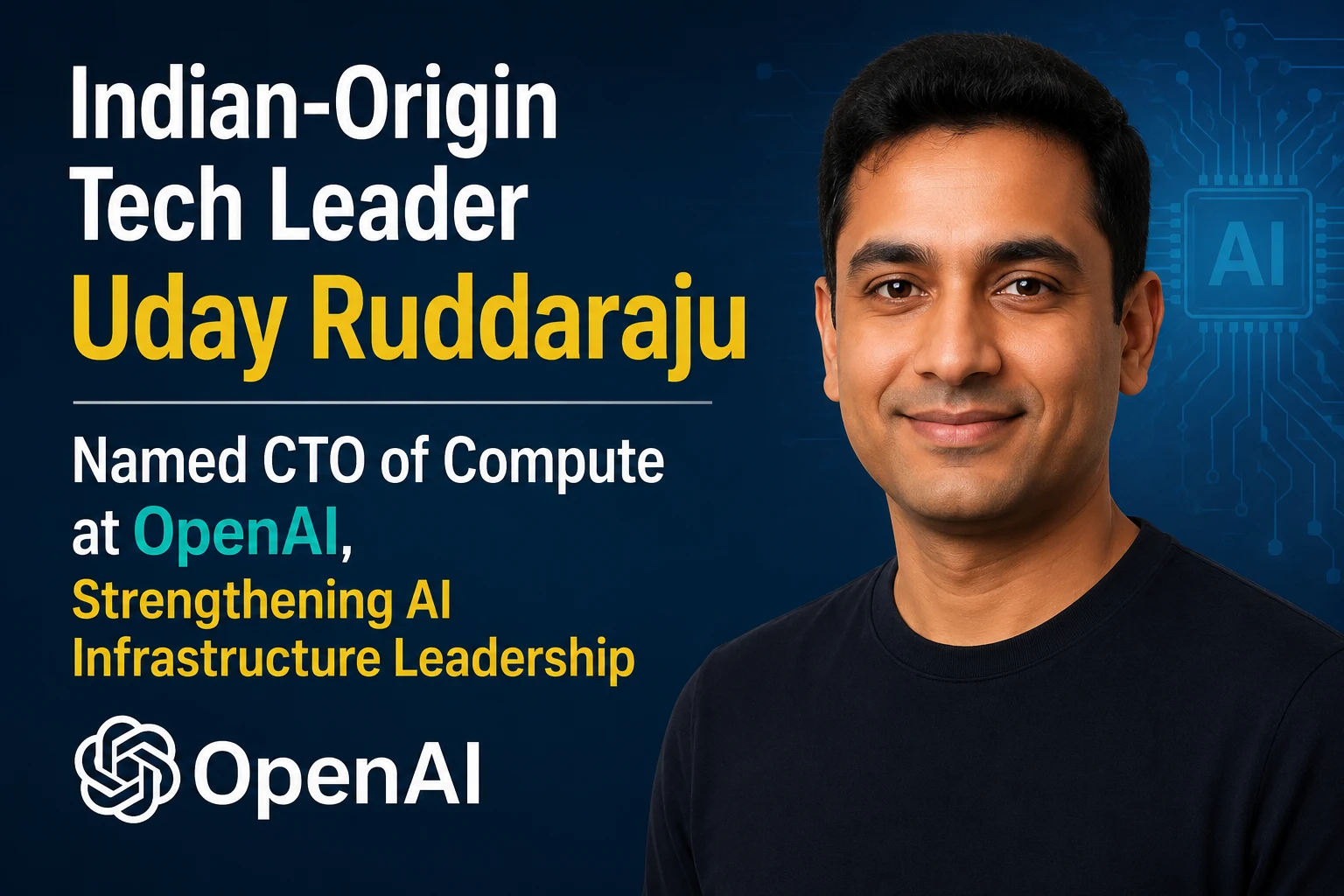
Originally from Hyderabad, Ruddaraju earned a bachelor's degree in computer science before pursuing higher education in the United States. Over the course of his career, he has held engineering leadership positions across several technology companies, building expertise in cloud infrastructure, distributed systems, and large-scale computing.
His experience at xAI, combined with his work at OpenAI, positions him among a growing group of Indian-origin technology executives leading critical engineering functions at some of the world's most influential AI organizations.
Why Compute Matters More Than Ever
Modern AI development depends not only on better software but also on enormous computing resources. Training advanced AI models requires thousands of high-performance chips operating together over extended periods.
As organizations worldwide integrate AI into products and services, demand for computing infrastructure continues to accelerate. Leaders responsible for compute strategy play a central role in improving efficiency, reducing operational bottlenecks, and enabling faster innovation.
OpenAI has repeatedly emphasized expanding its computing footprint as part of its long-term strategy to make advanced AI systems more widely available. Ruddaraju's appointment aligns with those broader infrastructure ambitions.
A Growing Presence of Indian-Origin Leaders in AI
Ruddaraju's promotion adds to the expanding list of Indian-origin professionals occupying senior leadership positions across the global technology industry. Their growing influence reflects India's long-standing contribution to engineering talent and its increasing role in shaping emerging technologies such as artificial intelligence, cloud computing, and semiconductor infrastructure.
While AI companies often receive attention for breakthroughs in models and applications, leadership in compute and infrastructure has become equally critical as organizations compete to build faster, larger, and more reliable AI platforms.
Balanced Analysis
The appointment highlights OpenAI's recognition that future AI progress depends as much on infrastructure excellence as on algorithmic innovation. As AI models become larger and more resource-intensive, leadership over compute systems will influence development speed, operating costs, and scalability.
At the same time, the broader AI industry faces challenges including hardware shortages, rising energy requirements, and increasing competition for advanced computing resources. Executives overseeing infrastructure will therefore play a significant role in determining how efficiently AI companies can expand while maintaining reliability and sustainability.
For OpenAI, strengthening compute leadership signals continued investment in the foundational technology required to support future generations of AI models.